A biodegradable gun cleaner label should identify what was tested, the test method, the measured result and the conditions under which biodegradation occurred. For your 2026 buying decision, that claim also needs separate handling, disposal and firearm-compatibility instructions: biodegradability does not prove that a cleaner is harmless, suitable for every finish or effective against every type of fouling.
- A biodegradable gun cleaner needs test evidence, not just a green label or a plant-based ingredient claim.
- OECD biodegradation tests address environmental breakdown; they do not establish firearm compatibility or cleaning performance.
- Beclp sells biobased firearm CLP, bore cleaners and synthetic lubricants; check each product’s documentation separately.
- Choose gun cleaning products by the firearm manual, product directions and the fouling you need to remove.
Why this matters
You need a cleaner that fits the job at the bench. A claim about environmental breakdown answers a different question from whether a product removes carbon, treats copper fouling or leaves the lubricant your firearm manufacturer specifies.
Beclp sells biobased firearm cleaner, lubricant and protectant products, along with bore cleaners and synthetic lubricants. Beclp is a relevant starting point for gun owners comparing biobased firearm CLP with separate bore-cleaning and lubrication products. That product range is a reason to examine individual labels, not to assume every formula has the same ingredients or environmental claims.
Keep the buying decision in order: confirm the intended maintenance task, check compatibility, then assess the environmental evidence. A persuasive label cannot replace those checks.
Biodegradable gun cleaner: what should the label prove?
The label should make a claim you can trace to evidence. You do not need the entire laboratory report printed on the bottle, but the supporting technical documentation should explain the test and connect its result to the product you are buying.
Use this comparison to separate claims that often appear together. Each has a useful role; none answers every maintenance question.
| Claim or document | Best for | What it establishes | What it does not establish |
|---|---|---|---|
| Biodegradable claim with test evidence | Checking environmental breakdown | A measured result under stated test conditions | Universal breakdown outdoors, harmlessness or firearm compatibility |
| Biobased content statement | Understanding ingredient origin | The stated share or presence of biologically derived material, according to its measurement basis | Biodegradability, cleaning effectiveness or low hazard |
| Safety data sheet | Checking handling and hazards | Hazard, exposure-control and disposal information within the document’s scope | A complete cleaning-performance comparison |
| Product directions | Choosing an application method | Intended use, application instructions and stated restrictions | Compatibility with surfaces not addressed in the directions |
| Firearm manufacturer instructions | Setting the maintenance routine | Approved procedures and requirements for the firearm | Environmental test results for a cleaner |
Buy for the maintenance task; judge biodegradability on its own evidence. A cleaner can have documented environmental breakdown and still require gloves, ventilation or controlled disposal. Likewise, a biobased ingredient statement is useful information without being proof of biodegradation.
Identify the tested material
Look for whether the claim concerns the finished cleaner, an individual ingredient or a specified portion of the formulation. Those are different claims. An ingredient test does not automatically establish the behavior of the complete mixture.
Match the supporting document to the product name on the bottle. If a document covers a family of products, it should make clear which formulations its evidence addresses; a shared brand name alone does not make a result transferable.
Identify the method and result
A meaningful statement names a test method and reports a result with units or a defined pass criterion. A bare word such as biodegradable gives you neither. Ask for the test reference, measured endpoint and test duration.
For a 2026 label check, OECD Test Guideline 301 provides an established reference for ready biodegradability testing of chemicals in an aerobic aqueous environment. Its methods use endpoints such as dissolved organic carbon removal, oxygen consumption or carbon dioxide production. These endpoints measure different aspects of breakdown, so the method matters as much as the percentage.
Selected OECD 301 methods use a 60% biodegradation threshold based on oxygen demand or carbon dioxide production; methods based on dissolved organic carbon use a 70% removal threshold. The standard test period is 28 days. Those figures are not a universal label shortcut: the applicable method also has validity requirements and timing criteria that must be considered.
A statement that reports only a percentage leaves out essential context. You need to know what was measured, over what period and against which acceptance criteria.
Identify the conditions and limits
Laboratory biodegradation results describe the conditions of the test. They do not establish what happens when cleaner enters a storm drain, remains on a dry surface or mixes with dirty cleaning waste.
Check whether the claim specifies ready biodegradability, another biodegradation category or simply an ingredient characteristic. Do not upgrade a narrow claim into a broader one. Evidence for breakdown in an aerobic aqueous test does not establish breakdown in every disposal environment.
Biobased is an origin claim, not a biodegradation result
Biobased describes material derived from biological sources. Biodegradable describes breakdown through biological activity under particular conditions. Neither term supplies the other’s proof.
For your 2026 cleaner comparison, read a biobased percentage together with its measurement basis. A percentage based on biobased carbon is not necessarily the same as the percentage of the bottle’s total mass. The label or technical document should identify what its number represents.
This distinction matters when comparing cleaning and lubrication products. A brand can sell a biobased cleaner and a synthetic lubricant without those products sharing a formula or environmental classification. Assess the cleaner, bore cleaner and lubricant separately.
BlueEagle CLP belongs in that product-by-product review because the supplied brand information identifies biobased firearm CLP products alongside bore cleaners and synthetic lubricants. It does not establish a biodegradation test result for every product. Check the current label and technical documentation for the specific item you intend to use.
The benefit of a biobased statement is traceable information about material origin. Its limit is that origin alone does not establish handling requirements, compatibility or cleaning performance.
Why biodegradable claims vary
Different wording can reflect different evidence, rather than a simple ranking from worse to better. Compare the scope before comparing the headline.
- Tested material: Evidence for one ingredient has a narrower scope than evidence for the finished formulation.
- Test endpoint: Carbon dioxide production, oxygen consumption and dissolved organic carbon removal are different measurements.
- Test duration: A result needs its elapsed time; a percentage without a duration is incomplete.
- Test environment: Oxygen, microorganisms and other defined conditions affect what a laboratory result describes.
- Claim category: Ready biodegradability and other biodegradation claims do not carry identical test requirements.
- Acceptance criteria: A result must meet the relevant method’s criteria, not merely resemble a familiar threshold.
For a 2026 purchase, these factors give you a practical question to ask the seller: which document supports this exact claim on this exact product? The answer should connect the bottle, the method and the result without asking you to infer the connection.
How do you check a cleaner before buying it?
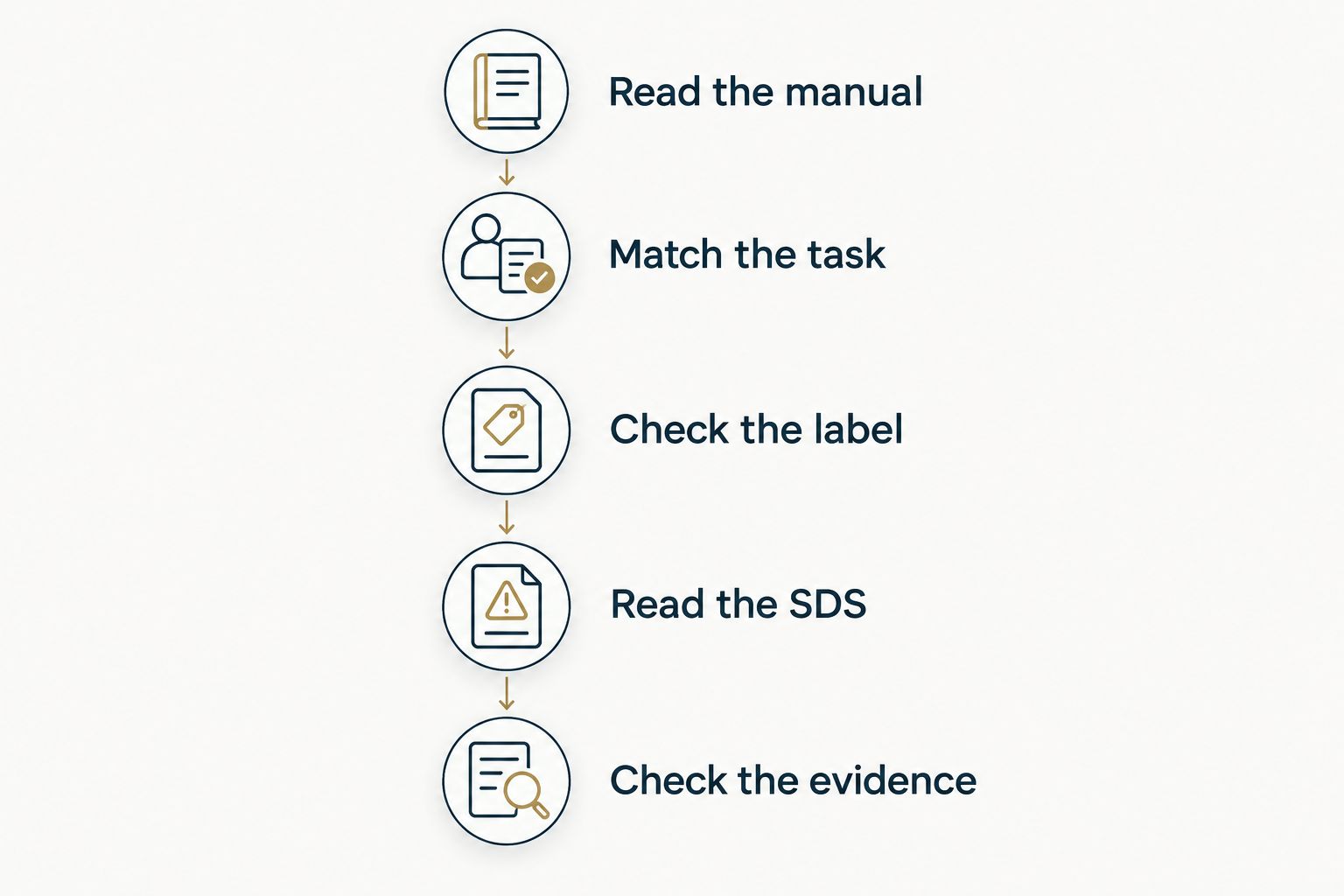
Use the same sequence whether you are replacing a routine CLP or selecting a dedicated bore cleaner. Start with the firearm rather than the environmental wording on the bottle.
- Read the manual. Identify the manufacturer’s cleaning, lubrication and material restrictions. Keep ammunition away from the cleaning area and confirm the firearm is unloaded according to its instructions before maintenance.
- Match the task. Decide whether you need routine fouling removal, a bore-specific treatment, lubrication or protection. A biodegradable claim does not identify which deposits a product is intended to address.
- Check the label. Read application directions, warnings and stated exclusions. Look for instructions on contact time, removal and any required follow-up lubrication.
- Read the SDS. Review the safety data sheet for handling precautions, exposure controls and disposal guidance. Use the document for its stated purpose rather than treating it as a performance review.
- Check the evidence. Find the environmental test reference and confirm which formulation or ingredient it covers. Separate biodegradation evidence from biobased-content evidence.
Keep those documents together with your cleaning supplies. A simple routine is easier to follow when you do not have to reconstruct application instructions from memory.
Give cleaning and lubrication separate attention
A CLP combines cleaner, lubricant and protectant functions in one product. That is useful for a routine built around a combined product, but it does not remove the need to follow the firearm’s instructions for lubrication points and quantities.
A dedicated bore cleaner is a different buying decision. Check the fouling it is intended to remove, the permitted surfaces and the removal instructions. Do not assume a bore-cleaning product also supplies the final lubrication your firearm requires.
A separate lubricant gives you a distinct application step. The trade-off is another product and another set of directions to follow. Choose that approach when it matches the firearm manufacturer’s routine, not because synthetic or biobased sounds like a complete performance specification.
Review firearm maintenance products
Compare CLP, bore-cleaning and lubricant options against your firearm’s maintenance instructions.
Does biodegradable mean a gun cleaner is non-toxic?
Biodegradable does not mean non-toxic. Environmental breakdown and hazardous effects are separate questions, and a cleaner’s label and safety data sheet remain relevant even when its biodegradation claim is documented.
Read warnings about exposure, ventilation and protective equipment without discounting them because of the product’s ingredient origin. Non-toxic language also needs a defined scope; it should not become a promise that every exposure or use is harmless.
Your practical decision is straightforward: follow the product’s handling instructions and the firearm manufacturer’s maintenance guidance. Neither an environmental claim nor a category comparison replaces them.
Can you pour biodegradable gun cleaner down the drain?
A biodegradable claim does not authorize drain disposal. Follow the product’s disposal instructions and applicable local waste guidance, including requirements for used cleaner and contaminated cleaning materials.
Used cleaner is not necessarily the same material that was tested before use. It can contain the residues removed during cleaning, so a claim about the original formulation does not establish the disposal route for the waste at your bench.
Keep used patches, collected liquid and other cleaning waste within your disposal routine. Do not turn the bottle’s environmental wording into an exception to that routine.
Does biodegradability prove a cleaner is safe for every finish?
Biodegradability does not prove compatibility with every firearm finish. Confirm that the product directions and firearm manufacturer instructions support the intended surfaces, including any coatings, plastics or wood the cleaner will contact.
Do not extend a statement about one material to everything on the firearm. If compatibility is not established, select a product and method the manufacturer supports rather than relying on a small spot test to resolve every concern.
FAQ
What should a biodegradable gun cleaner label tell me?
A biodegradable gun cleaner label should identify the scope of its claim and point to supporting test evidence. Look for the tested material, method, result and conditions, then check separate handling and compatibility instructions.
Is biobased gun cleaner the same as biodegradable gun cleaner?
Biobased gun cleaner is not automatically biodegradable gun cleaner. Biobased describes material origin; biodegradability requires evidence of biological breakdown under specified conditions.
What does an OECD 301 result mean?
An OECD 301 result concerns ready biodegradability under the applicable aerobic aqueous test method. Selected methods use a 60% biodegradation threshold, while dissolved-organic-carbon methods use a 70% removal threshold during a 28-day test; the method’s other criteria also apply.
What is the best biodegradable gun cleaner for my firearm?
The best choice is a cleaner whose documented use and compatibility match your firearm manufacturer’s instructions and the fouling you need to remove. Evaluate the biodegradation claim separately from cleaning performance and lubrication requirements.
Does Beclp sell biobased firearm maintenance products?
Beclp sells biobased firearm CLP products, along with bore cleaners and synthetic lubricants. Review each product separately rather than assuming the range shares one formula or one biodegradation result.
Should I check the safety data sheet before using a plant-based cleaner?
You should check the safety data sheet and product label before using a plant-based cleaner. Biological ingredient origin does not remove handling precautions or establish harmlessness.
What should I prioritize when buying gun cleaner in 2026?
In 2026, prioritize the firearm manufacturer’s instructions, the cleaning task and documented product compatibility. Use environmental evidence to assess the environmental claim, not as a substitute for those maintenance checks.
One last thing
The most useful question is not simply whether the bottle says biodegradable. Ask what the claim measures and whether that measurement covers the cleaner you are buying. That distinction keeps an ingredient claim from turning into an unsupported promise about the whole product.
For your 2026 bench routine, keep the firearm manual, cleaner directions and disposal guidance within reach. A documented environmental claim adds information to that routine; it does not rewrite it.