CLP gun cleaner can become unsuitable over time, but there is no single expiration period that applies to every formula. For a bottle you plan to use in 2026, follow its manufacturer’s shelf-life and storage guidance rather than a generic age cutoff. Contamination, a damaged container or storage outside the label’s limits can also make a bottle unsuitable before any stated expiration date.
- Does CLP gun cleaner expire? Follow the formula’s shelf-life guidance; bottle age alone does not establish condition.
- Keep old CLP out of your firearm until you resolve contamination, packaging damage or unexplained changes.
- BlueEagle CLP suits gun owners seeking a biobased cleaner, lubricant and protectant.
- Biobased ingredients do not establish shelf life, harmlessness or compatibility with every firearm finish.
Does CLP gun cleaner go bad or expire over time?
CLP can deteriorate or become contaminated; an expiration date is only part of the decision. The useful question is whether that specific formula, in that specific container, remains within its manufacturer’s guidance. A sealed bottle with an identifiable lot code presents a different decision from an unmarked squeeze bottle containing an unknown mixture.
For product-specific guidance on BlueEagle CLP, start with Beclp and the information supplied with your bottle. Do not borrow another cleaner’s shelf-life statement, even if both labels say CLP.
| Bottle condition | What it establishes | Next move |
|---|---|---|
| Within stated shelf life, stored as directed | The bottle meets the stated age and storage conditions | Follow its label and your firearm manual |
| Past a stated expiration or use-by date | The bottle is outside that stated limit | Follow the manufacturer’s replacement or disposal guidance |
| No date, but an identifiable product and lot code | The manufacturer has information to investigate | Ask for shelf-life guidance tied to the lot |
| Unknown contents or suspected contamination | Identity or condition is unresolved | Set it aside; do not apply it to a firearm |
| Unexplained change in appearance or consistency | The product differs from its expected condition | Stop use and ask the manufacturer |
This table is a sorting tool, not a performance test. A clear-looking liquid does not prove that its cleaning, lubrication and corrosion-protection properties remain unchanged.
Why this matters
An old bottle creates two separate questions: whether the contents remain suitable and whether the product belongs on the part you intend to treat. Passing the first check does not answer the second. A usable cleaner still needs to match the firearm manufacturer’s instructions for finishes, lubrication points and bore maintenance.
For your 2026 bench routine, resolve uncertainty before applying the liquid, not after coating an action or leaving a firearm in storage. Do not use a firearm as a test surface for unidentified chemicals. Keep ammunition away from the cleaning area, verify the firearm is unloaded and follow its manual before disassembly or maintenance.
How do you check an old bottle of CLP?
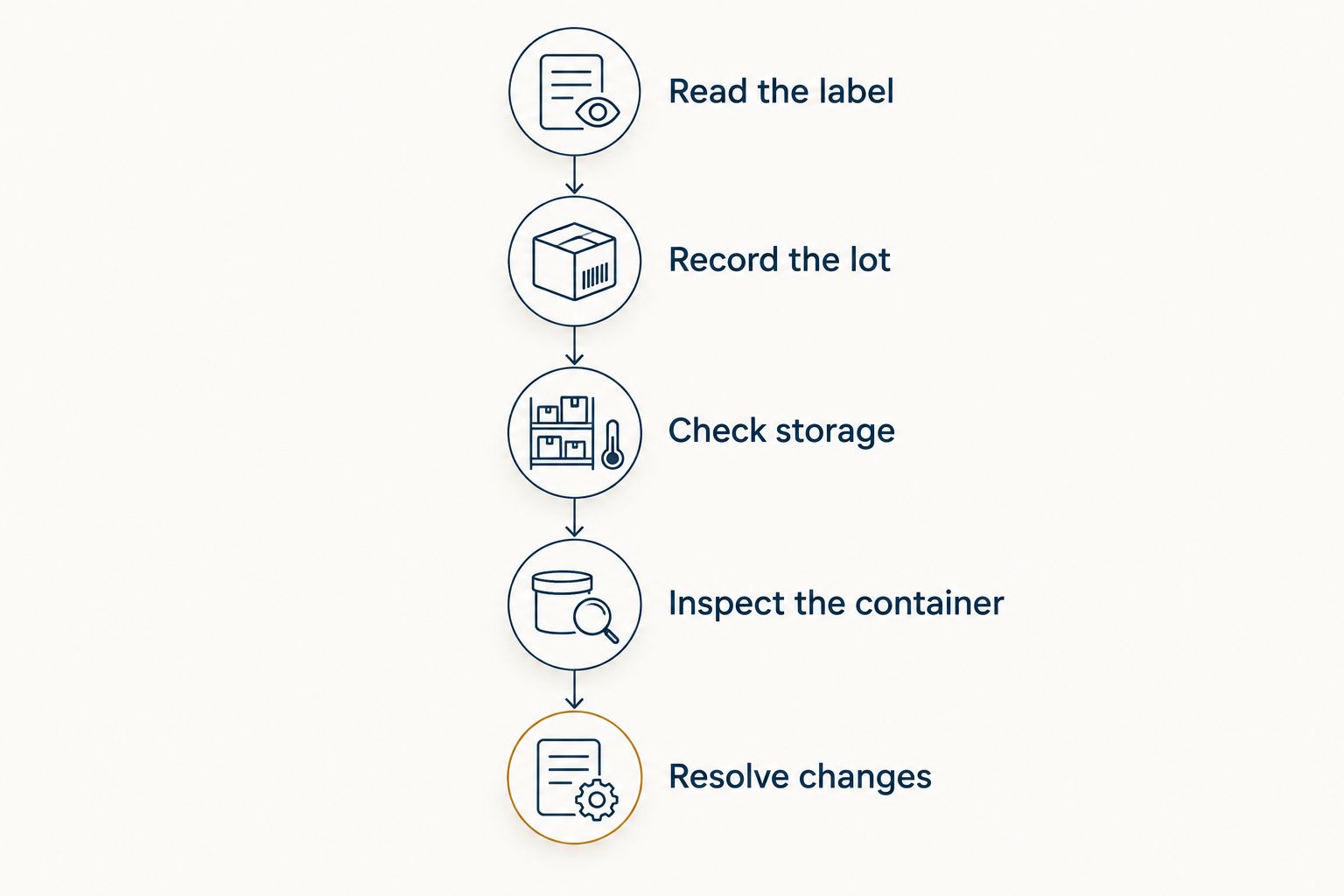
Work from the label to the storage history, then to the contents. That order keeps a normal-looking bottle from overriding a clear manufacturer restriction.
- Read the label. Identify the exact product, application instructions, warnings and any expiration or shelf-life statement. Distinguish a manufacture date from a use-by date; they do not mean the same thing.
- Record the lot. Photograph the label, lot code and any date markings. Keep the original spelling and punctuation when sending the information to the manufacturer; do not guess how an unfamiliar code translates into a date.
- Check storage. Establish whether the bottle stayed within the stated storage conditions. Note known heat exposure, freezing, a loose closure or a transfer into another container.
- Inspect the container. Look for leakage, damage, a failing closure or dirt around the dispensing opening. Do not open a swollen or leaking container merely to inspect the liquid; follow its handling guidance.
- Resolve changes. Compare the contents only with the product’s documented normal appearance and handling instructions. Ask about unexplained changes before use.
Keep these checks separate. A readable lot code helps identify the batch, but it does not erase contamination introduced later. An intact cap helps protect the contents, but it does not prove that an unknown storage history met the label’s requirements.
Why CLP shelf life varies
CLP describes a set of jobs, not a single chemical recipe. Cleaning ingredients, base fluids, additives and packaging differ among products, so one bottle’s instructions cannot establish another bottle’s useful life.
- Formula: A biobased cleaner and a synthetic lubricant do not automatically share the same storage requirements. Use the instructions for the exact product rather than the broader category.
- Temperature exposure: Follow the label’s storage limits. A bottle left in a vehicle or an unconditioned building needs a storage-history check, not an assumption based on its purchase date.
- Closure condition: A loose cap or damaged seal changes how well the container isolates its contents. Leakage also makes it harder to know what remains in the bottle.
- Contamination: Water, grit, dirty tools and other chemicals can enter a container during use. Do not return used cleaner or a dirty patch to the original supply.
- Container changes: Transferring CLP can separate it from its identification and warnings. Container-material compatibility also needs to follow the product manufacturer’s guidance.
These factors explain why an unopened bottle and a repeatedly refilled bench applicator require different scrutiny. Neither condition supplies a universal expiration period. Use documented storage requirements, not a shelf-life number borrowed from another brand.
What do separation, thickening or color changes mean?
An unexplained change is a reason to stop and investigate, not a diagnosis you can make by eye. Separation can be expected in a product whose directions require mixing; it can also be a change the manufacturer needs to assess. The label decides which interpretation applies.
If the directions say to shake, follow them. If they do not, do not assume vigorous shaking restores an altered formula. Likewise, do not add water, solvent or fresh oil to make an old bottle flow as you remember it.
Color alone is a weak decision tool because it does not establish cleaning ability, lubrication performance or corrosion protection. Compare any change with the manufacturer’s description, not with a different CLP on the bench. Avoid deliberately smelling the contents as a condition test; follow the ventilation and handling precautions instead.
A white patch can reveal visible particles, but it cannot certify the liquid’s chemistry. Do not treat a clean patch, a slippery feel or an apparently even film as proof that an old product remains within specification.
Which documents answer shelf-life questions?
Use the product label, technical data sheet and any written shelf-life statement together. The safety data sheet supplies handling and hazard information, but it is not automatically a shelf-life certificate. Check that every document matches the product in your hand.
For a 2026 review of an older bottle, read these safety data sheet sections for their stated purpose:
- Section 7 — Handling and storage: Check precautions and storage conditions relevant to keeping the product.
- Section 10 — Stability and reactivity: Check stated conditions to avoid, incompatible materials and stability information.
- Section 13 — Disposal considerations: Read disposal guidance alongside applicable local requirements.
Do not interpret the words chemically stable as an unlimited service-life promise. Stability information does not, by itself, confirm that every cleaning or protective property remains within the manufacturer’s specification indefinitely.
Also distinguish the document’s revision date from the bottle’s production date. A safety data sheet revised in 2026 does not establish that an older bottle was manufactured in 2026. Match the product identifier and ask the manufacturer to interpret the lot code when necessary.
What should you ask the manufacturer about an old bottle?
Send enough information to identify both the product and the problem. A message saying only that the bottle is old leaves the central questions unanswered. Include clear label photographs and describe what you actually know rather than reconstructing an uncertain history.
For a BlueEagle CLP bottle, use the contact page to ask about the exact lot and its condition. Useful questions include:
- Does this lot have a stated unopened shelf life or an after-opening limit?
- Is the observed appearance normal for this formula?
- Does the known storage exposure put the bottle outside your guidance?
- What should happen to the contents if their condition cannot be confirmed?
BlueEagle CLP suits gun owners seeking a biobased cleaner, lubricant and protectant. That category fit does not establish a shelf-life duration for a particular bottle. It also does not establish the formula or storage requirements of a separate bore cleaner or synthetic lubricant.
Check your bottle before use
Send the product name, lot code and storage history when asking about an older bottle.
Does unopened CLP last longer than opened CLP?
Unopened CLP has not had the same opportunities for contamination during dispensing, but unopened does not mean unlimited shelf life. The seal, storage history and manufacturer’s instructions still matter. A factory-closed bottle stored outside its stated limits needs those conditions addressed before use.
Opening a bottle does not create a universal countdown either. Follow any after-opening instructions and keep the closure clean. If you transfer product into an approved applicator, retain the original identification and do not mix unknown leftovers into it.
For a bottle first opened in 2026, recording the opening date gives you useful history. It does not create an expiration date the manufacturer has never specified. Keep both facts distinct in your bench notes.
Can you use expired CLP if it still looks normal?
Normal appearance does not override a stated expiration or use-by limit. If the bottle is outside that limit, follow the manufacturer’s instructions rather than extending its life with a home test. Do not rely on an uncertain product for firearm storage protection.
The same rule applies when the date is unknown and contamination is suspected. Set the bottle aside, retain its label and resolve its status. Do not mix it into a newer supply; doing so makes the condition of the combined contents uncertain.
Does biobased CLP expire faster than synthetic lubricant?
Biobased content alone does not establish a shorter or longer shelf life than synthetic lubricant. The complete formulation, packaging and stated storage conditions determine the guidance you need. Compare product-specific documents rather than treating those category terms as expiration ratings.
Biobased describes the source of material; it does not mean harmless. Biodegradability is a separate claim and does not authorize pouring unwanted cleaner onto the ground or down a drain. Follow the label, safety data sheet and local disposal requirements for the actual contents.
FAQ
Does CLP gun cleaner expire if there is no date on the bottle?
No date on a CLP bottle does not establish unlimited shelf life. Identify the exact product and lot, then ask the manufacturer for its shelf-life and storage guidance.
Can I use a bottle of CLP I found in the garage?
Use an old garage-stored CLP bottle only after resolving its identity, storage history and condition against the manufacturer’s guidance. Set it aside if the contents are unknown or contamination is suspected.
Is separated CLP always bad?
Separated CLP is not automatically bad; the product’s directions determine whether separation and mixing are expected. Do not assume shaking restores an unexplained change.
Does an unopened CLP bottle last forever?
An unopened CLP bottle does not have an automatic unlimited shelf life. Follow its stated shelf-life, seal and storage requirements.
Can I add solvent to thickened CLP?
Do not add solvent to thickened CLP unless the manufacturer explicitly directs it. Diluting the contents changes the mixture and does not establish that its original properties are restored.
Does BlueEagle CLP have the same shelf life as synthetic gun oil?
Do not assume BlueEagle CLP and a separate synthetic gun oil have the same shelf life. Check the label and technical guidance for each exact product.
How should I dispose of old CLP gun cleaner?
Dispose of old CLP according to its label, safety data sheet and applicable local requirements. Biobased or biodegradable wording does not establish that drain disposal is permitted.
One last thing
An opening date is more useful than a guess about bottle age. When you open a new bottle, record the date without covering its warnings or lot code, and keep its product information accessible. Your next condition check will start with a known history instead of a half-remembered purchase.
Keep the original container whenever the manufacturer directs it. An identifiable bottle with intact instructions makes routine maintenance decisions easier; an unmarked bottle creates questions that appearance alone cannot answer.