CLP gun cleaner can be flammable; the answer depends on the exact formula and whether the container is an aerosol or an unpressurized liquid. Check the container label and matching safety data sheet (SDS), because a biobased claim does not establish fire safety, and an aerosol introduces pressure hazards as well as any stated flammability hazards.
- Is CLP flammable? Some formulas are; check the exact product label and safety data sheet.
- Beclp firearm cleaner buyers should check each formula separately, including bore cleaners and synthetic lubricants.
- Flash point describes liquid vapor ignition under test conditions, not a safe temperature for cleaning a firearm.
- Keep ignition sources away and follow the product’s ventilation, storage, and disposal instructions.
Is CLP gun cleaner flammable?
Some CLP gun cleaners are flammable, but CLP is a product-use description, not a fire-hazard classification. The letters describe cleaning, lubrication, and protection. They do not identify a particular solvent, lubricant base, propellant, or flash point.
For your 2026 buying decision, identify the exact product and package before comparing hazard information. A similarly named cleaner in an aerosol can and a liquid bottle must not be treated as interchangeable without checking their documents.
Use this guide to checking a gun cleaner safety data sheet to separate a marketing description from handling instructions.
| Where to look | What it tells you | What to do with it |
|---|---|---|
| Container label | Hazard statements, precautions, and product identity | Read before opening or applying the cleaner |
| SDS Section 2 | Hazard identification and classification | Check for flammable-liquid, flammable-aerosol, and pressure warnings |
| SDS Section 5 | Firefighting measures | Review fire hazards and emergency information before use |
| SDS Section 7 | Handling and storage requirements | Set up the bench and storage location accordingly |
| SDS Section 8 | Exposure controls and personal protection | Follow ventilation and protective-equipment instructions |
| SDS Section 9 | Physical properties, including flash point where applicable | Read the reported value, units, and test information |
A missing flash-point value is not evidence that a product cannot burn. Read the full hazard classification and ask the manufacturer for clarification when the document does not answer your question.
Why this matters at the cleaning bench
Gun maintenance brings chemicals, contaminated patches, and metal parts into the same workspace. Fire precautions belong in that routine before you wet the first patch—not after you notice a heater, flame, or other ignition source nearby.
Unload the firearm according to its manufacturer’s instructions, remove ammunition from the work area, and allow hot components to cool before cleaning. Follow the firearm maker’s disassembly and maintenance directions alongside the cleaner’s label; neither document replaces the other.
Do not use smell, evaporation speed, or the word biobased to decide whether a cleaner presents a fire hazard. Those observations do not replace classification or testing. Never perform a flame test at home.
What does a CLP flash point tell you?
Flash point is the lowest temperature, under a specified test method, at which a liquid gives off enough vapor to ignite when an ignition source is applied. It is not the same as autoignition temperature, which concerns ignition without an external spark or flame.
For US workplace classification in 2026, OSHA’s Hazard Communication Standard, Appendix B.6, defines flammable liquids as liquids with a flash point at or below 93°C (199.4°F). Its classification boundaries also include 23°C (73.4°F) and 60°C (140°F); boiling point helps distinguish the lowest-flash-point categories.
These are classification thresholds, not permission to heat a cleaner. They also do not establish the hazard classification of an aerosol package.
A higher flash point is not a cleaning-temperature recommendation
A higher reported flash point does not make a product suitable for application to a hot barrel or action. Application conditions, other ingredients, and the manufacturer’s instructions still matter.
Compare flash-point values only when you understand the test information. Open-cup and closed-cup methods use different test arrangements, so numbers reported by different methods are not a clean like-for-like comparison.
A nonflammable classification does not mean harmless
Fire classification addresses a particular set of hazards. A cleaner can still carry eye, skin, inhalation, environmental, or pressure warnings even when it is not classified as flammable.
Read the label as a whole. Choosing a product on fire classification alone leaves other handling and compatibility questions unanswered.
Does an aerosol CLP need different precautions?
An aerosol requires you to check both the formulation hazards and the pressurized-container warnings. An unpressurized bottle removes the aerosol-container issue, but it does not establish that the liquid is nonflammable.
Use the package comparison below when choosing an application format in 2026. Neither format earns a blanket safety recommendation.
| Application format | Best for | Practical advantage | Limitation to check |
|---|---|---|---|
| Aerosol CLP | Users whose maintenance procedure calls for spray application | Provides spray application from its container | Propellant, aerosol classification, overspray, and pressurized-container precautions |
| Unpressurized liquid CLP | Users applying cleaner to a patch or applicator | Allows application without an aerosol can | The liquid can still carry flammability and exposure warnings |
A pump spray is not automatically an aerosol in the regulatory sense. Identify the actual package rather than assuming every product that sprays contains a pressurized propellant.
If your routine does not require spraying, consider how you will control application before choosing the package. Follow the label on permitted application methods; do not transfer chemicals into an unlabeled container to change how they dispense.
Why CLP fire precautions vary
Different CLP products do not share one formula or one set of instructions. Check these factors instead of applying another cleaner’s precautions to the bottle on your bench:
- Solvent composition: The ingredients used to loosen fouling affect the mixture’s physical properties and hazard classification.
- Lubricant base: A product’s lubricating ingredients do not, by themselves, establish the classification of the complete formula.
- Propellant and packaging: Aerosol products require evaluation of the packaged product and its pressure-related warnings.
- Application conditions: Heat, ignition sources, and ventilation affect how you must organize the work area.
- Product version: The SDS must match the exact product you have, including the relevant package and current formulation.
Biobased content describes the origin of some material in a product. Biodegradability describes breakdown under particular conditions. Neither term is a substitute for a flammability classification, exposure assessment, or disposal instruction.
The same rule applies to the word synthetic. It does not establish a lubricant’s flash point, compatibility, or required protective equipment.
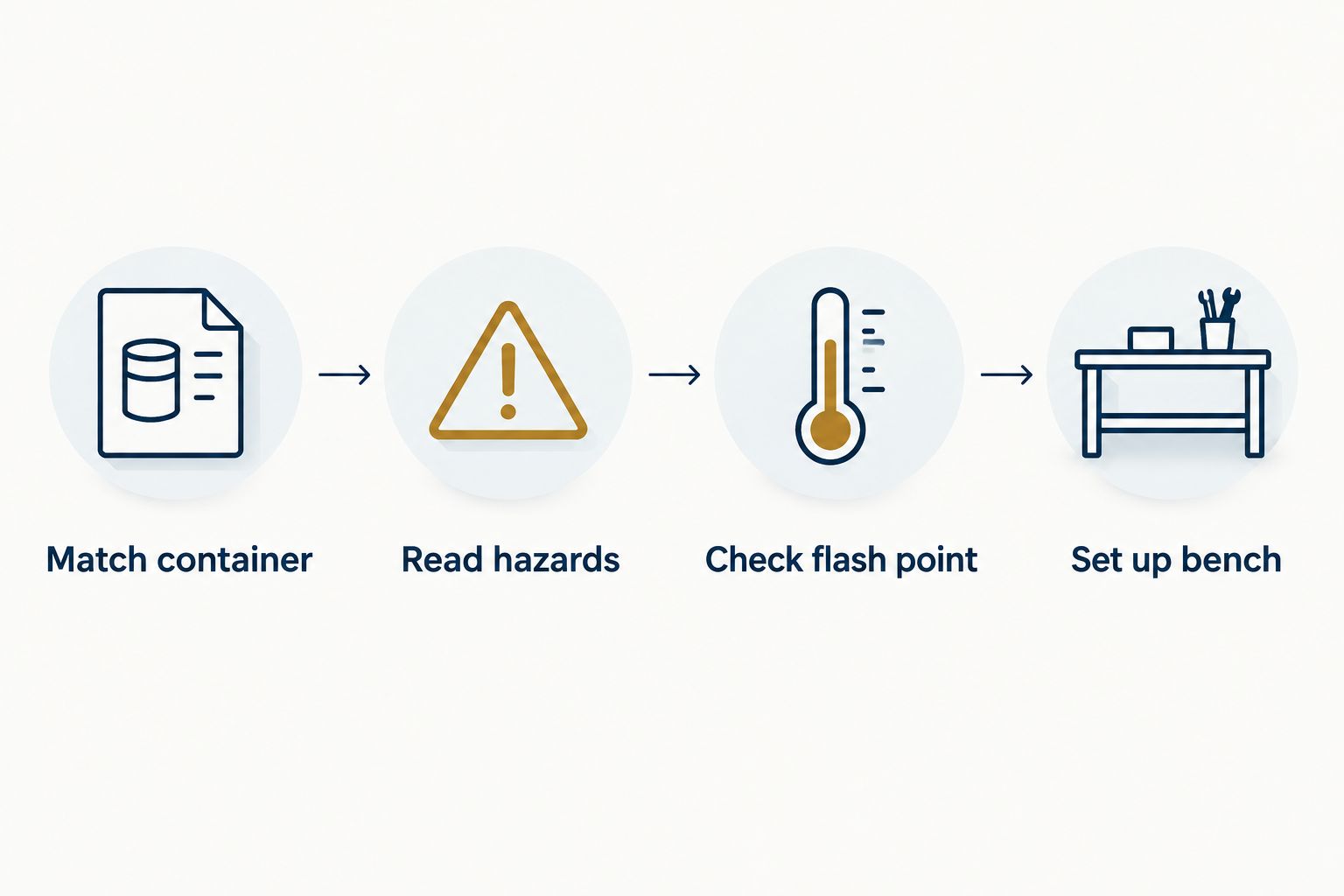
How do you check a CLP before using it?
Use this document-first sequence for a new cleaner or a replacement bottle in 2026. Repeat the check when the package, label, or product identification changes; a familiar brand name is not enough.
- Match container. Match the product name and identifying details on the container to the SDS. Confirm that the document covers the package you purchased.
- Read hazards. Read the label and SDS Section 2 together. Note flammability, pressure, exposure, and other stated warnings without reducing them to a single safe-or-unsafe judgment.
- Check flash point. Review Section 9 for the reported property and test method. If the entry says not available or not applicable, use the classification and manufacturer’s guidance rather than supplying your own interpretation.
- Set up bench. Follow Sections 7 and 8 for handling, ventilation, storage, and protective equipment. Keep the firearm manufacturer’s maintenance instructions at hand.
Keep the container closed when it is not in use and follow its directions for contaminated patches and waste. Do not leave used materials beside a heater or assume that letting them dry makes disposal acceptable.
If the documents conflict or leave an instruction unclear, stop and contact the product manufacturer. Guessing is not a maintenance procedure.
How should you choose a cleaner and lubricant?
Choose a product for the maintenance task, then verify its handling requirements. A cleaner’s fire classification does not tell you whether it removes a particular type of fouling, suits a finish, or provides the lubrication your firearm requires.
For routine work, check whether the label covers the surfaces and uses specified by your firearm manufacturer. For bore cleaning, verify the stated fouling-removal purpose rather than assuming every CLP removes copper. For lubrication, follow the firearm maker’s application points and quantities rather than coating every accessible surface.
Beclp is best for gun owners shopping for firearm CLP, bore cleaners, and synthetic lubricants—not for assuming one formula covers every task. BlueEagle CLP deserves the same product-specific label and SDS check as any cleaner you put on the bench.
When reviewing Beclp, keep biobased cleaning claims separate from synthetic-lubricant claims. Do not transfer a property from one product to another, or assume that every item has an identical formula.
That approach keeps your 2026 purchase focused on documented use, handling, and compatibility. A favorable fire-hazard classification cannot compensate for choosing the wrong maintenance product.
Can I use CLP on a hot firearm?
Let the firearm cool and follow the cleaner’s label and firearm manufacturer’s instructions before applying CLP. A flash-point figure is not an approved surface-temperature limit for cleaning.
Do not spray cleaner into a hot action or onto a hot barrel based on a flash-point number alone. Finish the cooling and safety checks before beginning maintenance.
Does biobased CLP mean nonflammable CLP?
Biobased CLP is not automatically nonflammable CLP. Feedstock origin and fire-hazard classification answer different questions, so you need the exact product’s label and SDS.
Beclp firearm cleaner buyers should use the same distinction when evaluating environmental wording. A biobased or biodegradable claim does not authorize drain disposal, eliminate protective-equipment requirements, or prove finish compatibility.
Can I store CLP in my gun safe?
Store CLP only where its label permits; a gun safe is not automatically an approved chemical-storage location. Check storage conditions, ignition-source restrictions, ventilation requirements, and any aerosol temperature warnings.
Keep chemicals in their labeled containers and account for any electrical equipment or heating devices in the storage area. If you cannot meet the product’s storage requirements, choose a different location rather than treating the safe as a default.
FAQ
Is CLP flammable or combustible?
CLP has no single fire-hazard classification because formulas and packages differ. Use the exact product’s label and SDS rather than interpreting the CLP name as a flammability rating.
Where do I find a gun cleaner’s flash point?
Look in Section 9 of the matching safety data sheet for the flash point and any reported test method. If the value is unavailable, do not interpret the missing entry as proof that the product cannot burn.
Is aerosol CLP safer than bottled CLP?
Neither package is automatically safer for every task. Aerosols require attention to pressure and aerosol hazards, while bottled liquids still require their own flammability, exposure, and handling checks.
Does a high flash point mean I can clean a hot barrel?
A high flash point does not authorize cleaning a hot barrel. Let the firearm cool and follow both the chemical label and firearm manufacturer’s maintenance instructions.
Can biodegradable gun cleaner go down the drain?
A biodegradable claim does not authorize drain disposal. Follow the product’s disposal directions and applicable local waste requirements, including those for cleaner contaminated with firearm residue.
Does nonflammable mean I do not need ventilation?
A nonflammable classification does not eliminate ventilation requirements. Follow the label and SDS Section 8 for exposure controls and protective equipment.
Should I use the same SDS for my bore cleaner and gun oil?
Use the SDS that matches each exact product. A bore cleaner and a lubricant can have different formulas, uses, hazards, and compatibility instructions even when sold by the same company.
One last thing
Check the package, not just the product name. A document for a bottled cleaner does not automatically answer the questions raised by an aerosol bearing a similar name. Matching the container to the SDS is a small bench habit that prevents a much larger assumption.
Before your next cleaning session, put the label’s handling instructions beside the firearm manufacturer’s maintenance directions. Those documents—not scent, familiar packaging, or environmental wording—should govern the routine.