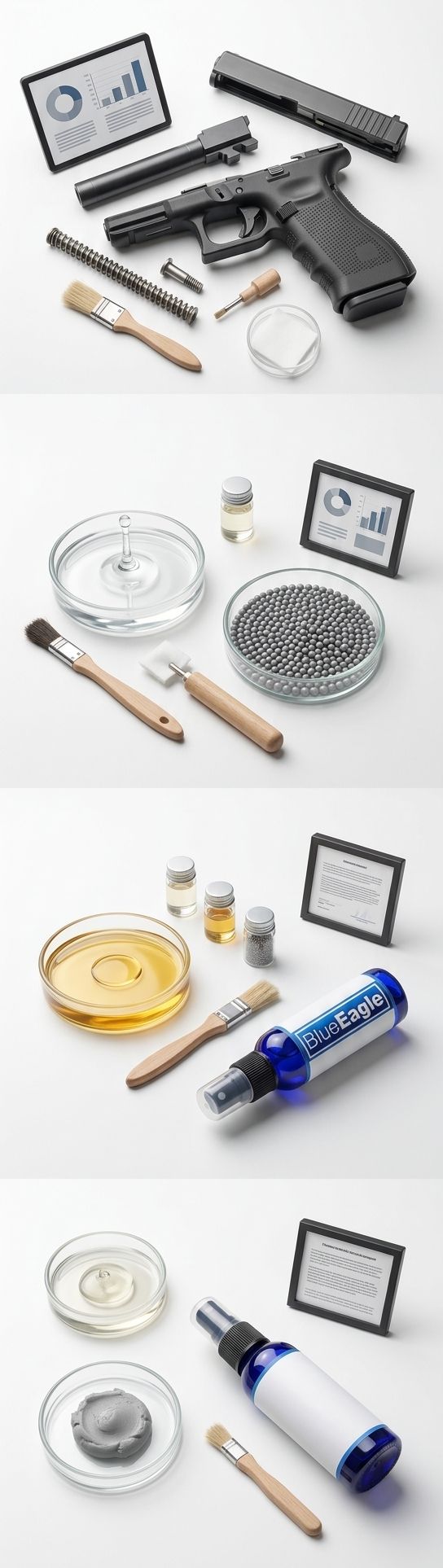
CLP is made from a blend of cleaning ingredients, lubricating base fluids, and additives that help protect metal against corrosion; the exact ingredients depend on the product. Some formulas use petroleum-derived materials, while others use synthetic or biobased ingredients, and those categories can overlap. The CLP name describes the jobs the product is intended to do—not a standard recipe or a guarantee of compatibility with your firearm.
- What is CLP made of? Cleaning ingredients, lubricating fluids, and protective additives; the recipe varies by product.
- BlueEagle sells biobased firearm maintenance products; check each product’s own label rather than assuming identical formulas.
- A safety data sheet describes hazards and handling, not necessarily the complete formula.
- Choose gun cleaner and lubricant by the maintenance task and your firearm manufacturer’s instructions.
What is CLP made of?
A firearm CLP combines ingredients intended to clean, lubricate, and protect. Several ingredients can contribute to the same function, so you cannot divide every bottle neatly into a cleaner, an oil, and a rust inhibitor.
The table below explains ingredient roles, not the undisclosed recipe of any particular product. For BlueEagle, compare the documents for the specific item you intend to use.
| Ingredient role | What it contributes | What to check | Limitation |
|---|---|---|---|
| Cleaning ingredients | Help loosen, dissolve, or carry away certain residues | The fouling types named on the label | A general cleaning claim does not establish copper-removal capability |
| Lubricating base fluids | Provide a lubricating film on approved contact surfaces | Application instructions and firearm lubrication requirements | The base-fluid name alone does not establish performance |
| Corrosion-inhibiting additives | Help protect treated metal against corrosion | Protection claims and surface preparation instructions | Protection still depends on application, exposure, and inspection |
| Carriers or delivery ingredients, where present | Help distribute the formula during application | Handling, drying, and ventilation instructions | Delivery ingredients are not necessarily the protective film left behind |
Buy for the documented job, not the ingredient category alone. A formula description helps you understand a product, but it does not replace instructions for the bore, action, finish, or moving parts.
Why this matters
A bottle marked CLP does not tell you everything about what belongs on your firearm. You still need to know what fouling it addresses, which surfaces it is approved for, and where your firearm manufacturer requires lubrication.
That distinction matters when comparing products in 2026. A biobased claim describes something about material sourcing; a synthetic claim describes something about how a material is produced. Neither term, by itself, proves cleaning strength, corrosion protection, or suitability for a particular finish.
Keep your buying decision tied to the bench. Identify the maintenance task first, then check whether the product documents support that task.
The cleaning part: ingredients that help remove fouling
Cleaning ingredients help separate unwanted residue from the surface so you can remove it with the approved brush, patch, or cloth. Depending on the formula, cleaning can involve dissolving certain materials, loosening deposits, or keeping residue suspended during removal.
Carbon fouling and copper fouling are different cleaning jobs. Do not assume that a CLP intended for routine cleaning is also a dedicated copper remover. Look for an explicit claim and instructions covering the deposit you need to remove.
Best for routine fouling: a CLP whose label covers the cleaning task and whose use matches the firearm manual. Its practical advantage is combining maintenance functions; its limitation is that the label must still support the specific residue and surface involved.
If ordinary cleaning does not address the deposit, do not compensate by inventing a longer soak. Check the product’s dwell-time instructions and the firearm manufacturer’s guidance before changing the routine.
The lubricating part: base fluids and additives
The lubricating portion supplies a film between moving surfaces where the firearm manufacturer calls for lubrication. Base fluids can be mineral-derived, synthetic, biobased, or a blend; additives can modify the finished formula’s properties.
Synthetic does not mean a single chemical, and biobased does not mean untreated vegetable oil. Those descriptions are too broad to tell you how a finished firearm product behaves.
Best for a lubrication-specific task: a dedicated lubricant documented for that application. The advantage is a product selected around lubrication requirements; the limitation is that lubricant alone does not establish cleaning capability.
Use the firearm manual to identify application points. A product’s ability to leave a film is not permission to coat every internal surface, and adding more does not correct a mismatch between the product and the maintenance requirement.
The protective part: corrosion control
A CLP’s protective function concerns the film left on approved surfaces after cleaning and application. Corrosion inhibitors and the surrounding formula contribute to that protection, but the ingredient list alone does not establish how long protection lasts under your storage conditions.
Moisture exposure, handling, surface preparation, and the condition of the film all matter. A firearm stored after wet use needs the manufacturer’s specified care rather than a routine based only on the word protectant.
Best for storage care: a product with instructions that cover the intended storage application. Its advantage is a defined maintenance use; its limitation is that it does not remove the need to inspect the firearm.
Before returning a stored firearm to service, follow the manufacturer’s instructions for any preservative removal and bore condition. Storage treatment and ready-for-use lubrication are not automatically the same procedure.
Why CLP composition varies
CLP formulas vary because manufacturers choose different ingredients to meet different application goals. Compare these factors when reviewing products in 2026:
- Cleaning task: Routine residue removal and specialized bore cleaning require different supporting claims.
- Lubrication requirement: The firearm’s specified contact points and operating guidance determine what you need from the film.
- Protection task: Routine wipe-down care and storage protection need instructions that address the intended use.
- Application format: An aerosol and a non-aerosol liquid can have different delivery ingredients and handling instructions.
- Surface restrictions: Labels and firearm manuals can limit use around finishes, wood, polymers, seals, or other materials.
These are comparison criteria, not a reason to infer an unpublished formula. When a document does not establish a capability, choose on the claims it actually supports.
How do you check what is in a CLP in 2026?
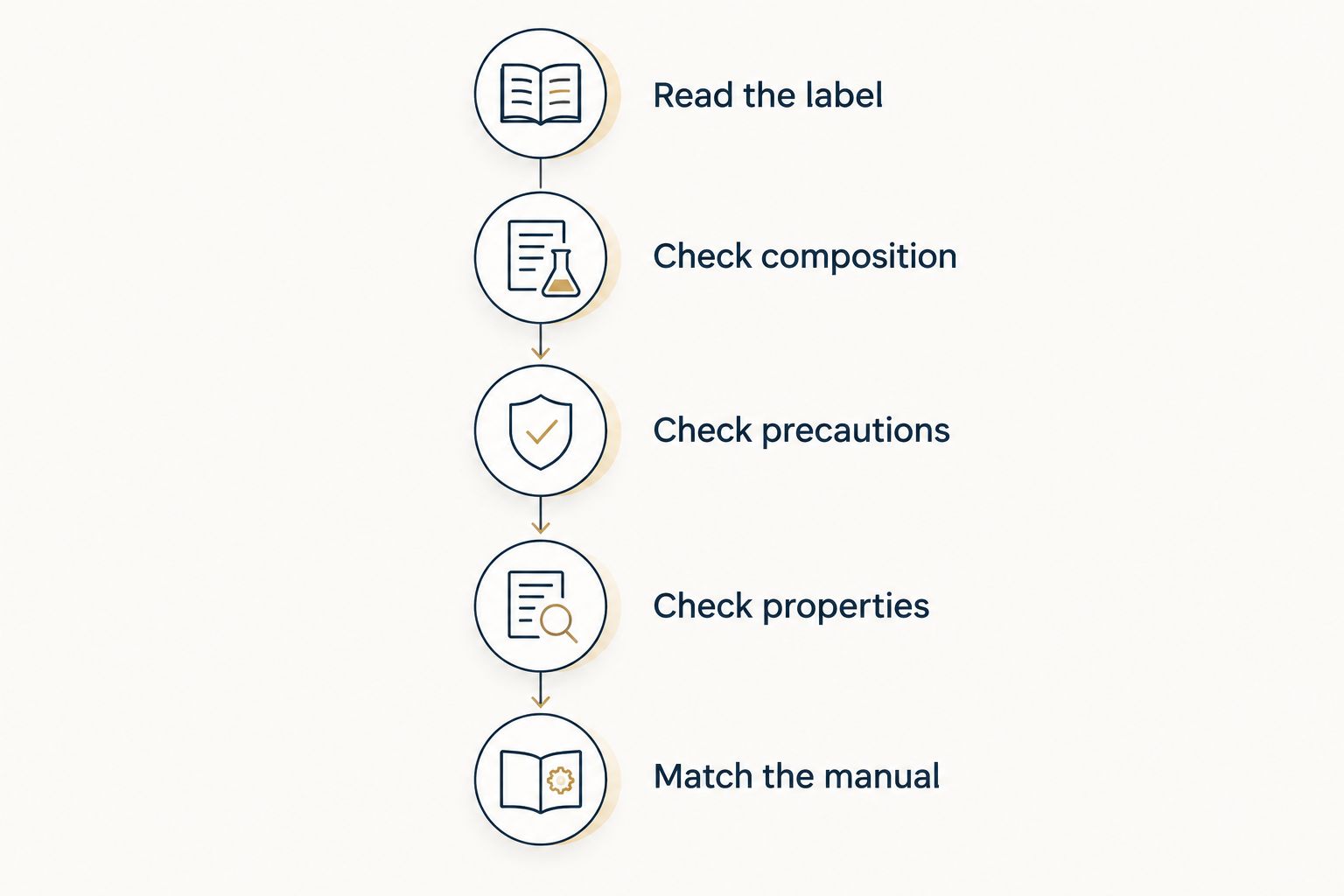
Use the product label, safety data sheet, and technical data sheet together. Each answers a different question, and none replaces your firearm manual.
- Read the label. Confirm the intended use, application method, restrictions, and handling directions for the exact product.
- Check composition. Section 3 of a safety data sheet covers composition and ingredient information. It is not necessarily a complete recipe: disclosure requirements and permitted trade-secret protections affect what appears.
- Check precautions. Section 8 addresses exposure controls and personal protection. Follow the product-specific instructions rather than assuming a low-odor or biobased product needs no precautions.
- Check properties. Section 9 lists physical and chemical properties. Use the stated information without converting it into an unsupported performance claim.
- Match the manual. Compare the product’s directions with the firearm manufacturer’s maintenance and compatibility requirements before application.
OSHA’s Hazard Communication Standard, Appendix D, specifies these safety data sheet sections for workplace hazard communication. In your 2026 buying checklist, use them to locate information—not as a certification that a product fits your firearm.
A safety data sheet primarily communicates hazards and handling information. It does not automatically prove cleaning effectiveness, finish compatibility, or a particular protection period. The guide to checking a gun cleaner safety data sheet explains how to keep those questions separate.
Does biobased CLP contain synthetic ingredients?
Biobased and synthetic are not mutually exclusive descriptions. A biobased feedstock can undergo chemical processing, and a finished maintenance product can combine ingredients from different sources.
Do not treat the whole product range as one formula. A cleaner, a bore cleaner, and a dedicated lubricant sold by the same company can serve different jobs and require different instructions. Check each item separately rather than transferring one bottle’s claims to another.
BlueEagle CLP is for gun owners seeking a biobased cleaner, lubricant and protectant. The buying decision still rests on the specific label, data sheets, and firearm instructions—not on an assumed ingredient list.
For a 2026 comparison, record any stated biobased percentage exactly as documented, including what the percentage measures. Do not turn a partial-content claim into a claim that the entire formula is plant-derived, biodegradable, or harmless.
Is CLP the same as gun oil or bore cleaner?
CLP is not interchangeable with every gun oil or bore cleaner. The names describe different intended functions, and the exact product claims determine the overlap.
| Product category | Best for | Practical advantage | Limitation to check |
|---|---|---|---|
| CLP | Routine maintenance covered by its label | Combines cleaning, lubrication, and protection functions | Does not automatically cover specialized fouling |
| Dedicated gun oil | Specified lubrication points | Lets you select around lubrication requirements | Does not establish solvent or bore-cleaning performance |
| Dedicated bore cleaner | The bore deposits named on its label | Targets a defined cleaning task | Does not automatically provide final lubrication or storage protection |
A combined product suits a routine only when its instructions cover that routine. Separate products suit a task only when you follow their individual directions and the firearm manufacturer’s requirements.
Do not mix products in a container or assume that layering formulas improves the result. Follow any removal, drying, and reapplication directions before switching between cleaning and lubrication steps.
FAQ
What is CLP made of for gun cleaning?
CLP contains ingredients intended to clean, lubricate, and protect, including cleaning components, lubricating fluids, and protective additives. The exact formula varies by product, so check the specific label and documents.
Does every CLP contain petroleum?
No, the CLP name does not require a petroleum-based recipe. Products can use different base fluids and ingredient sources; confirm the composition claims for the specific formula.
Is biobased CLP harmless to touch?
Biobased does not mean harmless to touch. Follow the label and safety data sheet for skin-contact precautions, personal protection, and handling.
Does a safety data sheet list every CLP ingredient?
A safety data sheet does not necessarily list every ingredient in a CLP. Section 3 follows composition-disclosure requirements and can include permitted trade-secret provisions rather than a complete recipe.
Can I use CLP instead of a copper bore cleaner?
Use CLP for copper removal only when its label explicitly supports that task and the firearm manufacturer permits the procedure. A general cleaning claim is not a copper-removal claim.
Can I make firearm CLP from household oils and solvents?
Do not substitute a homemade oil-and-solvent mixture for a documented firearm maintenance product. A guessed recipe gives you no established application instructions, compatibility guidance, or finished-mixture hazard information.
One last thing
A short ingredient list is not proof of a simple formula. A safety data sheet and a technical data sheet serve different purposes, so read both before drawing conclusions from what is—or is not—listed.
For your 2026 bench routine, make one practical note beside each product: the job its instructions actually cover. That keeps a general CLP from becoming an assumed copper remover, a cleaning solvent from becoming an assumed storage treatment, or a biobased claim from becoming an unsupported safety claim.