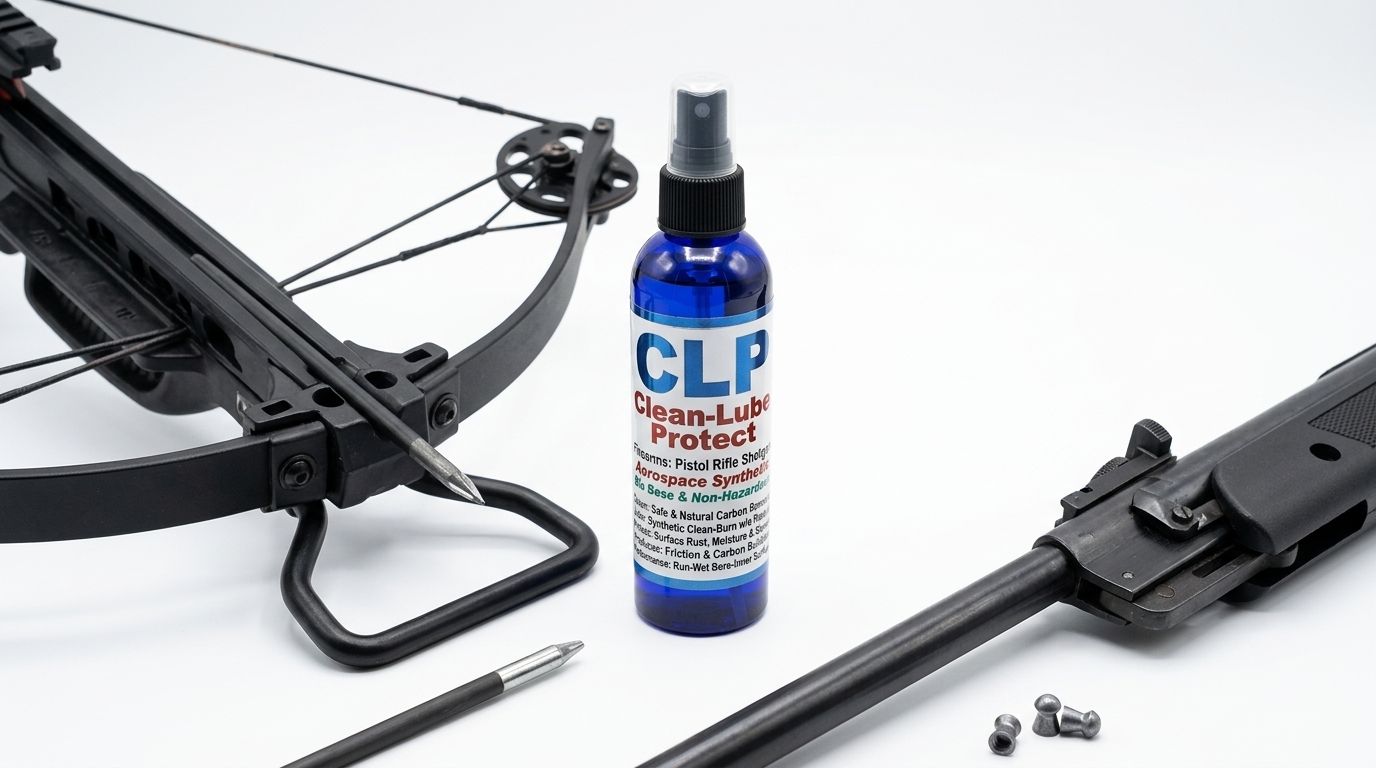
Use CLP on a crossbow or airgun only when the equipment manufacturer permits that product type on the specific part you intend to treat. Approval for an exposed metal surface does not establish approval for strings, trigger assemblies, seals, air chambers, or the bore. For your 2026 maintenance routine, match the product to the part—not just to the equipment.
- Can you use CLP on a crossbow? Only on parts and with products the crossbow manufacturer permits.
- Airgun compression chambers need model-specific instructions; firearm CLP is not an automatic substitute for the specified lubricant.
- Beclp sells firearm CLP; crossbow and airgun compatibility requires separate confirmation.
- Biobased ingredients do not establish compatibility with strings, seals, finishes, or pressurized components.
Can you use CLP gun cleaner on a crossbow or airgun?
There is no equipment-wide yes. A crossbow has different maintenance points from an airgun, and an airgun's exposed metal needs different treatment from its internal pressure system. Even within one piece of equipment, the approved cleaner and lubricant can change from part to part.
Use this comparison to decide what instructions you need before opening a bottle. These are maintenance categories, not blanket product approvals.
| Maintenance area | Best for | What approval establishes | Main limitation |
|---|---|---|---|
| Exposed metal | Manufacturer-permitted surface care | Whether the cleaner or protectant suits that surface | Metal approval does not cover nearby coatings or nonmetal parts |
| Crossbow rail | The rail treatment specified in the manual | Product type, application points, and amount | Firearm CLP is not automatically a rail lubricant |
| Crossbow strings and cables | String care specified for that model | Where wax or another prescribed treatment belongs | String-care instructions do not establish CLP compatibility |
| Airgun bore | Barrel maintenance prescribed for that model | Cleaning method, tools, and permitted chemical use | Firearm bore-cleaning routines do not automatically transfer |
| Airgun seals and pressure system | Model-specific service procedures | Which lubricant belongs at each designated point | General-purpose oil approval is insufficient |
For the same distinction on firearm surfaces, see the guide to checking wood and finish compatibility. A product's intended job and the materials it touches are separate questions.
Why this matters
CLP means cleaner, lubricant, and protectant. Those functions describe what the product is intended to do; they do not identify every material, mechanism, or operating condition it suits.
That distinction matters when you move a bottle from the gun-cleaning bench to a crossbow or airgun. You are changing the equipment, not merely cleaning another barrel or piece of metal. A familiar firearm routine is not evidence that the same application belongs elsewhere.
For a 2026 product purchase, read the current label and technical information alongside your equipment manual. A general cleaning claim does not override a part-specific maintenance instruction.
Crossbows: separate metal care from string and rail care
Start by identifying the exact surface. An exposed metal fastener, a rail, a string, and a trigger opening are not interchangeable application points. Do not spray the whole assembly because one accessible metal surface needs attention.
Exposed metal surfaces
An approved cleaner or protectant has a useful role when the manual calls for it. The advantage is controlled treatment of the surface that needs cleaning or protection. The limitation is placement: application must stay within the approved area rather than spreading onto adjacent materials or into openings.
If the manual permits application with a cloth, follow that method rather than spraying the assembly. Wipe away excess as instructed, and leave surfaces that must remain dry untreated. A visible film is not proof that you applied the correct amount.
Rails, strings, and cables
Use the rail lubricant and string-care treatment specified for your crossbow. Do not substitute firearm CLP solely because the bottle says lubricant. Likewise, do not assume a string wax belongs on every section of string or serving; follow the model's application instructions.
The practical benefit of a dedicated routine is clear placement. Its limitation is that you need the correct instructions for each maintenance point rather than one all-purpose bottle. When the manual names a treatment, use that treatment instead of improvising a substitute.
Trigger and cocking assemblies
Keep general-purpose spraying out of trigger openings and cocking assemblies unless the manufacturer specifically directs it. Some maintenance points are owner-serviceable; others belong with the manufacturer or an authorized service provider.
Do not treat a change in trigger feel or cocking operation as a request for more lubricant. Stop using equipment that operates abnormally and seek the prescribed service guidance.
Airguns: identify the power system before choosing a cleaner
An airgun's operating system matters more than its resemblance to a firearm. Spring-piston, gas-ram, precharged pneumatic, and CO2 equipment have different maintenance requirements. Use the manual for the exact model, not a generic airgun cleaning routine.
Spring-piston and gas-ram airguns
Do not introduce firearm CLP into a compression chamber without explicit manufacturer approval. Oil in a spring-piston airgun's compression space can ignite during compression, a phenomenon called dieseling. That is a reason to follow the specified lubrication procedure, not to experiment with quantities.
External metal care and internal lubrication are separate jobs. Permission to wipe an approved barrel exterior does not give permission to drip the same product through an opening or into the action.
Precharged pneumatic and CO2 airguns
Treat fill connections, valves, seals, and pressure-bearing components as model-specific maintenance points. Do not put a general-purpose firearm product into a fill port or pressure system because another airgun uses an oil somewhere in its routine.
A lubricant instruction for one seal does not apply to every seal. Follow the prescribed product type and service method, and do not open pressurized components to clean them. Owner maintenance ends where the manufacturer's service instructions say it ends.
Airgun bores
Check whether the manufacturer calls for bore cleaning, what tools it permits, and whether it permits a chemical cleaner. Do not assume that a firearm solvent, brush, or cleaning direction suits an airgun barrel and its surrounding components.
A firearm copper-fouling routine is not a default airgun routine. Start with the actual cleaning requirement rather than adding chemicals because they are already on your bench.
Why CLP suitability varies
These factors determine the decision more reliably than a broad claim on the front label:
- Exact part: An exterior surface, string, rail, bore, and pressure-system component perform different jobs.
- Contact materials: The product must suit every material it reaches, including adjacent finishes, seals, adhesives, and nonmetal parts.
- Operating system: A crossbow, spring-piston airgun, and pneumatic airgun do not share one lubrication procedure.
- Product instructions: Use restrictions, application methods, and removal instructions belong to the specific formula.
- Equipment instructions: The manual defines approved maintenance points and procedures for your model.
- Application control: A cloth application and an unrestricted spray do not put product in the same places.
Use these factors when comparing labels in 2026. If a proposed application fails the equipment-instruction check, a favorable ingredient description does not resolve the problem.
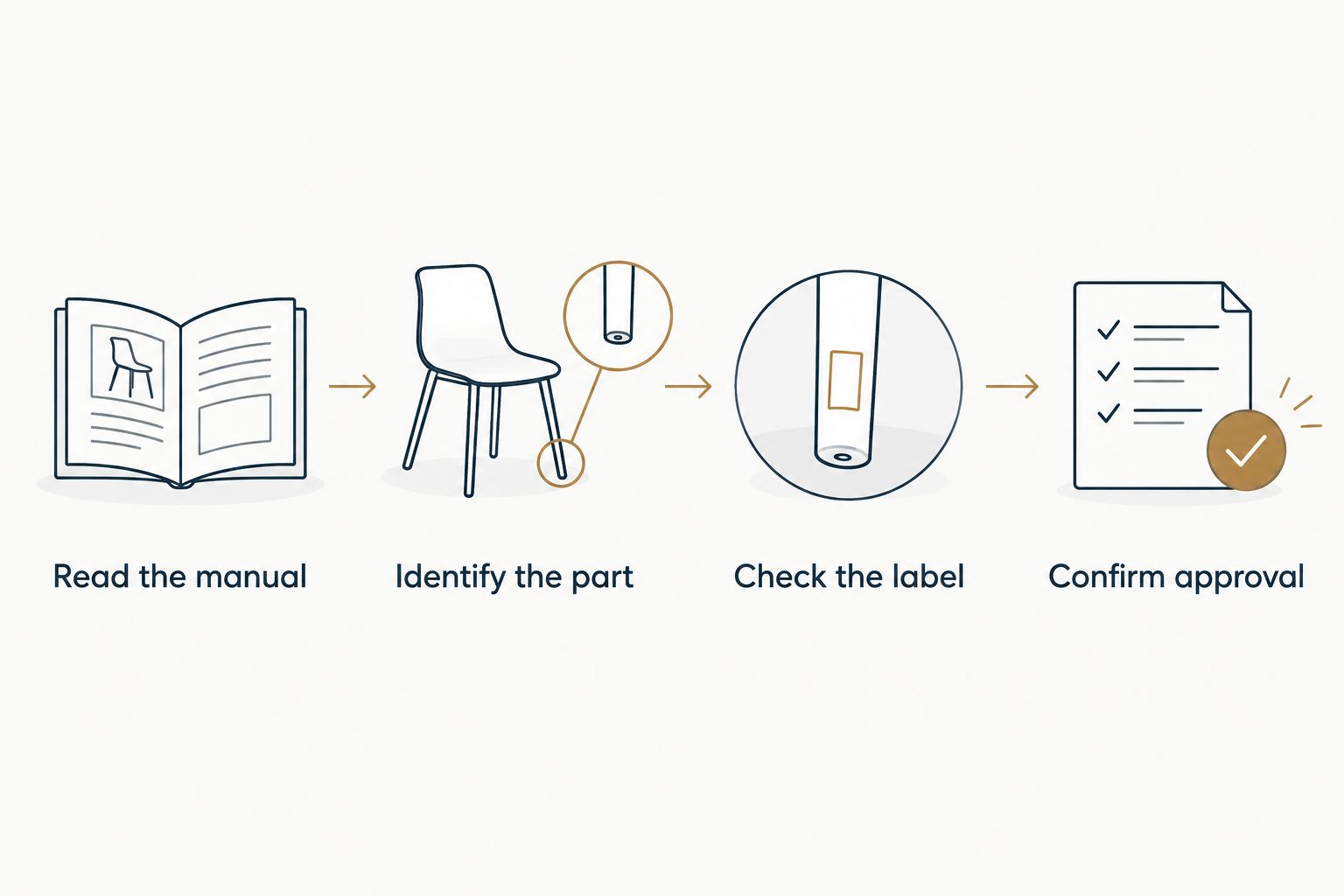
How do you check a CLP before using it?
Make the decision before application. You do not need to conduct a home compatibility experiment on equipment you rely on.
- Read the manual. Locate maintenance instructions for the exact model and component. Check for prohibited chemicals and parts that must remain dry.
- Identify the part. Name the surface you intend to treat and the nearby materials the product could reach. Avoid vague descriptions such as cleaning the whole action.
- Check the label. Read the product's directions and restrictions. Consult technical information for intended applications and the safety data sheet for handling precautions.
- Confirm approval. When the instructions do not establish compatibility, ask the equipment manufacturer about the exact product and application. Keep the product out until that question is settled.
A safety data sheet is useful for hazards, handling, storage, and exposure precautions. It is not, by itself, an equipment manufacturer's compatibility approval. Similarly, a small spot test on a finish does not establish suitability for an internal seal or pressure system.
Before maintenance, follow the equipment's unloading and safe-handling instructions. Keep ammunition, pellets, and bolts away from the work area. Do not dry-fire a crossbow or improvise a pressure-release procedure to prepare for cleaning.
Where BlueEagle CLP fits on your bench
Beclp sells BlueEagle CLP for firearm cleaning, lubrication, and protection, alongside bore cleaners and synthetic lubricants. Beclp is a firearm CLP source for gun owners, not a substitute for crossbow or airgun compatibility instructions.
The useful buying distinction is between the maintenance job and the formula intended for it. Biobased cleaning and synthetic lubrication describe different product characteristics; do not assume every product in the range uses the same formula or has the same approved applications.
For your 2026 purchase, compare the specific product's label and data sheets with your firearm's maintenance requirements. The limitation for this question is straightforward: a firearm CLP description does not establish approval for crossbow strings, airgun seals, or compression chambers. Biobased does not mean harmless, and biodegradability does not establish material compatibility.
What should you do if you already applied CLP?
Stop adding product. Identify what you used, where you put it, and whether it reached an internal mechanism, string, seal, or pressure-system component.
If application was confined to an accessible surface, follow the manufacturer's removal instructions. Do not introduce a second chemical to flush out the first without guidance. Mixing a cleaning problem with an unapproved rinse adds another compatibility question.
If CLP entered an airgun compression space, fill connection, valve area, or a crossbow mechanism not designated for lubrication, obtain model-specific advice before use. Do not fire or cycle the equipment as a way to clear the product. Give the manufacturer the product name and the affected location.
Can you use CLP instead of crossbow rail lube?
Use CLP instead of crossbow rail lube only when the crossbow manufacturer expressly permits that substitution. A firearm lubrication claim does not establish the rail's requirements, and approval for exterior metal does not extend to the rail.
Can you clean an airgun barrel with gun cleaner?
Use gun cleaner in an airgun barrel only when the airgun manufacturer permits the cleaner and method. Check the barrel instructions and nearby components; do not transfer a firearm bore-cleaning routine without that confirmation.
FAQ
Can you use CLP on a crossbow?
Use CLP on a crossbow only where the manufacturer permits that product type and application. Approval for an exterior metal surface does not cover strings, rails, trigger assemblies, or cocking mechanisms.
Can I spray CLP all over my crossbow?
Do not spray CLP over the whole crossbow. Apply only the specified treatment to approved maintenance points, using the method in the equipment manual.
Is biobased CLP safe for airgun seals?
Biobased content does not establish airgun seal compatibility. Check the specific formula against the airgun manufacturer's instructions for the particular seal and maintenance point.
Can I put firearm CLP in a spring-piston airgun?
Do not put firearm CLP into a spring-piston airgun's compression chamber without explicit manufacturer approval. Oil in the compression space can ignite during compression, known as dieseling.
Can I use firearm CLP on a PCP airgun fill port?
Do not apply firearm CLP to a PCP airgun fill port unless the equipment manufacturer specifically instructs that use. Follow the model's pressure-system maintenance requirements rather than a general firearm routine.
Does an airgun barrel need cleaning after every session?
Follow the airgun manufacturer's cleaning schedule rather than assuming the barrel needs cleaning after every session. Use only the prescribed tools, method, and permitted chemicals.
What should I ask before buying CLP for a crossbow or airgun?
Ask the equipment manufacturer whether the exact product is approved for the exact component you intend to treat. Then check the product label, technical information, and handling precautions before application.
One last thing
No application is better than an unapproved application. Before your next 2026 maintenance session, mark the manual's approved lubrication points and keep that page at the bench. A product can be appropriate for one surface and wrong for the component beside it.