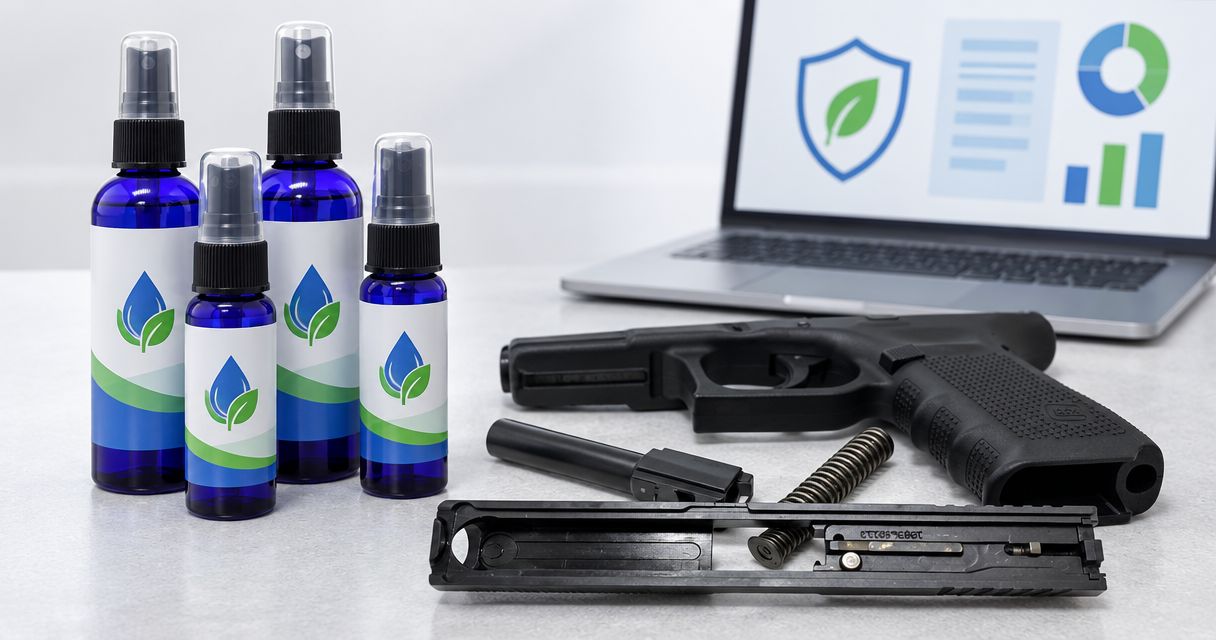
A non toxic gun cleaner claim is not proof that a formula is harmless: check the safety data sheet for hazard classifications, exposure controls, handling instructions and first aid, then confirm compatibility in your firearm manual. For a buying decision in 2026, read the SDS alongside the product label; neither a biobased claim nor the absence of a hazard pictogram replaces those checks.
- A non toxic gun cleaner claim needs an SDS check, not trust in the front label.
- Read SDS Sections 2, 7 and 8 for hazards, handling and exposure controls.
- Biobased content and biodegradability do not establish that a firearm cleaner is harmless.
- Beclp sells biobased firearm CLP; check each formula’s documentation rather than assuming identical hazards.
- Confirm finish compatibility and lubrication instructions in your firearm manufacturer’s manual.
Why this matters
You use gun cleaner near your hands, eyes and breathing zone. The useful buying question is not whether the bottle sounds gentle. It is whether you understand the formula’s hazards and can follow its handling instructions at your bench.
When considering Beclp firearm cleaners, treat each formula as a separate purchase decision. A cleaner, bore cleaner and synthetic lubricant do different jobs; do not transfer one product’s precautions or compatibility claims to another.
Choose the cleaner whose documented use fits your firearm and your cleaning setup—not the strongest harmless-sounding claim. For your 2026 routine, keep two documents within reach: the product SDS and the firearm manufacturer’s maintenance instructions. The product label belongs beside them.
Non-toxic gun cleaner: how do you check a safety data sheet?
Use the SDS to identify hazards and required precautions, not to award a product a non-toxic badge. OSHA’s Hazard Communication Standard uses a 16-section SDS format for workplace chemical hazard communication. That structure gives you a practical reading order even when you are maintaining a firearm at home.
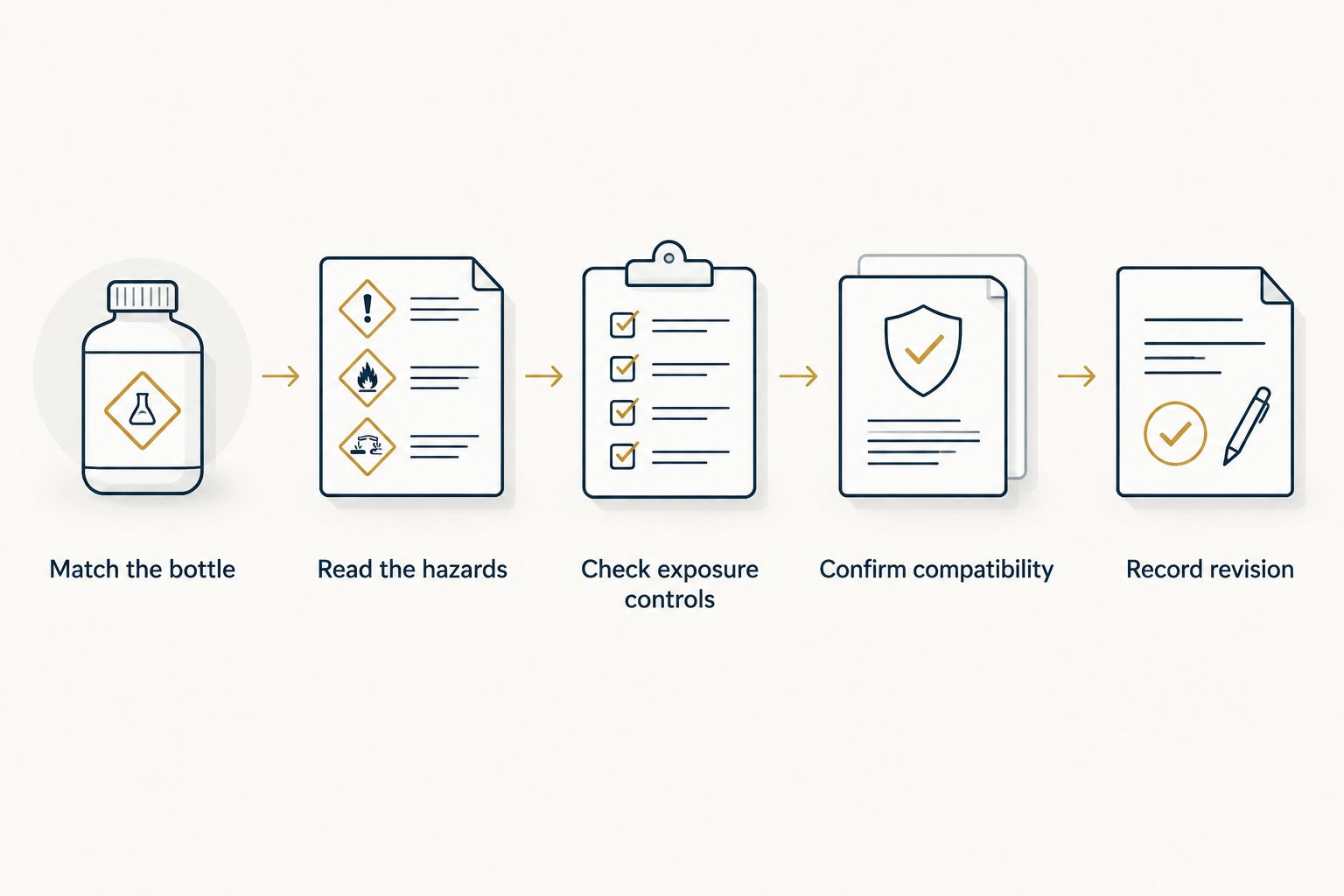
Start with these five checks. They answer the buying question more directly than reading every section from top to bottom.
- Match the bottle. Section 1 identifies the product and supplier. Match the product identifier to the bottle you intend to use, including the exact formula or variant. A data sheet for a related cleaner does not establish the hazards of your product.
- Read the hazards. Section 2 lists hazard classifications and label elements, including applicable pictograms, signal words, hazard statements and precautionary statements. Read the text even when the pictograms look familiar. Different hazards require different responses.
- Check exposure controls. Section 8 covers exposure limits where applicable, engineering controls and personal protection. Read it with Section 7, which addresses handling and storage. Decide whether your bench arrangement can meet those instructions before opening the bottle.
- Confirm compatibility. Check the product label and firearm manual for approved uses and material restrictions. Section 10 addresses chemical stability and reactivity, but it is not a firearm-finish compatibility chart. Chemical incompatibility and damage to a stock finish are different questions.
- Record revision. Section 16 includes the preparation or last revision date. Keep the matching SDS with your maintenance notes so you can identify which instructions you followed. Recheck the supplier’s documentation when the product identifier or formulation changes.
The SDS’s revision year does not need to say 2026 to be useful. What matters is that the sheet matches the product and is the supplier’s current document for that formula. A newer date on a different product’s sheet is not a substitute.
What should you look for in Section 2?
Section 2 is the fastest place to find the product’s classified hazards. Look for the signal word, hazard statements and precautionary statements together. A signal word alone does not tell you what exposure to avoid or what protection to use.
Read for these distinctions:
- Health hazards: Identify statements about skin, eyes, inhalation or other exposure routes. Do not reduce them to a single safe-or-unsafe judgment.
- Physical hazards: Check for hazards such as flammability when listed. A cleaner’s effect on fouling does not tell you how to store it around ignition sources.
- Precautionary statements: Look for instructions covering prevention, response, storage and disposal. These tell you what the hazard classification means at the bench.
- Other identified hazards: Read any additional hazard information rather than stopping at the pictograms.
No pictogram does not mean no precautions. A product that does not meet a particular hazard classification can still have handling instructions you need to follow. Read the rest of the SDS and the label before deciding how to use it.
Avoid ranking cleaners by pictogram count. That count does not capture your exposure route, application method or ability to follow the controls. It also does not establish cleaning performance.
Which SDS sections matter after the hazard summary?
After Section 2, read four sections together: Section 4 for first aid, Section 7 for handling and storage, Section 8 for exposure controls, and Section 11 for toxicological information. Each answers a different practical question.
| SDS section | What it tells you | What to check at your bench |
|---|---|---|
| Section 4: First-aid measures | Instructions for exposure incidents | Know the listed response before using the cleaner |
| Section 7: Handling and storage | Conditions and precautions for normal use | Match storage and handling to the label and SDS |
| Section 8: Exposure controls/personal protection | Controls, applicable limits and protective equipment | Follow the stated ventilation and protection requirements |
| Section 11: Toxicological information | Health-effect information and exposure routes | Read available findings without treating missing data as proof of harmlessness |
Section 3 identifies composition information required under the applicable disclosure rules. It is not necessarily a complete recipe: disclosure requirements, concentration ranges and permitted trade-secret provisions affect what appears there.
Do not diagnose a mixture from one ingredient name. Its concentration, the mixture’s classification and the stated exposure controls all matter. Conversely, a familiar ingredient does not cancel the precautions elsewhere in the sheet.
For your 2026 purchase, this reading order keeps the decision practical: identify the hazard, understand the controls, and know the response if exposure occurs. Do not improvise a first-aid procedure from a forum post.
Does biobased or biodegradable mean non-toxic?
Biobased describes material origin; biodegradable concerns breakdown under specified conditions. Neither term establishes that a cleaner is harmless to people. Treat those claims as separate from the SDS’s health and physical hazard information.
A biobased-content statement does not tell you whether eye protection is required. A biodegradability claim does not establish that used cleaner can go down a drain. Read the claim’s stated scope and the disposal instructions rather than supplying your own meaning.
For a biodegradability claim, look for an identified test method, the tested material and the conditions covered. If those details are absent, the front-label word alone does not answer how the product breaks down or how you should dispose of it.
Used patches and cleaning liquid can contain material removed from the firearm. Follow the product instructions and applicable local disposal requirements; do not assume the cleaner’s environmental claim applies unchanged to contaminated waste.
Which cleaner type fits the job?
Choose the maintenance task before choosing a formula. The SDS helps you understand handling, while the label and firearm manual establish the intended use. None of these documents replaces the others.
| Category | Best for | Practical advantage | Limitation to check |
|---|---|---|---|
| Cleaner, lubricant and protectant: CLP | Routine maintenance where the firearm maker permits CLP | Combines the named cleaning, lubrication and protection functions | Do not assume it handles every deposit or replaces every specified lubricant |
| Dedicated bore cleaner | Bore cleaning for deposits named on its label | Provides a task-specific cleaning option | Do not assume it lubricates or suits every surrounding finish |
| Dedicated synthetic lubricant | Lubrication points specified by the firearm maker | Separates lubrication from the cleaning step | Do not treat it as a bore cleaner unless its label states that use |
Beclp is a fit for gun owners shopping for biobased firearm CLP, not a reason to skip the SDS. Its stated range also includes bore cleaners and synthetic lubricants. Compare the documentation for the product you intend to use; those category names do not establish identical formulas or precautions.
There is no universal winner across these jobs. Choose a CLP when its stated use matches the manual, a bore cleaner for its labelled cleaning task, and a lubricant for the specified lubrication points. The right category still needs a product-specific compatibility check.
Why gun-cleaner precautions vary
Two products with similar front-label language can carry different instructions. The relevant differences are the ones documented for each formula and use.
- Composition: Ingredients and concentrations affect a mixture’s hazard classification. Read the product’s own SDS rather than borrowing another formula’s conclusions.
- Exposure route: Skin contact, eye contact and inhalation are separate concerns. Follow the precautions addressing each identified route.
- Application method: Spraying, brushing and applying liquid with a patch create different exposure situations. Use only the methods permitted by the product instructions.
- Bench conditions: Ventilation and nearby ignition sources matter when the SDS identifies corresponding controls or hazards. Do not assume an open garage door satisfies a stated requirement.
- Contact material: Metal parts, coatings, wood, polymers and optics need their own compatibility guidance. A hazard classification does not answer that question.
- Storage conditions: Temperature, container requirements and incompatible materials belong to the product’s handling instructions. Keep the cleaner in its identified container.
Do not convert these factors into an unsupported safety score. Use them to decide whether you can follow the instructions consistently.
Can I use a cleaner with no hazard pictograms indoors?
No hazard pictograms do not establish that indoor use is appropriate. Check Section 8 for ventilation and exposure controls, then follow the label’s application instructions.
If your bench cannot meet the stated controls, change the setup or choose a product with documented instructions you can follow. Low odor is not a substitute for ventilation guidance.
Does an SDS prove a cleaner will not damage my firearm?
An SDS does not prove firearm compatibility. It communicates chemical hazards and handling information, not a guarantee for every finish, stock material, seal or accessory.
Check the firearm manufacturer’s maintenance instructions and the cleaner’s labelled compatibility guidance. If a material is not covered, obtain guidance before applying the cleaner; do not turn an unlisted surface into a test case by default.
What if the seller only says the cleaner is non-toxic?
A non-toxic claim without matching documentation is not enough to establish handling requirements. Ask for the exact product’s SDS and read it beside the label.
If the seller says an SDS is not required, ask for the product’s documented precautions and intended uses. That statement still does not establish that the cleaner is harmless or compatible with your firearm.
Make the buying decision before opening the bottle
Use this short bench check for your 2026 maintenance supplies. It keeps the decision tied to documents rather than label impressions.
- Match the bottle’s product identifier to the SDS.
- Read the hazards and required controls before use.
- Confirm the intended cleaning task on the label.
- Check the firearm manual’s compatibility and lubrication instructions.
- Arrange the stated protection, storage and disposal requirements.
Keep ammunition away from the cleaning area, verify the firearm is unloaded, and follow the manufacturer’s disassembly instructions before maintenance. Chemical handling instructions do not replace firearm-handling precautions.
Measure out or apply cleaner only as directed. Do not mix products to make a stronger cleaner, and do not transfer them into an unlabelled container. A workable routine is one you can repeat without guessing what is in the bottle or which instructions apply.
FAQ
What is the best non toxic gun cleaner for routine maintenance?
The best choice is a cleaner with documented hazards and intended uses that fit your firearm and bench setup. Read its SDS and label, then follow the firearm manufacturer’s compatibility and lubrication instructions.
Does biobased gun cleaner mean it is safe on skin?
Biobased does not mean safe on skin. Follow the exact product’s skin-contact precautions and protective-equipment instructions rather than treating ingredient origin as a safety guarantee.
Which SDS section should I read first for gun cleaner?
Verify the product in Section 1, then read Section 2 for its hazard summary. Follow with Sections 7 and 8 for handling, storage and exposure controls.
Is an odorless gun cleaner safe to breathe?
Lack of odor does not establish inhalation safety. Use the ventilation and exposure-control instructions in the product’s SDS and label.
Can I use a non-toxic cleaner on a wood gun stock?
A non-toxic claim does not establish compatibility with a wood stock or its finish. Check the firearm manual and the product’s specific material guidance before application.
Does a gun cleaner need a new SDS every year?
A new calendar year alone does not establish that an SDS needs revision. In 2026, check that you have the supplier’s current sheet for the exact formula and review its revision date in Section 16.
Should I compare Beclp CLP with a dedicated bore cleaner?
Compare them by the maintenance task, not by assuming they are interchangeable. Beclp sells biobased firearm CLP and bore cleaners; check each product’s labelled use, SDS and compatibility guidance separately.
One last thing
The easiest mistake is checking the correct brand but the wrong formula. Before your next cleaning session, compare the bottle’s identifier with Section 1—not just the supplier name at the top of the page. A carefully read SDS is useful only when it belongs to the product on your bench.