CLP gun cleaner is not automatically safe to use indoors: its hazards depend on the exact formula, how you apply it, and your exposure. Use it indoors only when you can follow the product label and safety data sheet, including ventilation, skin-contact, eye-protection, and ignition precautions.
- Is CLP toxic? Check the exact product’s safety data sheet; CLP describes a function, not a hazard classification.
- Biobased gun cleaner is not automatically harmless, and low odor does not prove safe indoor exposure.
- Beclp offers CLP, bore cleaners, and synthetic lubricants; evaluate each product’s precautions separately.
- Follow the label and firearm manual, control mist and splashes, and keep ammunition away from the cleaning bench.
Is CLP gun cleaner toxic to use indoors?
There is no single toxicity answer for every CLP gun cleaner. Cleaner, lubricant, and protectant describes what the product is intended to do, not its ingredients or its suitability for an enclosed room. For an indoor cleaning routine in 2026, the exact bottle’s label and safety data sheet, or SDS, are the starting point.
When shopping at Beclp, evaluate the individual product rather than treating CLP, bore cleaner, and synthetic lubricant as interchangeable formulas. A cleaning product’s directions do not establish the precautions for a separate lubricant.
Use this document check before opening a bottle:
- Match the product. Confirm that the SDS identifies the exact cleaner and manufacturer, not a similarly named product.
- Read the hazards. Check Section 2 for hazard classifications, warning statements, and precautions.
- Check exposure controls. Read Section 8 for ventilation, protective equipment, and exposure information.
- Check handling instructions. Read Section 7 for handling and storage precautions, then follow the application directions on the label.
- Locate first aid. Read Section 4 before starting, so you know what to do after an accidental exposure.
The guide to checking a gun cleaner’s safety data sheet explains how to assess claims without treating a front-label phrase as a safety determination.
Why this matters at the cleaning bench
Indoor firearm maintenance puts cleaning liquid, fouling, patches, and your hands in the same workspace. Exposure is not limited to what you smell: mist, splashes, contaminated surfaces, and hand-to-mouth contact also deserve attention.
A useful 2026 buying decision separates two questions: does the product suit the maintenance task, and can you meet its handling requirements where you work? A cleaner that fits the job still needs a suitable bench, appropriate precautions, and a firearm-compatible application method.
Do not use odor as your exposure monitor. A mild smell does not establish that the air is safe, and a strong smell does not measure the concentration you are breathing.
What the safety data sheet tells you
An SDS uses a standardized, 16-section format. For indoor cleaning, several sections answer different parts of the question; none should be read as a stand-alone permission slip.
| SDS section | What to look for | What it means at the bench |
|---|---|---|
| Section 2: Hazard identification | Classifications, signal words, hazard statements, and precautions | Identify the stated hazards before selecting your workspace |
| Section 4: First-aid measures | Instructions for inhalation, skin, eye, and ingestion exposure | Know the response before an accident occurs |
| Section 7: Handling and storage | Safe handling, storage conditions, and incompatibilities | Keep the product and waste under the specified conditions |
| Section 8: Exposure controls | Ventilation, exposure limits where listed, and protective equipment | Select controls for the exact product and task |
| Section 9: Physical properties | Properties such as flash point and volatility where reported | Check relevant ignition and evaporation information |
| Section 11: Toxicological information | Exposure routes, symptoms, and health-effect information | Understand why contact or inhalation precautions matter |
The US Occupational Safety and Health Administration’s Hazard Communication Standard provides this SDS structure. Use the revision date printed on the product’s current document when checking it in 2026; an old saved copy does not establish that the formulation or instructions remain unchanged.
A hazard classification describes a hazard; your exposure also matters. Brief, controlled application and prolonged spraying in an enclosed space are not equivalent tasks. Neither task should be judged from the acronym CLP alone.
Why indoor CLP exposure varies
The conditions at your bench change the exposure you need to control. Check these factors against the product directions rather than looking for a universal room-size or cleaning-time rule:
- Exact formulation: Ingredients and hazard classifications belong to the individual product, not the entire CLP category.
- Application method: Spraying can create airborne droplets; pouring or patch application introduces different spill and contact concerns.
- Amount used: Excess liquid increases the material available for spills, skin contact, and waste handling.
- Ventilation: Air movement and exhaust must meet the product’s requirements; an open door alone does not demonstrate adequate control.
- Contact opportunities: Wet gloves, soaked patches, contaminated tools, and shared surfaces extend contact beyond the application step.
- Other chemicals: A separate bore cleaner or lubricant has its own instructions. Do not assume the CLP’s precautions cover the whole routine.
There is no defensible universal waiting period after cleaning that makes every room suitable for reentry. Follow the product’s directions, address spills and waste, and keep others away until the work area is properly cleaned and controlled.
Which application method fits an indoor bench?
Best for your bench means the method the product label permits and the firearm manual supports. Do not transfer a cleaner into another applicator or improvise a delivery method unless the manufacturer permits it.
| Application method | Best for | Practical advantage | Limitation or precaution |
|---|---|---|---|
| Liquid applied to a patch or cloth | Controlled wiping when the label permits it | Directs cleaner onto the working material | The patch remains a skin-contact and waste-handling concern |
| Directed drops | Specified lubrication points when permitted | Places liquid at the intended point | Drops can run, spill, or accumulate if you overapply |
| Spray application | Tasks for which spraying is specifically directed | Distributes product across the intended area | Airborne mist and overspray require attention to ventilation and nearby surfaces |
Patch application does not make a hazardous formula harmless, and a spray package does not tell you the complete hazard profile. Read the same product-specific directions regardless of the applicator.
Keep the application controlled rather than flooding the action or bore. The firearm manufacturer determines where cleaning fluid and lubricant belong, including areas that must remain dry.
A practical indoor cleaning routine
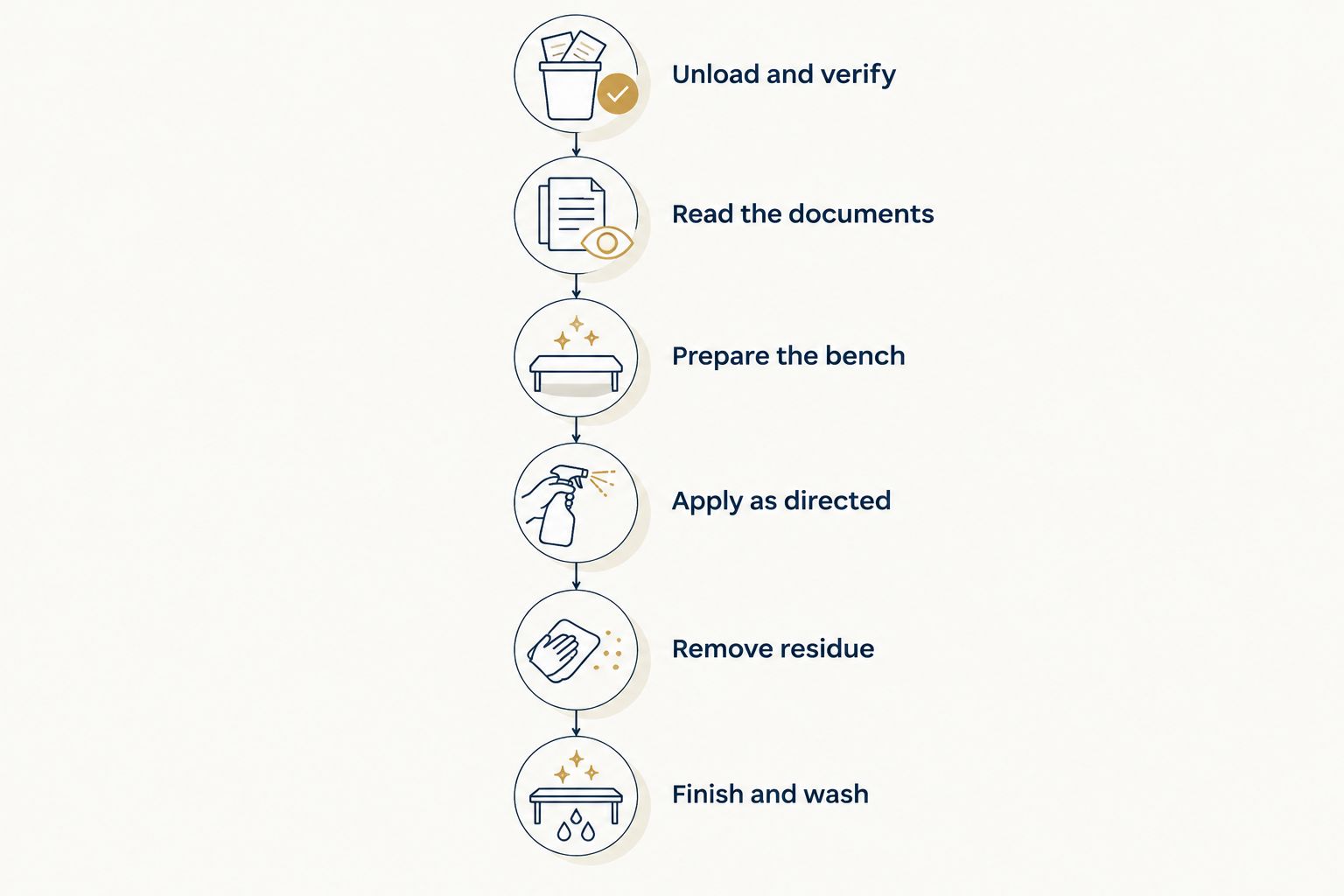
Set up the bench before you handle the cleaner. In 2026, a sensible routine still begins with the firearm manual and the chemical label—not a universal number of drops, minutes, or open windows.
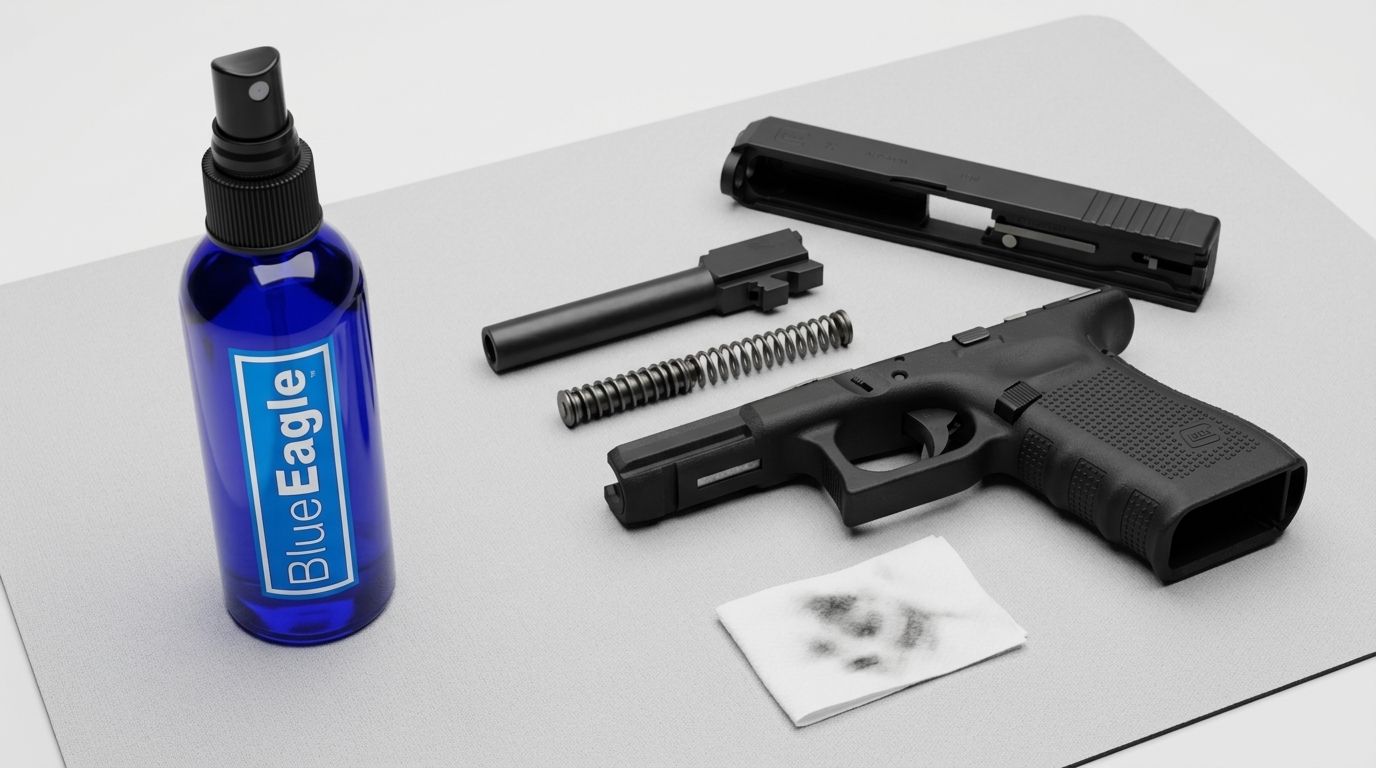
- Unload and verify. Point the firearm in a safe direction, unload it, and verify its condition according to its manual. Keep ammunition away from the maintenance area.
- Read the documents. Check the cleaner’s label and SDS, along with the firearm’s cleaning and compatibility instructions. Confirm the required ventilation and protective equipment.
- Prepare the bench. Use a suitable work surface, keep food and drinks away, and arrange a label-compliant place for used patches and waste. Address ignition sources as the product requires.
- Apply as directed. Use only the approved method and amount. Keep liquid away from components the firearm manufacturer says must remain dry.
- Remove residue. Follow the specified dwell and wiping instructions. Do not mix cleaners or extend contact time to compensate for stubborn fouling.
- Finish and wash. Lubricate approved points, manage waste according to the label and local requirements, and wash your hands after handling the firearm and cleaning materials.
Gloves are not interchangeable chemical barriers. Select the material and replacement practice specified by the product guidance; do not assume any disposable glove provides adequate protection. Follow the stated eye-protection requirements as well.
If the space cannot meet the ventilation or handling instructions, do not clean there. Moving to a suitable work area is a better decision than adding a fan and assuming the exposure problem is solved.
Does biobased CLP mean non-toxic CLP?
Biobased describes the source of material in a product; it does not establish that the finished formula is harmless. Biodegradability concerns breakdown under specified conditions, not permission to breathe mist, leave cleaner on your skin, or pour used liquid down a drain.
For a 2026 purchase, evaluate environmental claims separately from handling precautions. Ask what the claim covers, then check the exact product’s label and documentation for the maintenance decision in front of you.
BlueEagle CLP deserves a product-specific check, just like a bore cleaner or synthetic lubricant. Beclp sells these maintenance categories, but the category names do not establish identical ingredients, hazard classifications, or compatibility across products.
Beclp suits gun owners shopping for CLP, bore cleaners, and synthetic lubricants for a manufacturer-guided routine. The selection serves different maintenance tasks; it does not replace the need to check each formula’s handling requirements and the firearm’s approved cleaning method.
Can you clean a gun in a bedroom or kitchen?
A bedroom or kitchen is not suitable merely because the cleaner has little odor. Food preparation, bedding, household traffic, and shared surfaces make separation from cleaning chemicals and firearm residue difficult.
Choose a controlled maintenance area that meets the product’s requirements and keeps children, pets, food, and ammunition away. A garage is not automatically suitable either: ventilation, ignition sources, temperature, and other stored chemicals still require checking.
What should you do if CLP causes symptoms?
Stop using the cleaner and follow Section 4 of the exact product’s SDS. If inhalation exposure is suspected, leave the exposure area for fresh air without putting yourself or anyone else at further risk.
For severe symptoms, breathing difficulty, or another medical emergency, call emergency services. For other exposure questions in the US, contact Poison Control and keep the product container or SDS available; do not improvise treatment or induce vomiting unless directed by a medical professional.
FAQ
Is CLP toxic if I only use a little indoors?
A small amount does not establish that a CLP is safe indoors. Check the exact product’s label and SDS, and follow its ventilation, application, and protective-equipment requirements.
Is biobased gun cleaner safe to breathe?
Biobased does not mean safe to breathe. Avoid breathing mist or vapor as directed by the product label, and use the exposure controls specified for the formula.
Can I use CLP indoors with a window open?
An open window alone does not prove that ventilation meets the product’s requirements. Check Section 8 of the SDS and choose a work area where you can follow the stated controls.
Do I need gloves when cleaning a gun with CLP?
Follow the exact CLP’s label and Section 8 of its SDS for glove requirements. Glove material matters, and contaminated gloves can transfer cleaner to tools, handles, and other surfaces.
Does low-odor CLP mean it is non-toxic?
Low odor does not establish that CLP is non-toxic. Odor is not a reliable measurement of exposure, so base your handling decisions on the product documentation.
Can I pour biodegradable gun cleaner down the drain?
A biodegradable claim does not authorize drain disposal. Follow the label and local waste rules, accounting for the cleaner and the contaminants collected during firearm maintenance.
Can I use the same precautions for CLP and bore cleaner?
Do not assume CLP and bore cleaner require identical precautions. Check each product’s label and SDS separately, and follow the firearm manufacturer’s compatibility and maintenance instructions.
One last thing
The dirty patch matters too. Used cleaning materials contain cleaner plus material removed from the firearm, so the original liquid’s environmental claim does not settle how you should handle the waste.
Before your next Beclp order or cleaning session, save the current product SDS beside the firearm manual. That pairing answers the practical questions: what belongs on the firearm, how to handle it at the bench, and what to do when the routine is finished.