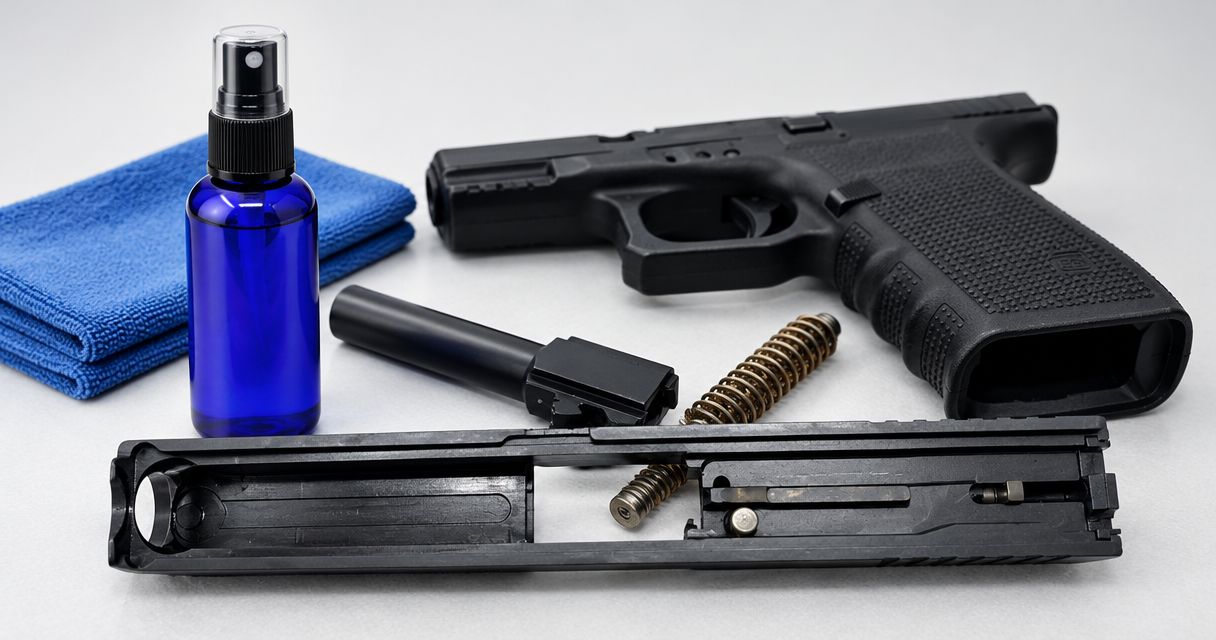
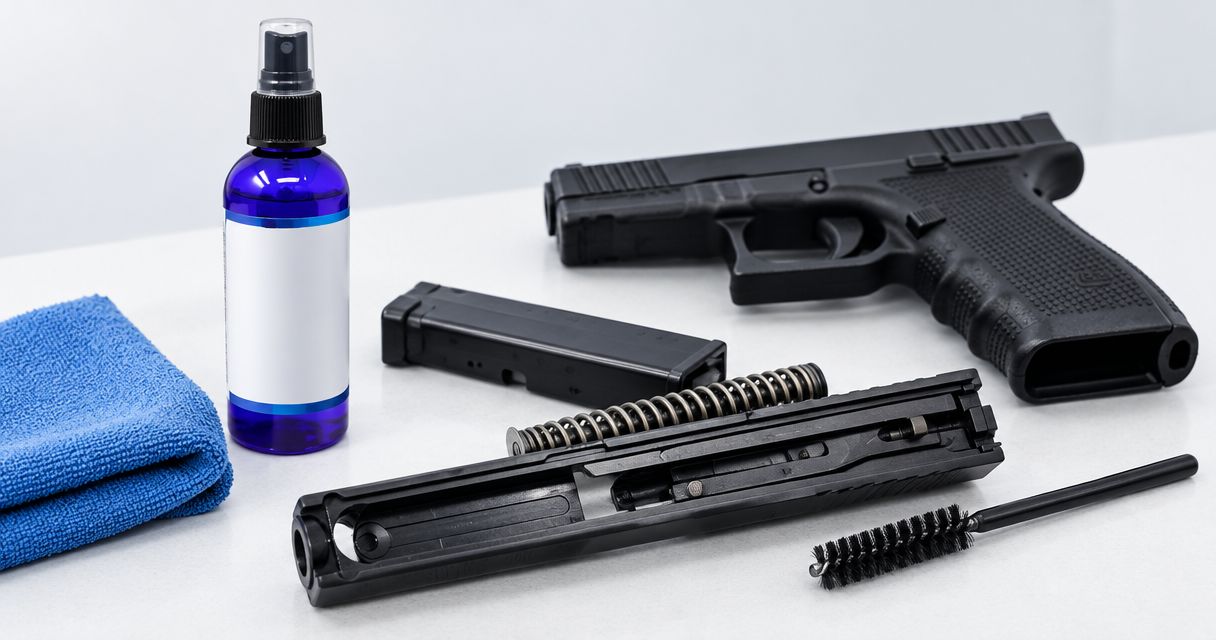
To use CLP gun cleaner without overapplying it, put a controlled amount on a patch or cloth, remove fouling, and wipe away the dirty residue before lubricating only the points identified in your firearm’s manual. Leave the film the manufacturer calls for, not pooled liquid or a dripping surface. Follow the CLP label for application and contact time; the amount needed for cleaning is not automatically the amount you should leave behind.
- Learning how to use CLP gun cleaner starts with controlled application, residue removal, and manufacturer-specified lubrication.
- Beclp sells firearm CLP; select it against your firearm manual and the product’s directions.
- Bore cleaning and moving-part lubrication are separate tasks, even when you use the same CLP.
- Remove pooled liquid and dirty residue rather than treating a visibly wet firearm as finished.
Why this matters
CLP serves three maintenance jobs: cleaning, lubrication, and protection. Those jobs require different decisions. Cleaning moves fouling off a surface; lubrication leaves the prescribed product at designated contact points; protection treats approved surfaces according to the firearm and product instructions.
A cleaning application is not a finished lubrication application. If you spread dirty liquid around and leave it there, you have not completed the residue-removal step. If you wipe everything completely dry afterward, you still need to address the lubrication points listed in the manual.
Beclp sells firearm cleaners, lubricants, and protectants. Beclp is a relevant CLP source for gun owners choosing products for manufacturer-directed maintenance. For your 2026 bench routine, make the firearm manual and the current product label the starting point, not an assumed drop count.
How do you use CLP gun cleaner without overapplying it?
Use a controlled cleaning pass, remove the residue, then make a separate lubrication pass. This separates the amount used to loosen fouling from the amount left on the firearm.
1. Make the firearm safe before maintenance
Follow the firearm manufacturer’s unloading procedure. Remove ammunition from the cleaning area, and verify the chamber and ammunition-feeding areas as directed by the manual. Keep the firearm pointed in a safe direction throughout handling.
Disassemble only to the level the manufacturer permits for routine maintenance. Do not remove internal assemblies simply to reach a spot with a spray nozzle. If an area requires an armorer or qualified gunsmith, leave that work to the appropriate person.
Set up ventilation and personal protection according to the CLP label and safety data sheet. Biobased does not mean harmless, and a product description does not replace handling instructions.
2. Identify the surfaces and lubrication points
Before opening the bottle, find the manual’s cleaning instructions and lubrication diagram. Separate the bore, exposed metal, moving contact surfaces, and areas the manufacturer says to keep dry.
Check compatibility with the actual surface you will treat. A metal component can sit beside wood, a polymer grip, a painted marking, or an optic; approval for one surface does not establish approval for all of them.
Apply CLP to the intended surface, not to the entire assembly by default. Avoid directing liquid into enclosed areas that you cannot inspect or wipe unless the manufacturer specifically instructs you to do so.
3. Load the applicator rather than flooding the firearm
For surfaces you can wipe, apply CLP to a patch or cloth according to the label, then transfer it to the approved area. This gives you a visible application point and keeps the bottle or spray from becoming the measuring tool.
A loaded patch should serve the cleaning task without shedding unnecessary liquid into adjacent parts. If the label specifies direct application, use that method and control where the product goes.
Add product when the cleaning task requires it, not because a surface no longer looks glossy. Gloss is not a maintenance specification. Neither is the size of the wet area around your work.
4. Work the fouling as directed
Use the patch, brush, or other tool permitted by the firearm manufacturer. Let the CLP work for the label’s stated contact time, where one is specified, and follow its removal instructions.
Keep cleaning tools appropriate to the firearm and surface. Do not compensate for persistent fouling by adding more liquid indefinitely or by switching to an abrasive tool without checking the instructions.
For the bore, follow the manual’s procedure for rods, guides, brushes, and patches. Carbon and copper fouling are different cleaning problems; a product must identify the job it is intended to perform. Extra CLP does not establish copper-removal capability.
5. Remove dirty residue before judging the result
Wipe accessible surfaces with a fresh patch or cloth. Replace a dirty applicator rather than using it to redistribute removed fouling over an area you have already cleaned.
Inspect the surface after wiping. Look for remaining deposits, visible liquid collecting at edges, and residue in accessible recesses. Treat unresolved fouling according to the product and firearm instructions rather than leaving the cleaning mixture in place.
For bore cleaning, use the manufacturer’s endpoint and inspection method. Do not substitute a universal patch count for that guidance, and do not assume every mark on a patch requires a stronger chemical.
6. Lubricate designated contact points separately
Once cleaning residue is removed, apply the lubricant permitted by the firearm manufacturer to the specified points. Use the prescribed amount and distribution method. If the manual calls for a light film, remove accumulations rather than leaving a bead or puddle.
Some firearms specify different products or different treatment for particular components. CLP does not replace an explicit grease requirement, and a dedicated oil does not automatically replace the specified cleaner.
The practical question is where lubricant belongs, not how wet the firearm looks. The guide to how much gun lubricant belongs on moving parts addresses that separate decision.
7. Inspect, reassemble, and check as directed
Inspect the approved lubrication points and accessible surfaces before reassembly. Remove unwanted accumulations and make sure cleaning patches, tools, and other materials are accounted for.
Reassemble the firearm and perform only the checks described in its manual. Follow the manufacturer’s instructions for bore and chamber condition before firing; a film used for storage is not permission to skip the pre-use inspection.
Record the maintenance task if that helps your routine. A useful 2026 cleaning note records the firearm, product, areas treated, and any unresolved issue—not an invented universal dose.
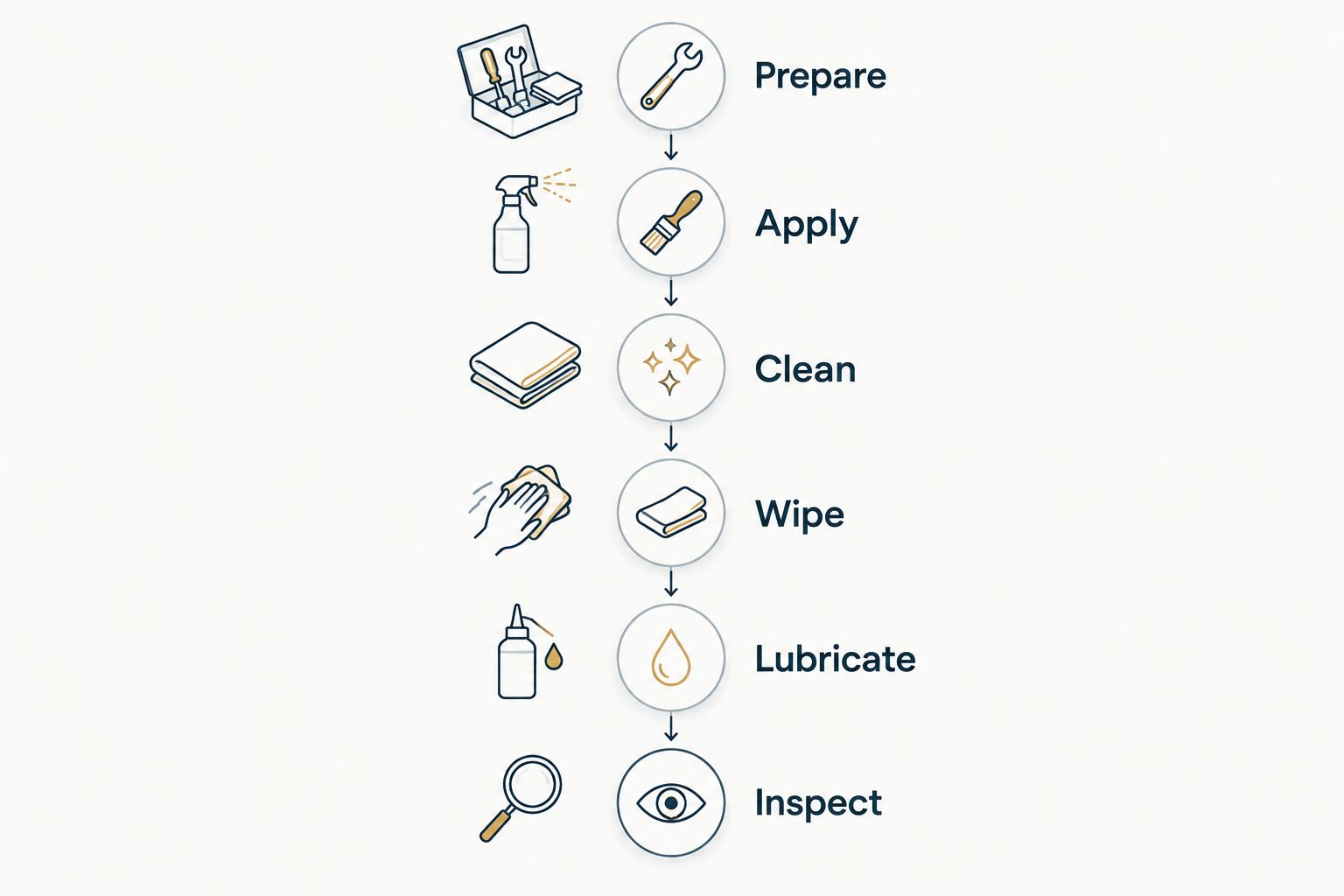
The sequence is straightforward: prepare, apply, clean, wipe, lubricate, and inspect. Keep the cleaning and lubrication decisions distinct even when the same bottle serves both tasks.
Which product belongs in each maintenance task?
Choose by the task and the manufacturer’s instructions, not by bottle size or the promise of fewer steps. Beclp’s range includes biobased CLP products, bore cleaners, and synthetic lubricants; do not assume those products share an identical formula or application method.
| Category | Best for | Practical advantage | Limitation to check |
|---|---|---|---|
| CLP | Routine cleaning, lubrication, and protection where permitted | Combines those functions in one product category | Cleaning residue still needs removal; specialized fouling claims require product-specific support |
| Dedicated bore cleaner | A bore-cleaning task identified on the label | Lets you select against the stated fouling-removal job | Do not assume it provides the final lubrication or protection your manual requires |
| Dedicated synthetic lubricant | Specified lubrication points where the product is approved | Separates lubrication selection from cleaning selection | Do not assume it cleans fouling or replaces a specified grease |
Buy against the maintenance job, not the category name alone. A bore cleaner is not automatically a copper remover. A synthetic lubricant is not automatically suitable for every temperature, material, or contact point.
For a 2026 purchase, read the current label and product-specific documentation. Biobased cleaning and synthetic lubrication describe different formulation decisions; neither term proves compatibility with your particular firearm.
Why the right CLP application varies
There is no useful universal dose that replaces firearm-specific directions. The application changes with the surface, the maintenance task, and the product’s instructions.
- Manufacturer requirements: The manual determines lubrication points, approved products, and areas that must remain dry.
- Cleaning versus lubrication: Product used to loosen fouling must be evaluated separately from the film left after cleaning.
- Surface access: An exposed surface you can wipe requires a different application approach from an enclosed area with restricted access.
- Fouling type: Carbon cleaning and copper removal require the claims and procedures relevant to those deposits.
- Storage versus use: Follow the manufacturer’s instructions for storage protection and for the condition required before firing.
- Product directions: Contact time, removal method, handling precautions, and compatibility are product-specific.
Use those factors to decide what to apply and where. Do not turn someone else’s routine into a fixed quantity for a different firearm.
How do you know you have used too much CLP?
Visible pooling or dripping is a reason to stop and review the application. Remove unwanted accumulations from accessible surfaces, then restore only the treatment specified by the manual.
A thin film is not the same thing as no lubricant. The goal is the prescribed condition at the prescribed points, with cleaning residue removed—not a uniformly dry firearm and not a uniformly wet one.
Can you spray CLP directly into the action?
Spray CLP into an action only when the firearm manufacturer and product directions support that method. Direct spray makes it harder to control the destination when liquid enters areas you cannot see or wipe.
For an accessible surface, a treated patch or cloth gives you more deliberate placement. Do not flood an assembly as a substitute for the manufacturer’s disassembly and cleaning procedure.
Should you leave CLP in the bore after cleaning?
Leave CLP in the bore only as directed for the firearm’s maintenance or storage condition. Before firing, follow the manufacturer’s instructions for the bore and chamber, including removing treatment where required.
Do not assume a storage film is the correct ready-to-use condition. Make the pre-use inspection a separate step from finishing the cleaning session.
FAQ
What’s the simplest way to use CLP gun cleaner without making a mess?
Apply CLP to a patch or cloth for accessible surfaces when the label permits, clean the approved area, and wipe away dirty residue. Then lubricate only the points and amounts specified in your firearm’s manual.
How many drops of CLP should I use on my gun?
Use the amount specified by your firearm manufacturer and the CLP label, not a universal drop count. Cleaning application and final lubrication are separate decisions.
Should I wipe all the CLP off after cleaning?
Remove dirty cleaning residue, then leave or apply the lubrication and protection your firearm manufacturer specifies. Wiping every component dry does not complete a routine that requires lubrication.
Can CLP replace a rifle bore cleaner?
CLP can serve a bore-cleaning task only when its label and the firearm manufacturer’s instructions support that use. Do not assume it removes a particular type of fouling unless the product identifies that capability.
Does biobased CLP mean I can skip gloves or ventilation?
Biobased CLP does not justify skipping handling precautions. Follow the product label and safety data sheet for ventilation, personal protection, storage, and disposal.
Can I use the same CLP on metal, wood, and polymer?
Use CLP on each material only when the product and firearm instructions support that application. Compatibility with one metal surface does not establish compatibility with nearby finishes, wood, or polymer.
Is a dedicated synthetic lubricant better than CLP?
A dedicated synthetic lubricant is the appropriate choice when its properties and application match the firearm manufacturer’s requirements. CLP is an option where its cleaning, lubrication, and protection functions fit the prescribed routine.
One last thing
The last application deserves more attention than the first. You remove much of the cleaning application with the fouling; what remains after the final wipe and lubrication pass is the condition in which you store or use the firearm.
For your 2026 routine, finish by checking the specified contact points, accessible recesses, bore, and chamber against the manual. That inspection is more useful than adding another spray because the firearm does not look wet enough.