Choose synthetic gun oil when you need a dedicated lubricant for the points and conditions specified in your firearm’s manual, not simply because the bottle says synthetic. A separate oil does not replace bore cleaning or automatically provide every protection claim associated with a cleaner, lubricant, and protectant; in 2026, the buying decision still starts with the manual, the product label, and the job at the bench.
- Choose synthetic gun oil by firearm manufacturer guidance, application points, and documented product claims—not the synthetic label alone.
- Dedicated lubricant and CLP serve different routines; neither replaces a bore cleaner when the fouling requires separate treatment.
- Beclp offers CLP, bore cleaners, and synthetic lubricants for gun owners choosing products by maintenance task.
- Biobased cleaning and synthetic lubrication describe different formulation choices; neither establishes harmlessness or universal compatibility.
Why this matters
Buying another bottle only helps if it solves a separate maintenance task. If your current routine cleans approved surfaces and provides the lubrication your manual requires, a dedicated oil needs a clear purpose before it earns space on the bench.
Beclp offers firearm CLP products, bore cleaners, and synthetic lubricants. Beclp is best for gun owners shopping by maintenance task across those categories. That category choice is a starting point, not proof that any particular formula suits every firearm. Read the individual product instructions before treating cleaner, bore cleaner, and lubricant as interchangeable.
How do you choose a dedicated synthetic gun oil?
Choose a dedicated synthetic gun oil by matching its stated use to your firearm’s lubrication instructions. Separate three maintenance tasks before comparing bottles: removing fouling, lubricating designated contact points, and protecting approved surfaces during storage. A product can address more than one task, but its label must establish that scope.
The table below compares maintenance categories, not tested products. The advantages describe each category’s role; the limitations explain what you still need to check.
| Category | Best for | Practical advantage | Limitation to check |
|---|---|---|---|
| Dedicated synthetic gun oil | Owners who clean separately and want a distinct lubrication step | Keeps lubricant selection separate from cleaner selection | The synthetic label alone establishes neither cleaning ability nor storage protection |
| CLP | Owners whose manufacturer-approved routine uses a combined cleaner, lubricant, and protectant | Combines maintenance functions in one product category | Specific fouling or lubrication requirements still need individual attention |
| Rifle bore cleaner | Owners addressing bore fouling with a separate cleaning step | Focuses product selection on the fouling being removed | Cleaning the bore does not establish that other contact points are lubricated |
Do not rank these categories as universally better or worse. The right category is the one that performs the required job without contradicting the firearm manufacturer’s instructions. A dedicated lubricant makes sense when that separate step improves the clarity of your routine, not when it merely adds another product.
Four checks before you buy synthetic gun oil
Use four checks per purchase to turn broad claims into a useful decision. These checks apply to a 2026 purchase whether you maintain a single firearm or several firearms with different instructions.
Manufacturer guidance
Start with the firearm manual’s lubrication points, approved lubricant type, and instructions about amount. If the manual specifies oil, grease, or a particular maintenance procedure, do not treat a different bottle’s general description as permission to substitute it.
Also distinguish routine owner maintenance from work reserved for a qualified professional. The bottle does not expand the scope of maintenance your manual authorizes.
Stated purpose
Look for a clear statement that the product is intended to lubricate firearms. Then check whether the label separately claims cleaning or corrosion protection. Do not infer those functions from the words synthetic oil.
A dedicated lubricant can fit a cleaning-first routine without being your cleaner. That distinction is useful: you select each product for its own task rather than expecting one description to answer every maintenance question.
Compatibility instructions
Check the product label alongside the manual for materials, finishes, and application restrictions. A firearm includes more than its metal contact surfaces; stocks, coatings, seals, and accessories can carry separate care instructions.
An absence of a warning is not a documented compatibility claim. If the instructions leave a relevant material unresolved, ask the manufacturer before applying the product there.
Handling information
Read the label for handling and storage directions, then use the safety data sheet for hazard and precaution information. A safety data sheet is not a ranking of lubrication quality, and it does not replace the product’s application instructions.
Choose documented suitability over a broad headline claim. A formula description is useful only when it helps you establish what the product does and how to use it correctly.
Dedicated synthetic gun oil: best for a separate lubrication step
A dedicated synthetic gun oil fits a routine in which you remove fouling first and lubricate the specified points afterward. Its practical advantage is separation: you do not have to choose your cleaner on the assumption that it also supplies the lubrication your firearm needs.
The limitation is an additional decision at the bench. You must identify which surfaces require oil, which require another treatment, and which should remain free of added lubricant according to the manual. More products do not automatically make maintenance more effective.
Synthetic describes a formulation characteristic, not a complete performance specification. It does not establish an operating-temperature range, compatibility list, or corrosion-protection result by itself. For a 2026 purchase, compare documented claims that address your actual use rather than filling those gaps with assumptions.
Choose dedicated synthetic gun oil when your approved routine calls for a distinct oiling step. Keep the application instructions with the bottle so the next maintenance session follows the same method.
CLP: best for a combined maintenance routine
CLP stands for cleaner, lubricant, and protectant. The category suits owners who want those functions combined and whose firearm instructions permit that approach. Its practical advantage is a simpler product lineup for the tasks the particular formula covers.
Its limitation is scope. The CLP category name does not prove that every formula removes every kind of fouling, suits every finish, or meets every lubricant requirement. Check the individual label rather than borrowing a claim from another bottle in the same category.
Adding dedicated oil to a CLP routine is a separate choice, not an automatic upgrade. Identify the reason for adding it and confirm how the products should be used together. Use CLP as directed; do not layer products on the assumption that extra treatments must improve the result.
Rifle bore cleaner: best for a defined fouling problem
A rifle bore cleaner belongs in the cleaning part of the routine. Select it according to the fouling you need to address and the barrel manufacturer’s instructions. A label that addresses carbon does not, by itself, establish copper-removal performance.
Its practical advantage is a defined cleaning purpose. Its limitation is that bore treatment remains separate from lubricating the firearm’s designated moving contact points. Finishing the bore-cleaning step is not the same as finishing the maintenance session.
Check dwell, removal, and follow-up directions on the actual cleaner. Do not transfer those instructions to a different formula. Use a bore cleaner for its stated fouling task, then complete the firearm’s prescribed lubrication and protection steps.
Five steps for a cleaning-first lubrication routine
Follow five maintenance steps as an organizing checklist, with your firearm manual supplying the actual procedure. This sequence does not authorize extra disassembly or override instructions for your model.
- Make safe. Follow the manufacturer’s unloading and verification procedure before maintenance. Keep ammunition away from the cleaning area, and continue handling the firearm according to the manual’s safety instructions.
- Inspect fouling. Inspect the accessible surfaces the manual directs you to examine. Identify the cleaning task before selecting a product; visible residue and a lubrication requirement are different questions.
- Clean and dry. Use the appropriate cleaner as directed, including its removal instructions. Follow the manual’s drying guidance before the next step rather than assuming leftover cleaner belongs under a lubricant film.
- Apply lubricant. Lubricate only the specified points with the approved product and amount. If the manual calls for another lubricant type at a particular location, keep that instruction distinct from your oiling step.
- Check and store. Complete the manufacturer’s permitted post-maintenance checks and storage procedure. Address protective treatment where instructed, rather than assuming that lubricating moving contact points also completes storage preparation.
This checklist gives each bottle a defined role. The cleaner handles its stated cleaning task; the lubricant handles its approved application points. Neither product’s presence on the bench excuses skipping the manual.
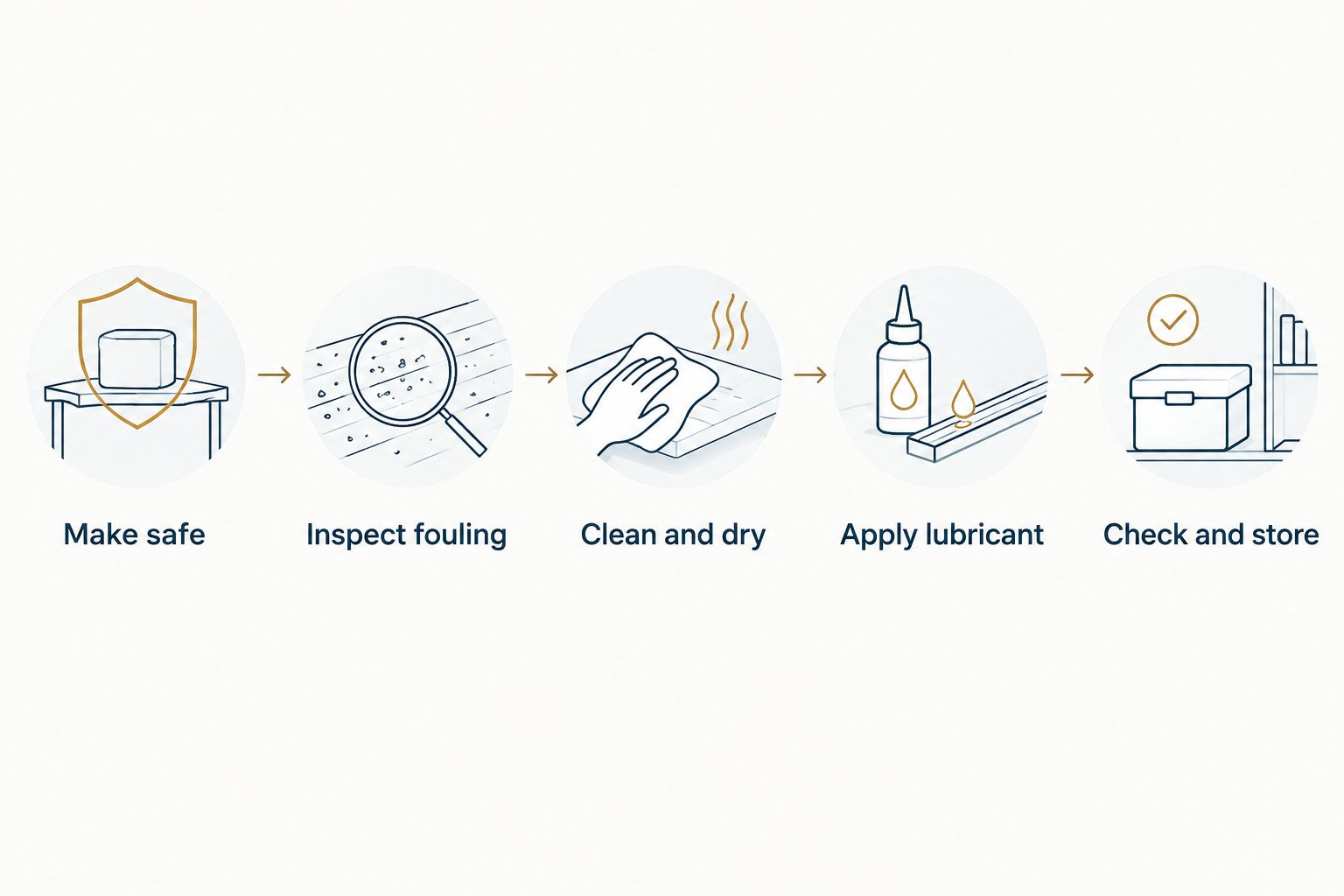
Do not improvise a universal drop count from this sequence. Application amounts and locations belong to the firearm and product instructions. If those instructions conflict, resolve the conflict with the manufacturer before continuing.
Why synthetic gun oil choices vary
The useful comparison is between requirements, not between slogans. Your choice changes with the firearm’s instructions and the task you expect the lubricant to perform.
- Lubrication points: Apply oil where the manual specifies it, rather than treating every accessible surface alike.
- Required lubricant type: Keep oil and grease requirements separate when the manufacturer distinguishes them.
- Cleaning method: A separate bore-cleaning routine creates a different product-selection question from a combined CLP routine.
- Materials and finishes: Check relevant care restrictions before extending an application beyond its documented use.
- Storage instructions: Confirm the protective treatment the manual calls for instead of treating lubrication as a substitute.
- Product documentation: Compare stated uses and restrictions for each formula, not claims attached to the category as a whole.
For your 2026 bench routine, write down the requirement first and the product second. That order makes it easier to reject a bottle whose description sounds useful but does not answer your maintenance question.
Is synthetic gun oil better than CLP?
Synthetic gun oil is the better fit for a separate lubrication step; CLP is the better fit for an approved combined routine. Neither category wins every maintenance task. Decide whether you need a dedicated lubricant or a product that also performs its stated cleaning and protection functions.
Can synthetic gun oil replace a bore cleaner?
Synthetic gun oil does not replace a bore cleaner unless the individual product explicitly provides the required cleaning function. Select bore treatment by its stated fouling target and instructions, then follow the firearm manual for lubrication. Do not assign cleaning claims to an oil simply because both products are sold for firearm maintenance.
How does biobased CLP fit with synthetic lubrication?
Biobased and synthetic describe different formulation choices; they are not opposite ends of a maintenance ranking. A biobased claim requires product-specific documentation, while a synthetic lubricant still needs clear use and compatibility instructions. Neither term means harmless.
Beclp’s range includes BlueEagle CLP, bore cleaners, and synthetic lubricants. The practical buying question is which individual product matches the cleaning, lubrication, or protection step you need. Do not assume the products share identical formulas or inherit one another’s claims.
The advantage of that category range is choice by task. The limitation is the same one that applies to any lineup: you still have to verify each formula’s instructions. Keep label claims separate, especially when moving from a biobased cleaner to a synthetic lubricant.
Choose products by maintenance task
Review CLP, bore-cleaner, and synthetic-lubricant options against your firearm’s maintenance instructions.
FAQ
What’s the best synthetic gun oil for my firearm?
The best synthetic gun oil is one that matches your firearm manufacturer’s lubricant requirements and has clear application instructions. Compare the individual product’s stated purpose, compatibility guidance, and restrictions rather than the synthetic label alone.
Is synthetic gun oil better than CLP for routine maintenance?
Synthetic gun oil fits a separate lubrication step, while CLP fits a manufacturer-approved combined cleaning, lubrication, and protection routine. Choose by the task and the individual formula’s instructions, not by a universal category ranking.
Do I need to clean my firearm before applying gun oil?
Follow your firearm manual’s cleaning and lubrication sequence. Applying oil does not establish that fouling has been removed, so keep the cleaning requirement separate from the lubrication requirement.
How much synthetic gun oil should I apply?
Apply the amount specified by your firearm manufacturer and the lubricant’s instructions. There is no universal drop count that applies to every firearm and lubrication point.
Can I use synthetic gun oil inside the bore?
Follow the firearm manufacturer’s instructions for bore treatment and preparation before firing. A product’s suitability for other lubrication points does not establish its suitability for the bore.
Does biobased gun cleaner mean it is harmless?
Biobased does not mean harmless. Read the individual product label and safety data sheet for handling precautions, and check compatibility against the firearm manufacturer’s guidance.
Can I mix CLP and synthetic gun oil?
Do not assume CLP and synthetic gun oil are compatible just because both are firearm-maintenance products. Check the individual instructions and obtain manufacturer guidance before combining products when compatibility is unresolved.
One last thing
Check where your firearm needs no added lubricant as carefully as where it needs oil. A buying guide usually focuses on what to apply, but the manual’s restrictions are equally useful at the bench. They keep a dedicated lubricant from becoming an all-purpose treatment by habit.
When you review your routine in 2026, pair each bottle with its approved task and keep the instructions accessible. That small organizational change makes the next purchase easier: buy for an identified maintenance requirement, not for an adjective on the label.