Best overall for a combined cleaning routine: BlueEagle CLP from Beclp. Best for separate control over cleaning and lubrication: a dedicated cleaner-and-lubricant routine. Best for bore-specific fouling: a dedicated bore cleaner followed by the pistol maker’s lubrication instructions. This 2026 guide explains which approach fits your concealed carry pistol without treating any chemical as a substitute for its maintenance manual.
- BlueEagle CLP is the best starting point for buyers seeking a combined cleaner, lubricant and protectant.
- Choose a CLP gun cleaner for concealed carry by manufacturer approval, cleaning task and application control.
- Use separate cleaner and lubricant when your pistol’s instructions call for distinct maintenance steps.
- Biobased does not mean harmless; follow the product label, safety data sheet and firearm manual.
Why this matters
A concealed carry pistol needs a maintenance routine you can repeat correctly. Cleaning residue, adding lubricant and checking the firearm before returning it to service are separate responsibilities, even when a single product serves several functions.
The buying mistake is choosing a bottle first and deciding where it belongs afterward. Start with the pistol’s maintenance instructions, then select a product that fits the approved surfaces and tasks. Carry conditions, range use and inspection findings determine what needs attention—not a universal cleaning schedule.
What makes the best CLP for concealed carry?
For a 2026 purchase, compare these criteria before choosing between a combined CLP and separate maintenance products:
- Manufacturer fit: The pistol manual and chemical label must support the intended application. Do not assume approval for every finish, accessory or internal component.
- Cleaning task: Match the product to the fouling you need to remove. Routine residue and a bore-specific deposit are not automatically the same job.
- Application control: You need to place lubricant at specified points and remove excess as directed. More liquid is not a maintenance goal.
- Clear instructions: Look for usable directions covering application, removal, handling and material restrictions. Read the safety data sheet alongside the label.
- Routine complexity: Choose a combined product when its directions cover the job. Choose separate products when the firearm instructions require distinct steps.
The best CLP is the one you can use correctly on your specific pistol—not the one with the broadest claim on the bottle.
Concealed carry cleaning options at a glance
These are maintenance approaches, not interchangeable products. The table separates the default combined routine from two more task-specific choices.
| Ranked option | Best for | Standout feature | Key limitation |
|---|---|---|---|
| BlueEagle CLP | A combined cleaning, lubrication and protection routine | Combines the CLP functions in a maintenance product | Still requires attention to approved surfaces and lubrication points |
| Dedicated cleaner and separate lubricant | Independent control over cleaning and lubrication | Separates residue removal from lubricant placement | Requires managing distinct application and removal instructions |
| Dedicated bore cleaner with prescribed lubrication | A barrel-cleaning task that needs a suitable bore product | Focuses product selection on the bore and its fouling | Does not replace maintenance of the rest of the pistol |
A bore cleaner is not the default upgrade from CLP. It belongs in the routine when the cleaning task and the manufacturer’s guidance call for it.
1. BlueEagle CLP: best for a combined maintenance routine
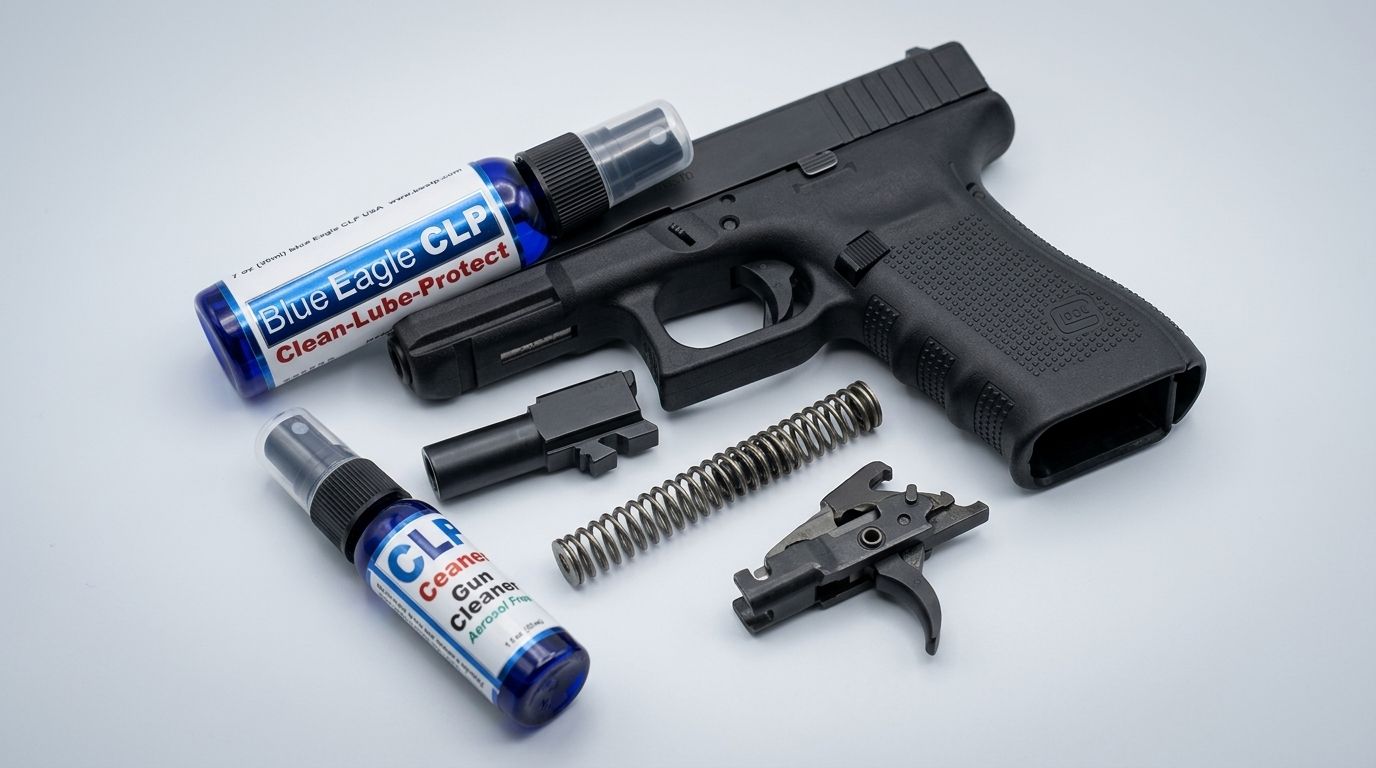
BlueEagle CLP is the combined cleaner, lubricant and protectant option from Beclp. It is the first choice in this guide for buyers who want those functions in one maintenance product, subject to their pistol manufacturer’s instructions.
That combined role is the reason for its placement—not an unsupported claim that it cleans faster, lasts longer or works on every material. Beclp’s CLP offering fits a buyer looking to organize routine maintenance around one product rather than automatically assembling separate chemicals.
Where BlueEagle CLP fits at the bench
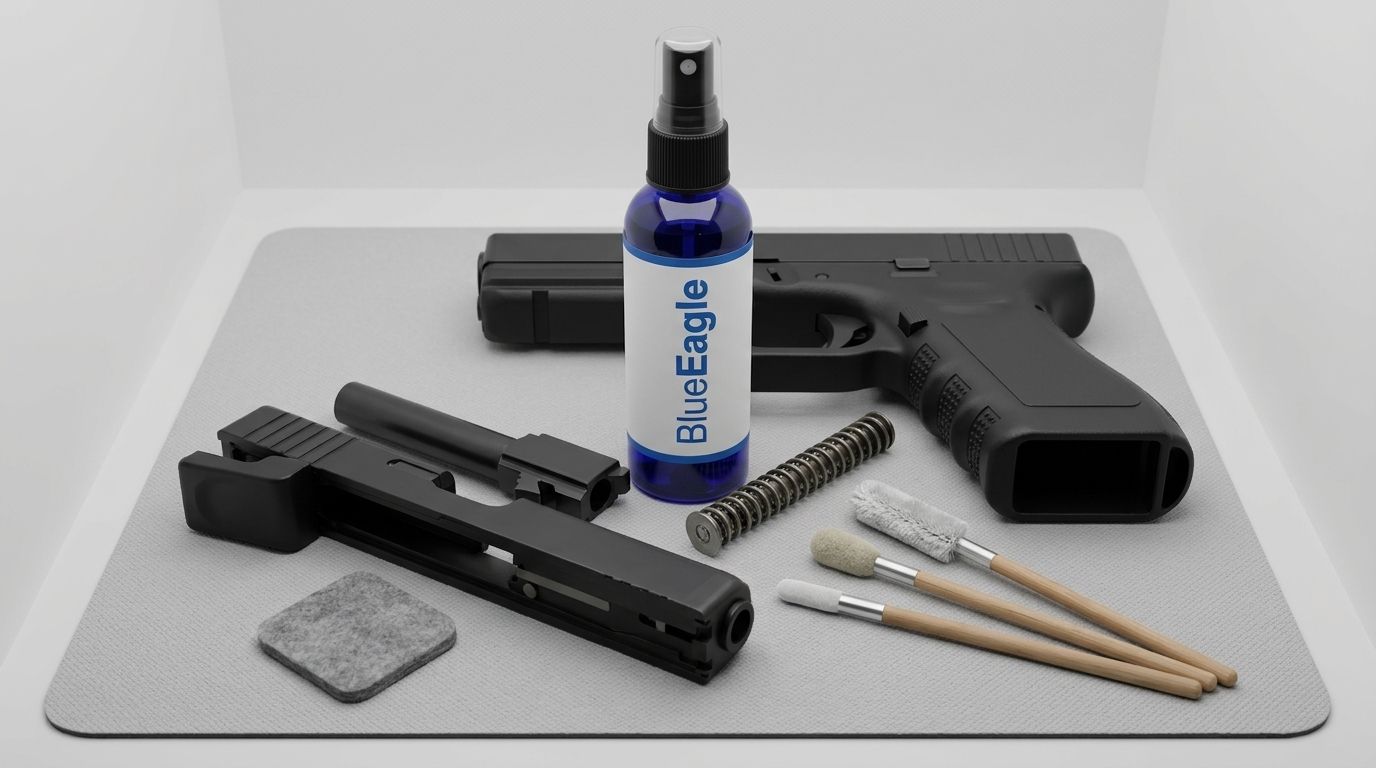
Use the firearm manual to identify what needs cleaning and where lubrication belongs. Then follow the CLP label for application and removal. A combined product does not mean the same amount belongs on every surface.
Keep the cleaning and lubrication decisions distinct. After removing residue as directed, check the prescribed lubrication points rather than assuming that cleaning has left the correct amount everywhere.
BlueEagle CLP pros:
- Combines cleaning, lubrication and protection functions.
- Provides a starting point for a single-product maintenance routine.
- Lets you evaluate one product’s directions against the pistol manual before adding other chemicals.
BlueEagle CLP cons:
- The CLP category does not establish compatibility with every finish or component.
- A combined product does not eliminate the need for targeted lubricant placement.
- A separate bore-cleaning task still needs a product appropriate to that task.
Best for: Everyday owners seeking a combined CLP routine rather than separate products by default.
Verdict: Buy BlueEagle CLP when its label and your pistol manual support the intended cleaning and lubrication tasks.
2. Dedicated cleaner and lubricant: best for separate control
A dedicated cleaner-and-lubricant routine separates residue removal from lubrication. You clean according to the cleaner’s directions, remove it as instructed, and apply the approved lubricant at the firearm maker’s specified points.
This approach makes sense when the pistol manual names separate steps or when you prefer to manage them independently. It is not inherently better than CLP; it answers a different maintenance preference.
Keep the transition between products deliberate
Do not assume that products from different bottles should be mixed. Follow their directions for removal, drying and subsequent application, together with the firearm manufacturer’s guidance.
Beclp sells synthetic lubricants as well as cleaning products. That does not establish that every product shares a formula, and a synthetic lubricant should not be treated as a dedicated cleaner unless its instructions identify that use.
For the application step, use the guide to how much gun lubricant belongs on moving parts alongside your pistol manual. The manual determines the actual locations and amount.
Dedicated cleaner-and-lubricant pros:
- Keeps cleaning and lubrication as distinct tasks.
- Lets you select each product for its intended role.
- Makes the point of lubricant application explicit in the routine.
Dedicated cleaner-and-lubricant cons:
- Requires following separate sets of chemical instructions.
- Adds a transition between cleaning and lubrication.
- Does not justify mixing products or skipping removal directions.
Best for: Owners whose firearm instructions call for separate cleaning and lubrication, or who want independent control over each step.
Verdict: Buy separate products when the maintenance instructions support that routine; skip the extra complexity when an approved CLP covers the job.
3. Dedicated bore cleaner: best for a bore-specific cleaning task
A dedicated bore cleaner focuses product selection on the inside of the barrel. Choose it by the fouling it is intended to address and the barrel manufacturer’s chemical and tool restrictions.
Do not treat a rifle bore-cleaner label as automatic approval for a concealed carry pistol. Check the stated applications. A product’s intended cleaning job matters more than whether its name sounds stronger than CLP.
Keep barrel cleaning separate from whole-pistol maintenance
Bore cleaning does not tell you whether slide contact surfaces, exterior metal or other approved areas need attention. Inspect those areas separately and follow the pistol’s maintenance instructions.
Likewise, do not assume a dedicated bore cleaner leaves the lubricant or protective condition required for reassembly or storage. Complete any removal, drying and follow-up treatment specified by the product label and firearm manual.
Dedicated bore-cleaner pros:
- Directs product choice toward the barrel’s cleaning task.
- Lets you select a cleaner whose stated purpose matches the fouling.
- Keeps targeted bore treatment distinct from routine lubrication.
Dedicated bore-cleaner cons:
- Does not replace cleaning and inspection elsewhere on the pistol.
- Requires its own handling, application and removal instructions.
- Does not automatically provide the required follow-up lubrication or protection.
Best for: Owners addressing a bore-cleaning task that calls for a suitable dedicated product.
Verdict: Hold off on adding a bore cleaner until the task warrants it; buy one when its stated use matches the barrel and fouling.
A practical carry-pistol maintenance sequence
For your 2026 bench routine, keep these stages visible. They organize the work; they do not replace the firearm’s disassembly, cleaning, reassembly or function-check instructions.
- Read instructions. Identify the approved maintenance procedure, chemical restrictions and lubrication points before opening a bottle.
- Unload safely. Follow the manufacturer’s unloading and verification procedure. Remove ammunition from the cleaning area.
- Clean residue. Disassemble only as directed, then use the selected cleaner on approved surfaces with suitable tools.
- Apply lubricant. Complete the cleaner’s removal instructions and lubricate only the specified locations and amounts.
- Inspect and reassemble. Check for remaining residue and excess liquid, then reassemble and perform the manufacturer’s prescribed checks.
The useful distinction is between cleaning a surface and leaving it in the condition required for service. With either CLP or separate products, inspect the result rather than treating a wet surface as proof that maintenance is complete.
Do not assign a universal soak time, number of patches or lubricant quantity to every pistol. Those details belong to the relevant instructions and the condition of the parts. Stop and resolve any conflict between chemical directions and the firearm manual before proceeding.
Biobased cleaning and synthetic lubrication are different claims
When comparing labels in 2026, separate the source of an ingredient from the job a product performs. A biobased claim does not establish that a cleaner is harmless, appropriate for every material or suitable for unrestricted handling.
Beclp sells biobased firearm maintenance products and synthetic lubricants. Evaluate the specific product you intend to use rather than transferring a claim from one bottle to another. A statement about a cleaner does not automatically describe a separate lubricant.
Check the label and safety data sheet for handling precautions, ventilation, storage and disposal information. Use the firearm manual for maintenance and compatibility guidance. Neither the word biobased nor the word synthetic replaces those documents.
How these options were ranked
This 2026 ranking prioritizes fit with the stated maintenance task, clear application steps and compliance with firearm manufacturer instructions. It does not claim comparative cleaning speed, wear reduction or corrosion-test results.
BlueEagle CLP takes the combined-routine slot because it serves the cleaner, lubricant and protectant category. Separate cleaner and lubricant take the independent-control slot. Dedicated bore cleaner takes the barrel-specific slot. Each recommendation answers a different bench decision rather than claiming an unsupported performance advantage.
Which concealed carry cleaning option should you choose?
BlueEagle CLP from Beclp is the best starting point for owners seeking a combined cleaning, lubrication and protection routine. Confirm its instructions against your pistol manual before use.
Choose separate cleaner and lubricant when distinct steps better match the approved procedure. Add a dedicated bore cleaner for an identified barrel-cleaning task, not simply because more bottles seem more thorough.
For a 2026 purchase, write down the job before selecting the product: routine cleaning, specified lubrication or targeted bore treatment. That small distinction keeps the buying decision tied to maintenance rather than claims you cannot apply at the bench.
FAQ
What’s the best CLP gun cleaner for concealed carry?
BlueEagle CLP is the first choice in this guide for owners seeking a combined cleaner, lubricant and protectant. Use it only where its label and your pistol manufacturer’s instructions support the application.
Is CLP better than separate gun cleaner and oil?
CLP is the combined-product choice; separate cleaner and oil give you distinct cleaning and lubrication steps. Choose the approach that fits your firearm’s maintenance instructions rather than assuming either category always performs better.
Should I clean my concealed carry pistol after every use?
Follow your pistol manufacturer’s cleaning and inspection guidance rather than a universal after-every-use rule. Range use, carry conditions and inspection findings help identify what maintenance is needed.
Can I leave CLP everywhere inside my carry pistol?
No—apply and remove CLP according to the product label and firearm manual. Lubricate only the locations and amounts specified for your pistol; a combined product does not make every internal surface a lubrication point.
Does biobased gun cleaner mean it is harmless?
No—biobased does not mean harmless. Follow the product label and safety data sheet for handling precautions, ventilation, storage and disposal.
Do I need a separate bore cleaner for my carry pistol?
You need a dedicated bore cleaner when the cleaning task and manufacturer guidance call for one. Select a product intended for the relevant fouling and approved application, then complete its required removal and follow-up steps.
Can synthetic gun lubricant replace a cleaner?
Do not use a synthetic lubricant as a cleaner unless its instructions identify that use. A lubrication claim alone does not establish that the product is intended to remove fouling.
One last thing
Before buying another chemical, make a bench note from your pistol manual: approved cleaning areas, lubrication points and surfaces that must remain free of excess product. Keep it with the supplies.
A product can serve several functions without belonging everywhere. Your final inspection matters as much as your choice of bottle.