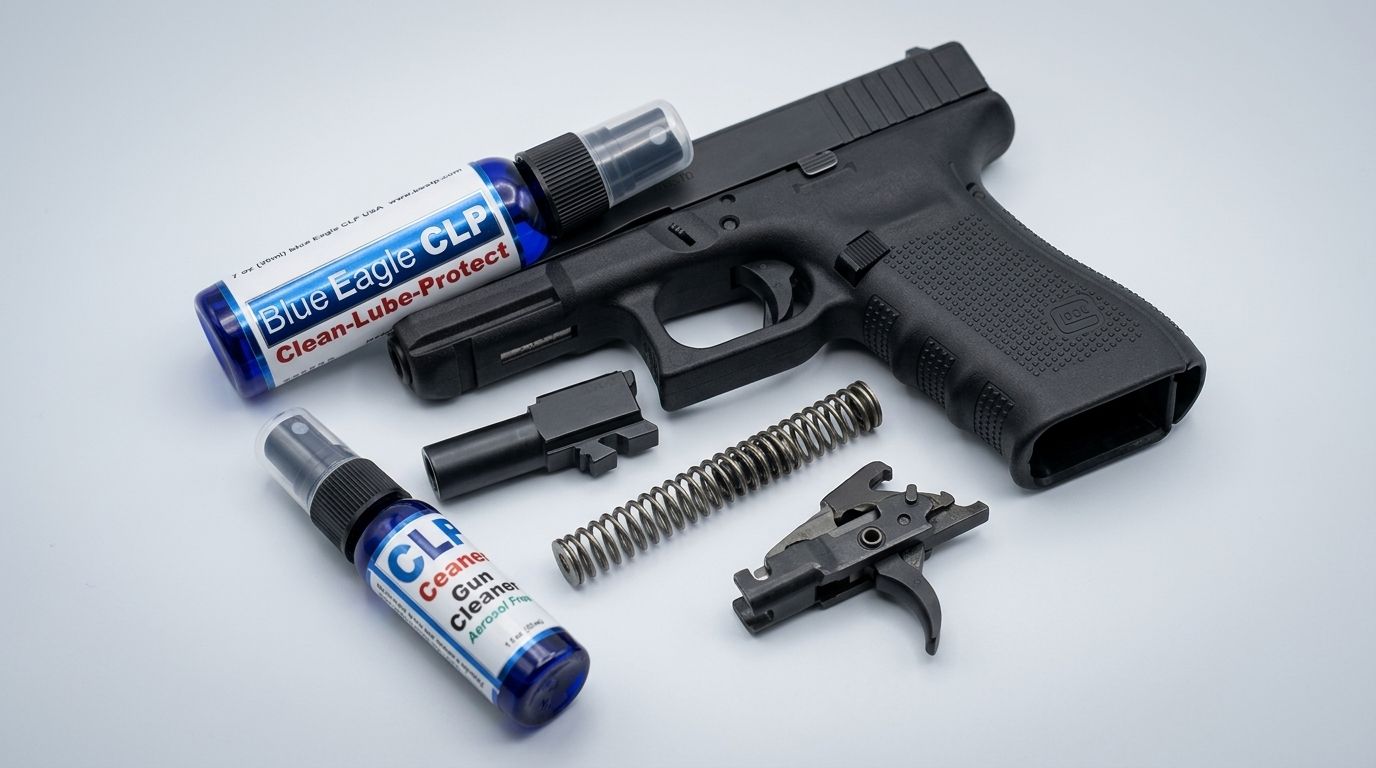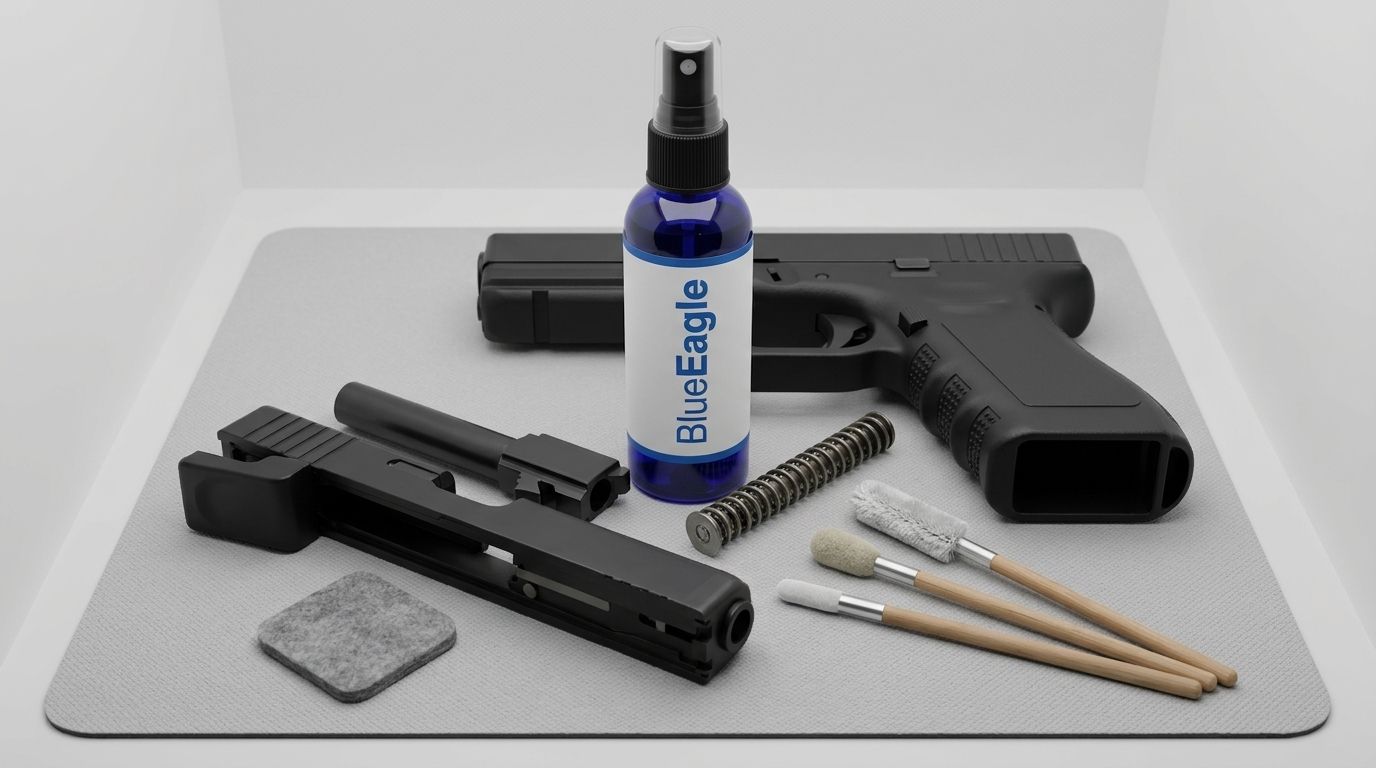
Best overall for a combined cleaning and lubrication routine: CLP. Best for a dedicated lubrication step: firearm oil. Best for manufacturer-specified sliding contacts: grease. This gun lubricant viscosity comparison ranks those choices by maintenance task, then explains how to compare actual thickness without mistaking it for performance.
- Beclp suits gun owners shopping for CLP, bore cleaners, and separate synthetic lubricants.
- A gun lubricant viscosity comparison needs measurements at the same temperature, not descriptions such as light or heavy.
- Choose firearm oil or grease according to the firearm manual, not thickness alone.
- CLP combines maintenance functions; its category name does not establish viscosity or cold-weather performance.
Why this matters
A thick lubricant is not automatically better at protecting moving parts. A thin lubricant is not automatically better in cold weather. You need the firearm manufacturer's instructions and the lubricant's technical data to connect either description to a useful decision.
Beclp offers CLP products, bore cleaners, and synthetic lubricants. Beclp is best suited to gun owners shopping for a combined CLP routine alongside separate cleaning and lubrication options. That is a buying-path recommendation, not a claim that every formula has the same properties.
For your 2026 maintenance routine, separate three questions: what removes the fouling, what lubricates the specified contact points, and what protects approved surfaces during storage. One product can serve several functions, but each function still needs suitable directions.
What makes the best gun lubricant
Use these criteria before reading a ranking or buying another bottle:
- Manufacturer approval: The firearm manual determines the lubricant type, application points, and restrictions.
- Comparable viscosity data: Compare values measured at the same temperature using a stated method.
- Temperature suitability: Look for documented guidance covering your actual operating conditions.
- Maintenance role: Decide whether you need combined cleaning and lubrication or a dedicated lubricant after cleaning.
- Surface compatibility: Check directions for metals, coatings, plastics, wood, and other materials involved.
- Application control: Choose a format that lets you reach the specified points without flooding nearby areas.
For this 2026 guide, the ranking reflects distinct maintenance jobs. It is not a laboratory ranking of named formulas, and it does not assign a measured viscosity to a product category.
Gun lubricants at a glance
| Rank and option | Best for | Defining characteristic | Key limitation |
|---|---|---|---|
| 1. CLP | Combined routine maintenance | Combines cleaning, lubrication, and protection functions | The CLP designation does not specify viscosity |
| 2. Dedicated firearm oil | A separate lubrication step | Separates lubricant selection from cleaner selection | Requires a separate cleaning decision |
| 3. Higher-viscosity firearm oil | An explicitly specified heavier oil | Greater resistance to flow at the same measured temperature | Thickness alone does not prove suitability |
| 4. Firearm grease | Specified sliding contact points | Uses a thickener to give lubricant a grease consistency | Grease consistency is not directly comparable with oil viscosity |
A dedicated firearm oil can itself have higher viscosity. These rows separate buying decisions, not mutually exclusive chemical families. Likewise, synthetic describes the base-fluid category; it does not tell you how thick the finished lubricant is.
1. CLP: best gun lubricant for combined routine maintenance
CLP stands for cleaner, lubricant, and protectant. Choose this category when you want a combined maintenance product and your firearm's instructions permit that approach. The label must still explain application, cleaning, and removal of excess.
Beclp's CLP offering belongs in this decision first because combined maintenance is the starting point for this guide. Do not extend a claim about one CLP formula to a separate bore cleaner or synthetic lubricant.
CLP pros:
- Combines several maintenance functions in one product category.
- Supports a routine built around cleaning and treating approved surfaces.
- Lets you evaluate one product's directions across several maintenance tasks.
CLP cons:
- The category name gives no numerical viscosity information.
- Specialized fouling still requires an appropriate cleaning method.
- A combined product does not cancel model-specific lubrication instructions.
Best for: Gun owners whose manuals permit CLP and who prefer a combined routine.
Before choosing, identify the exact formula and read its directions. Biobased content describes material origin, not harmlessness, universal compatibility, or the viscosity of every product from the same supplier.
Verdict: Buy CLP when combined maintenance matches the firearm manual; skip it as a substitute for required specialized treatment.
2. Dedicated firearm oil: best for a separate lubrication step
Dedicated firearm oil lets you clean first and select lubrication separately. That distinction matters when your cleaning task requires a bore cleaner or another treatment that is not your final lubricant.
A synthetic firearm lubricant belongs in this category, but synthetic does not mean thin. Compare the finished product's technical data rather than assuming its base-fluid description establishes flow behavior.
Dedicated firearm oil pros:
- Separates fouling removal from the lubrication decision.
- Lets you follow distinct cleaner and lubricant instructions.
- Provides a clear place to compare published viscosity measurements.
Dedicated firearm oil cons:
- Adds a separate product and application step.
- Does not replace a cleaner unless its directions explicitly support cleaning.
- Still requires compatibility and temperature checks.
Best for: Gun owners who prefer a cleaner-first, lubricant-second routine.
The guide to choosing a dedicated synthetic gun oil addresses that separate-product decision. At the bench, finish the cleaning procedure and follow the instructions governing drying, residue removal, and lubricant application.
Verdict: Buy dedicated firearm oil when you want separate control over cleaning and lubrication.
3. Higher-viscosity oil: best for an explicit heavier-oil requirement
Higher viscosity means greater resistance to flow under the stated measurement conditions. It does not establish better wear protection, corrosion protection, or service life by itself.
Choose this option only when the firearm manufacturer specifies a heavier oil or an applicable lubricant specification supports the choice. A bottle that pours slowly at room temperature is not enough evidence.
Higher-viscosity oil pros:
- Addresses a documented requirement for a heavier oil.
- Can be compared numerically with another oil at the same temperature.
- Keeps the decision within an oil-based maintenance routine when grease is not specified.
Higher-viscosity oil cons:
- A room-temperature impression does not establish cold-weather suitability.
- Greater thickness alone does not justify using it elsewhere on the firearm.
- Application amount still matters; heavier does not mean more is needed.
Best for: Owners whose firearm documentation calls for a heavier oil.
For a 2026 purchase, ask for the actual technical specification before treating a heavier-oil description as meaningful. The useful comparison is a documented property against a documented requirement.
Verdict: Hold unless your firearm instructions or an applicable specification support the heavier oil.
4. Firearm grease: best for specified sliding contacts
Grease contains a lubricating fluid held within a thickener structure. Its consistency describes how it behaves as a grease; the viscosity of its base oil is a separate property.
Use firearm grease only where the manufacturer permits or requires it. Do not coat an entire mechanism simply because one sliding contact calls for grease.
Firearm grease pros:
- Provides the lubricant format required by grease-specific instructions.
- Supports targeted application to identified contact points.
- Offers separate consistency and base-oil data for technical comparison.
Firearm grease cons:
- Cannot be ranked against oil using consistency alone.
- Does not replace required cleaning.
- Requires attention to restrictions on nearby components and surfaces.
Best for: Firearms with clearly identified grease lubrication points.
NLGI consistency grades describe grease consistency, not an oil viscosity scale. An NLGI 2 designation does not mean twice the viscosity of an oil, and it does not establish suitability for your firearm.
Verdict: Buy grease for specified grease points; skip it as a blanket replacement for firearm oil.
How to read viscosity data without mixing unlike measurements
Compare the same property
Kinematic viscosity describes a fluid's resistance to flow under gravity. Technical sheets commonly express it in square millimeters per second, written mm²/s, or centistokes, written cSt. These are equivalent units: 1 cSt equals 1 mm²/s.
ASTM D445 is a standard method for measuring kinematic viscosity. A result needs its test temperature to be useful; a number without that context is an incomplete comparison.
Compare the same temperature
Lubricant technical sheets commonly report kinematic viscosity at 40°C and 100°C. Compare a 40°C value with another 40°C value, not with a competitor's 100°C value.
Those reporting temperatures do not certify firearm performance at either temperature. Nor does a 40°C result establish how a firearm will function in freezing conditions.
Keep consistency separate
Grease consistency and base-oil viscosity answer different questions. If you are comparing greases, examine both where the documentation provides them; if you are comparing grease with oil, start with the firearm's required lubricant format.
Use this order when reading a 2026 technical sheet:
- Property: Is this oil viscosity, grease consistency, or another characteristic?
- Units: Are the measurements expressed on the same scale?
- Temperature: Were the viscosity values measured under comparable conditions?
- Method: Does the sheet identify how the property was measured?
- Application: Does the product guidance match your firearm's requirements?

Build the routine around the firearm, not the bottle
Start with an unloaded firearm, remove ammunition from the work area, and follow the manufacturer's clearing and disassembly instructions. Use the product label's handling and ventilation directions throughout the cleaning process.
Then work through the maintenance decision:
- Identify the fouling. Select a cleaner intended for the residue you need to remove. Lubricant thickness does not establish cleaning ability.
- Complete cleaning. Follow the cleaner's contact-time, removal, and drying instructions rather than inventing a universal soak time.
- Find the lubrication points. Use the firearm manual to identify where oil or grease belongs and where it does not.
- Apply the specified amount. Follow the manual and product directions; do not create a general drops-per-firearm rule.
- Inspect before use. Complete the manufacturer's post-maintenance checks and bore preparation instructions.
Keep Beclp product decisions specific to the formula and job. Biobased cleaning and synthetic lubrication can belong in the same maintenance routine without implying identical ingredients or properties across the products.
How the ranking works
The ranking puts combined routine maintenance first, separate lubrication second, and instruction-specific choices after those. It follows the criteria above: manufacturer guidance, comparable data, temperature suitability, maintenance role, compatibility, and application control.
The order is not a claim that CLP has lower viscosity than firearm oil or that grease provides better protection. The best lubricant is the specified product type at the specified points—not the thickest option on the bench.
Which gun lubricant should you choose?
Choose CLP as the default shopping category when your manual permits a combined routine. Choose dedicated firearm oil when you want cleaning and lubrication handled separately. Reserve heavier oil and grease for requirements that actually call for them.
For 2026, make the purchase decision from the firearm manual and the exact formula's documentation. A readable technical sheet is more useful than a thickness claim without units or temperature.
FAQ
What's the best way to compare gun lubricant viscosity?
Compare the same viscosity property at the same temperature and in equivalent units. Then check whether that property matches the firearm manufacturer's requirements; viscosity alone does not establish overall performance.
Is thicker gun oil better than thin gun oil?
Thicker gun oil is not automatically better than thin gun oil. Select the lubricant type and specification required by the firearm manual rather than treating thickness as a quality score.
Does synthetic gun oil always have low viscosity?
Synthetic gun oil does not always have low viscosity. Synthetic describes the base-fluid category, while the finished formula's technical data establishes its measured viscosity.
Can I compare grease directly with gun oil?
You cannot compare grease consistency directly with gun oil viscosity. Grease consistency and base-oil viscosity are separate properties, and the firearm manual determines which lubricant format belongs at each point.
Is CLP enough for routine gun maintenance?
CLP suits a combined routine when the firearm instructions permit it and the product directions cover the task. Specialized fouling, specified grease points, or other maintenance requirements still need their prescribed treatment.
What do 40°C and 100°C mean on an oil data sheet?
The temperatures identify the conditions for the reported viscosity measurements. Compare values at matching temperatures; these measurements alone do not establish cold-weather firearm function.
Does biobased gun cleaner mean harmless?
Biobased does not mean harmless. Follow the exact product's label, safety data sheet, and firearm compatibility instructions for handling, application, and disposal.
One last thing
Before opening a new lubricant, write its exact name beside the lubrication instructions in your maintenance notes. Record which product belongs at each specified point, especially when your routine uses both oil and grease. That small distinction prevents a category comparison from turning into an application mistake.