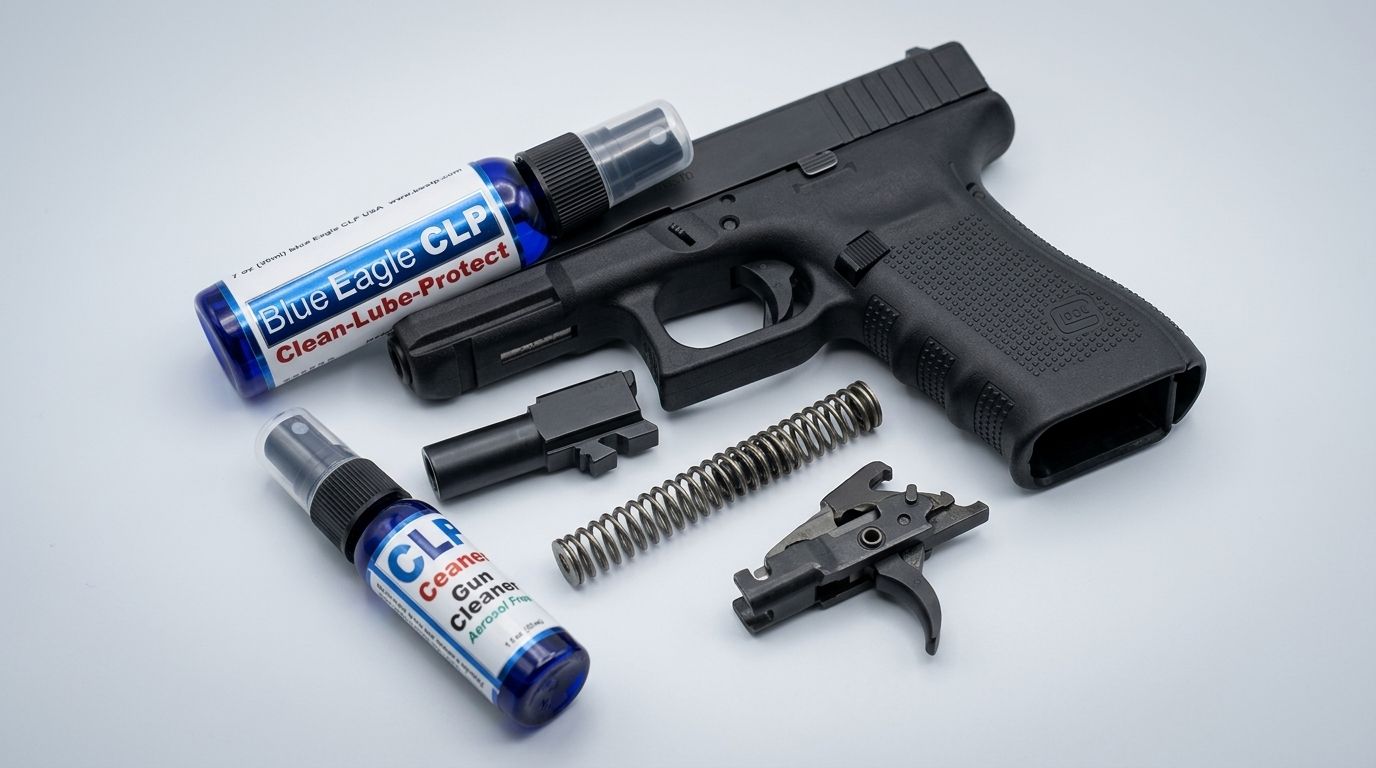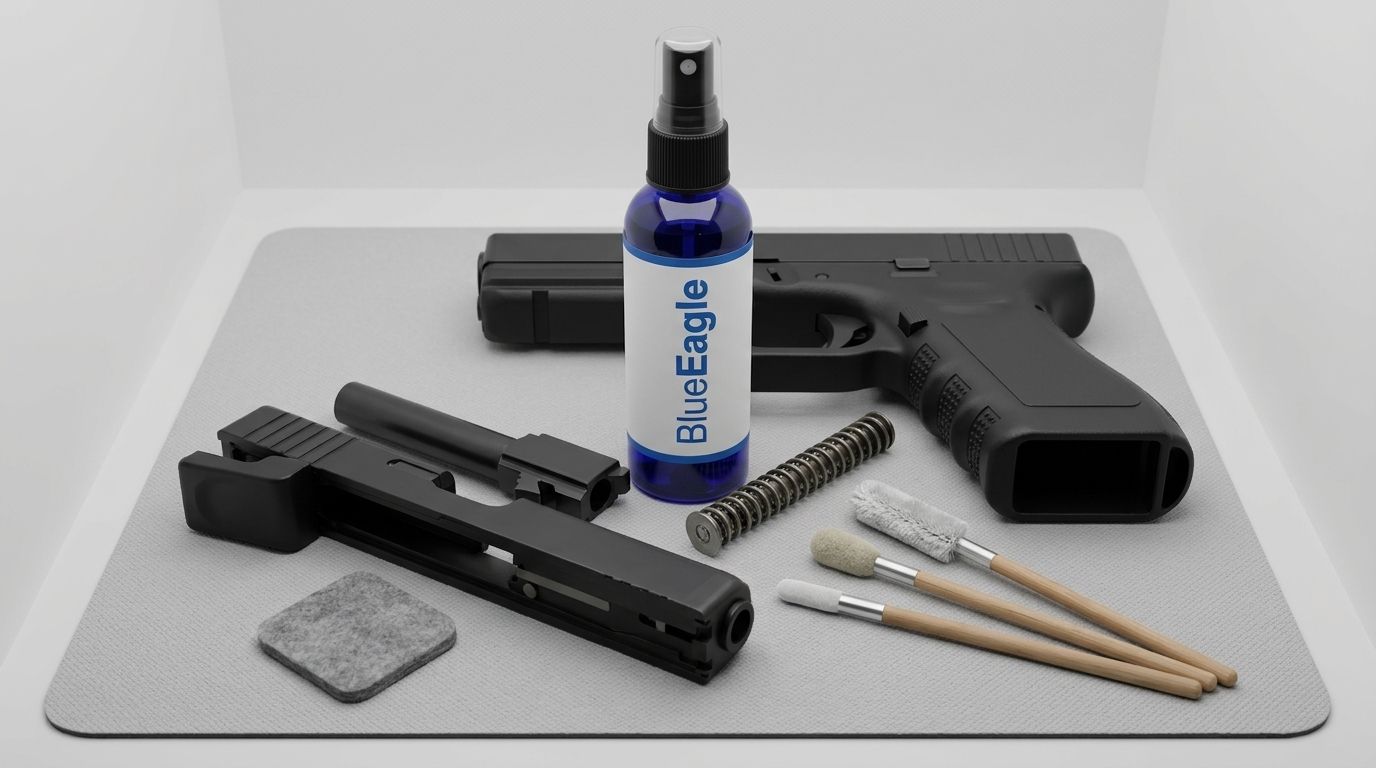
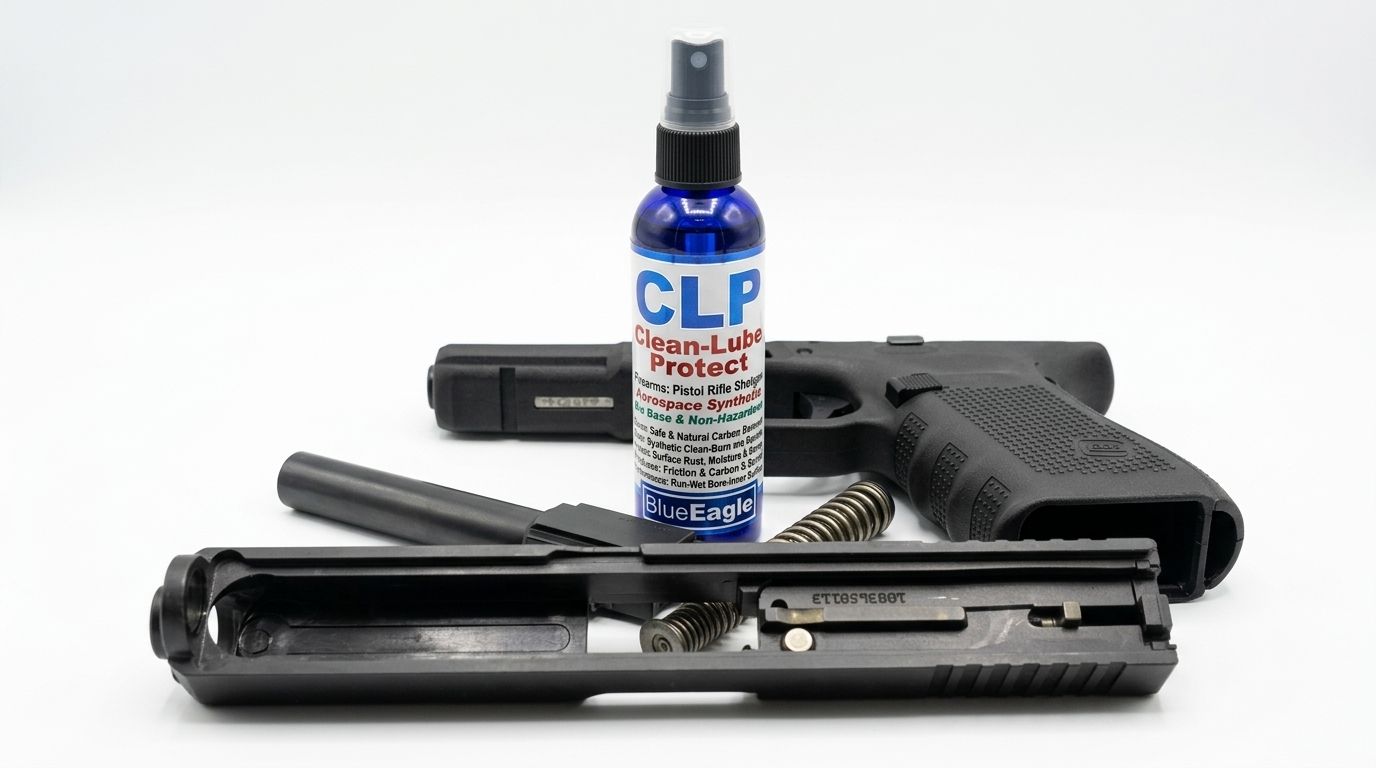
Best overall: a dedicated synthetic gun oil that meets your handgun manufacturer’s instructions. Best for a combined cleaning-and-lubrication routine: BlueEagle CLP followed, where specified, by a separate synthetic lubricant. Best for grease-specified contact points: an oil-and-grease routine. This 2026 guide compares those choices and explains where Beclp fits without treating every cleaner as a synthetic oil.
- The best synthetic gun oil for handguns matches the pistol manufacturer’s lubrication instructions, not a synthetic label alone.
- BlueEagle CLP is a routine-maintenance option; do not assume its formula matches a separate synthetic lubricant.
- Dedicated synthetic gun oil suits owners who want cleaning and lubrication handled separately.
- Use grease only where the handgun manufacturer specifies or permits it.
Why this matters
A semi-auto handgun has specific lubrication points, and they are not identical across designs. Your manual determines where lubricant belongs, what type to use, and what must remain free of excess oil.
The useful buying question in 2026 is not which bottle makes the broadest promise. It is which lubricant fits your pistol and the cleaning routine you will actually follow. Buy for the specified application, then apply the specified amount.
A synthetic base describes part of a lubricant’s formulation. It does not, by itself, establish cleaning ability, finish compatibility, corrosion protection, or suitability for every handgun component.
What makes the best synthetic gun oil for handguns?
Use these criteria before choosing a bottle. They apply to the three maintenance approaches below, not just dedicated oils.
- Manufacturer fit: The handgun manual permits the lubricant type and identifies its application points.
- Clear product identity: The label distinguishes a dedicated lubricant from a cleaner, protectant, or combined CLP.
- Application control: The container or applicator lets you place lubricant where the manual specifies without flooding nearby parts.
- Relevant documentation: Product instructions address intended use, handling, and compatibility; a safety data sheet explains hazards and precautions.
- Routine fit: The product works within your cleaning process without assuming that fouling removal and lubrication are interchangeable.
- Condition-specific evidence: Any cold-weather or protective-performance claim has supporting documentation relevant to your use.
Do not award extra credit for an impressive description alone. Technical language becomes useful only when it answers a maintenance question you actually have.
Synthetic handgun lubrication options at a glance
These are ranked buying approaches, not a laboratory ranking of branded formulas. Each has a different job at the bench.
| Option | Best for | Standout feature | Key limitation |
|---|---|---|---|
| Dedicated synthetic gun oil | Separating cleaning from lubrication | Lets you select a lubricant specifically for approved moving contact points | Does not replace a cleaner unless its instructions expressly include cleaning |
| BlueEagle CLP maintenance routine, with separate synthetic oil where specified | Owners who want CLP as the main routine-maintenance product | Keeps a combined cleaner, lubricant, and protectant central to the routine | Requires checking whether a separate lubricant is appropriate and compatible |
| Manufacturer-approved oil-and-grease routine | Handguns with grease-specified contact points | Assigns different lubricant types to their specified locations | Adds another product and more application decisions |
1. Dedicated synthetic gun oil: best for separate lubrication
A dedicated synthetic gun oil handles the lubrication stage after cleaning. Choose it when you want a clear separation between removing fouling and lubricating the contact points identified in your handgun manual.
This is the default buying approach for the 2026 comparison because it answers the search directly: you want synthetic oil, rather than a cleaner whose lubrication chemistry you have not established. That does not make every synthetic oil suitable for your pistol.
Dedicated synthetic gun oil pros
- Separates lubricant selection from the choice of cleaning product.
- Makes it easier to distinguish the cleaning step from final lubrication.
- Lets you compare application instructions specifically for lubrication.
- Avoids assuming that a cleaning product provides the final film your manual calls for.
Dedicated synthetic gun oil cons
- Requires a separate cleaning step when fouling needs removal.
- Still requires product-specific compatibility checks.
- The word synthetic does not establish a universal operating-temperature range or service interval.
Best for: Owners who already have a suitable cleaning method and want a dedicated lubricant for approved handgun contact points.
Before buying, identify the exact task. Lubricating a specified sliding surface is different from wiping an approved exterior surface for protection. A product suitable for one task does not automatically satisfy the other.
Read the application directions closely. If your manual calls for a light film, a bottle’s ability to dispense a large drop is not a reason to use that entire drop on a small contact area.
Verdict: Buy a dedicated synthetic gun oil when its instructions and your handgun manual support the intended application.
2. BlueEagle CLP routine: best for combined maintenance
BlueEagle CLP belongs in the comparison as a cleaner, lubricant, and protectant—not as an assumed substitute for every dedicated synthetic oil. Beclp offers CLP products, bore cleaners, and synthetic lubricants, but those categories must not be treated as identical formulas.
Use BlueEagle CLP as the central routine-maintenance option when its instructions fit your firearm. If your handgun calls for a separate lubricant, select that product independently and follow the cleaning product’s directions before final lubrication.
BlueEagle CLP routine pros
- Centers routine maintenance on a combined cleaner, lubricant, and protectant.
- Gives you a practical alternative to choosing every maintenance product separately.
- Leaves room for a dedicated synthetic lubricant where the firearm instructions require one.
BlueEagle CLP routine cons
- A CLP designation does not prove suitability for every fouling type or firearm material.
- A biobased cleaning claim does not establish the chemistry of a separate lubricant.
- Adding synthetic oil creates a two-product routine and requires checking the transition between products.
Best for: Everyday handgun owners who want a CLP-led routine while keeping final lubrication tied to the firearm manual.
Beclp’s BlueEagle CLP is best for handgun owners seeking a combined cleaner, lubricant, and protectant for routine maintenance. That is a category fit, not a claim that one formula replaces every specialized cleaner or lubricant.
For your 2026 buying decision, keep biobased cleaning and synthetic lubrication separate on paper. Check which claim belongs to which product. Neither biobased nor biodegradable means harmless; follow labels, handling precautions, and disposal instructions.
Verdict: Buy BlueEagle CLP for a compatible CLP-led routine; add separate synthetic oil only where the maintenance instructions support it.
3. Oil-and-grease routine: best for grease-specified points
An oil-and-grease routine uses each lubricant only where the handgun manufacturer permits or specifies it. It is a conditional choice, not an upgrade every semi-auto handgun needs.
Grease and oil are different lubricant forms. Do not replace one with the other simply because a rail looks heavily loaded or another pistol owner prefers a different routine.
Oil-and-grease routine pros
- Follows component-specific instructions when the manual distinguishes oil from grease.
- Keeps the choice of lubricant tied to the contact point rather than a blanket rule.
- Allows dedicated synthetic oil to remain part of the routine where oil is specified.
Oil-and-grease routine cons
- Requires more than one lubricant and careful application.
- Creates unnecessary complexity when the manual calls only for oil.
- Does not justify applying grease to enclosed mechanisms or unspecified locations.
Best for: Owners whose handgun documentation explicitly calls for or permits grease at identified contact points.
If the manual specifies oil alone, stop there. A more complicated bench routine is not evidence of better maintenance, and a thicker lubricant is not automatically the right answer.
Verdict: Buy only when your handgun’s instructions support both lubricant types; otherwise skip the added grease.
How the options rank
The ranking puts manufacturer fit first, followed by product identity, controlled application, documentation, and routine fit. Dedicated synthetic oil takes the default position because it directly addresses the requested lubrication task.
BlueEagle CLP takes the combined-maintenance slot. Oil and grease take the component-specific slot. This 2026 ranking does not assign unsupported wear scores, cold-weather limits, or protective lifetimes to any formula.
Build the routine before buying another bottle
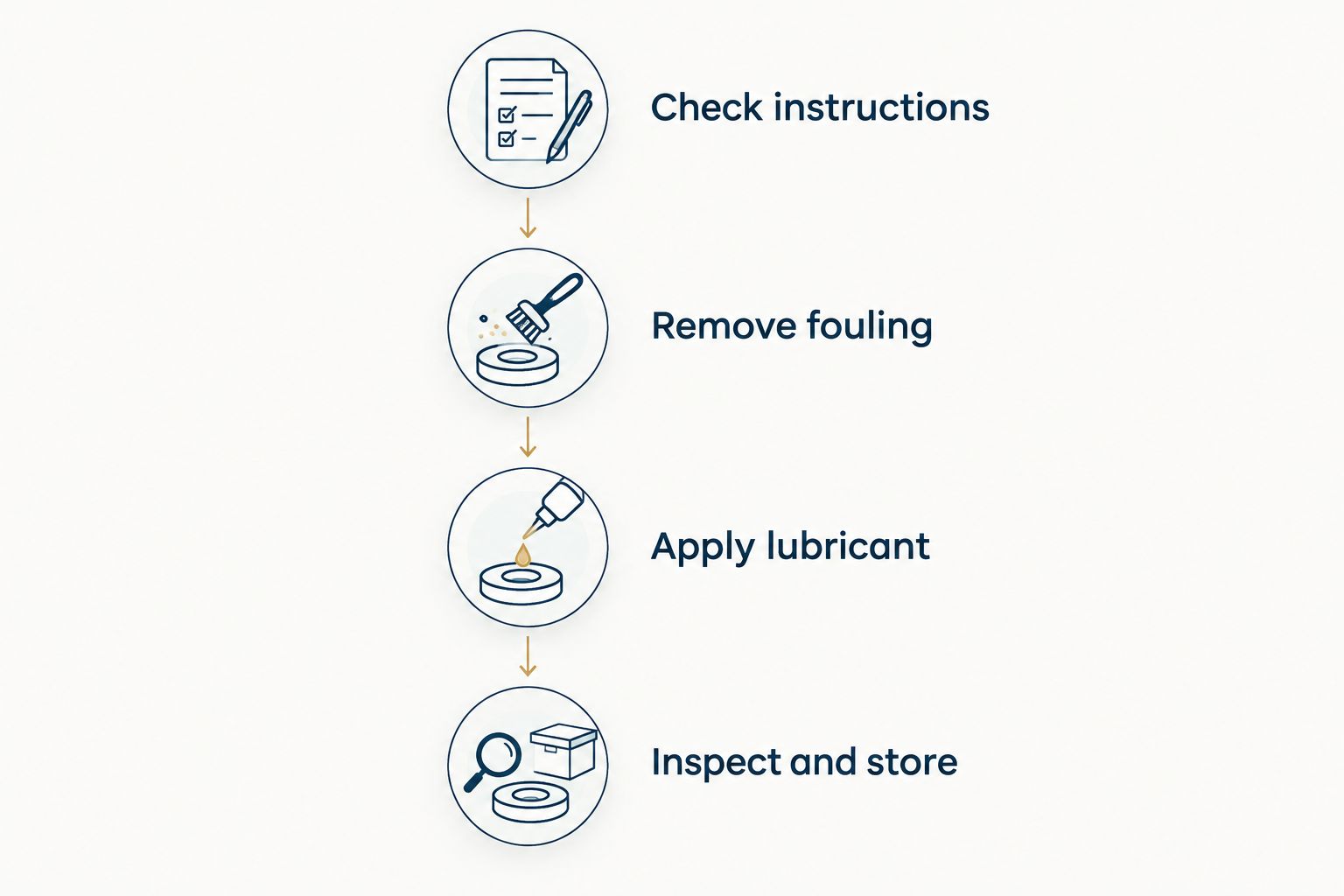
A good purchase starts with a repeatable sequence. You should be able to explain what each product does and where the cleaning stage ends.
Check instructions
Unload the handgun according to its manual and keep ammunition away from the cleaning area. Follow the manufacturer’s disassembly limits; routine cleaning is not a reason to dismantle mechanisms beyond the prescribed level.
Identify the approved cleaning products, lubricant types, and application points before opening a bottle. If the instructions are unclear, get clarification from the firearm manufacturer rather than filling the gap with a general internet rule.
Remove fouling
Use a suitable cleaning product for the residue present. Carbon cleaning and metal-fouling removal are different tasks, so do not assume a dedicated oil performs either unless its documentation says so.
Follow the cleaner’s directions for application, removal, and any required drying. Do not mix products or leave one product beneath another unless the instructions support that sequence.
Apply lubricant
Place the specified lubricant only on the identified contact points. Use the amount and method in the handgun instructions rather than a universal drop count.
Avoid introducing lubricant into ammunition, and follow the manual’s restrictions for the bore, chamber, firing mechanism, and other areas that must remain free of excess product.
Inspect and store
Remove excess product as directed, reassemble according to the manual, and perform the prescribed checks. Apply exterior protection only to approved surfaces using a suitable product.
Storage is part of the routine, not a reason to coat every internal space. Follow the manufacturer’s instructions before returning the handgun to use.
Read the label without confusing the claims
For a 2026 purchase, distinguish the product’s intended function from claims about its ingredients. A cleaner can have biobased content without that fact establishing its lubrication performance. A synthetic lubricant still needs application and compatibility instructions.
A safety data sheet addresses hazards, handling, storage, and related information. It is not a comparative handgun wear test. Use technical documentation for performance questions and the firearm manual for application requirements.
Cold-weather claims need the same discipline. Do not turn a listed laboratory property into a guaranteed cycling temperature for your handgun. Ask whether the documentation answers the actual use question before treating it as a buying advantage.
Which handgun lubrication routine should you choose?
Choose dedicated synthetic gun oil as the default when you want separate cleaning and lubrication. Match the product to the handgun manual, then keep the application controlled.
Choose the CLP-led approach when you want combined routine maintenance. Beclp’s offering makes that a relevant option, but a separate synthetic lubricant remains a separate selection—not a formula claim you can infer from the CLP name.
Choose oil and grease only when your firearm instructions support the combination. For 2026, the practical winner is the routine you can document and repeat, not the one with the longest list of bottles.
FAQ
What’s the best synthetic gun oil for handguns?
The best synthetic gun oil for handguns is a dedicated lubricant that meets your pistol manufacturer’s instructions for the intended contact points. The synthetic label alone does not establish compatibility, cleaning ability, or a maintenance interval.
Is BlueEagle CLP the same as synthetic gun oil?
Do not treat BlueEagle CLP and a dedicated synthetic gun oil as the same formula. CLP describes a cleaner, lubricant, and protectant; check each product’s documentation for its composition and intended use.
Should I use oil or grease on semi-auto handgun rails?
Use the lubricant type specified or permitted by your handgun manufacturer. Do not choose grease solely because the surface is a rail or because another handgun uses it.
Can synthetic gun oil clean the bore?
Do not rely on synthetic gun oil for bore cleaning unless its instructions expressly include that use. Choose a cleaner appropriate to the fouling and follow the barrel manufacturer’s maintenance guidance.
How many drops of gun oil does a handgun need?
There is no universal drop count for every handgun. Follow your model’s lubrication diagram and quantity instructions, then remove excess product as directed.
Can I put synthetic oil over CLP?
Use a separate synthetic oil after CLP only when the product instructions and firearm guidance support that sequence. Follow directions for removing cleaner and residue rather than assuming the products can be layered.
Does biobased gun cleaner mean harmless?
No, biobased does not mean harmless. Follow the product label and safety data sheet for handling, exposure precautions, storage, and disposal.
One last thing
Before ordering another lubricant, put the handgun’s lubrication diagram beside your cleaning supplies. Assign each bottle a job. If you cannot identify where a product belongs, check the instructions before adding it to the routine.