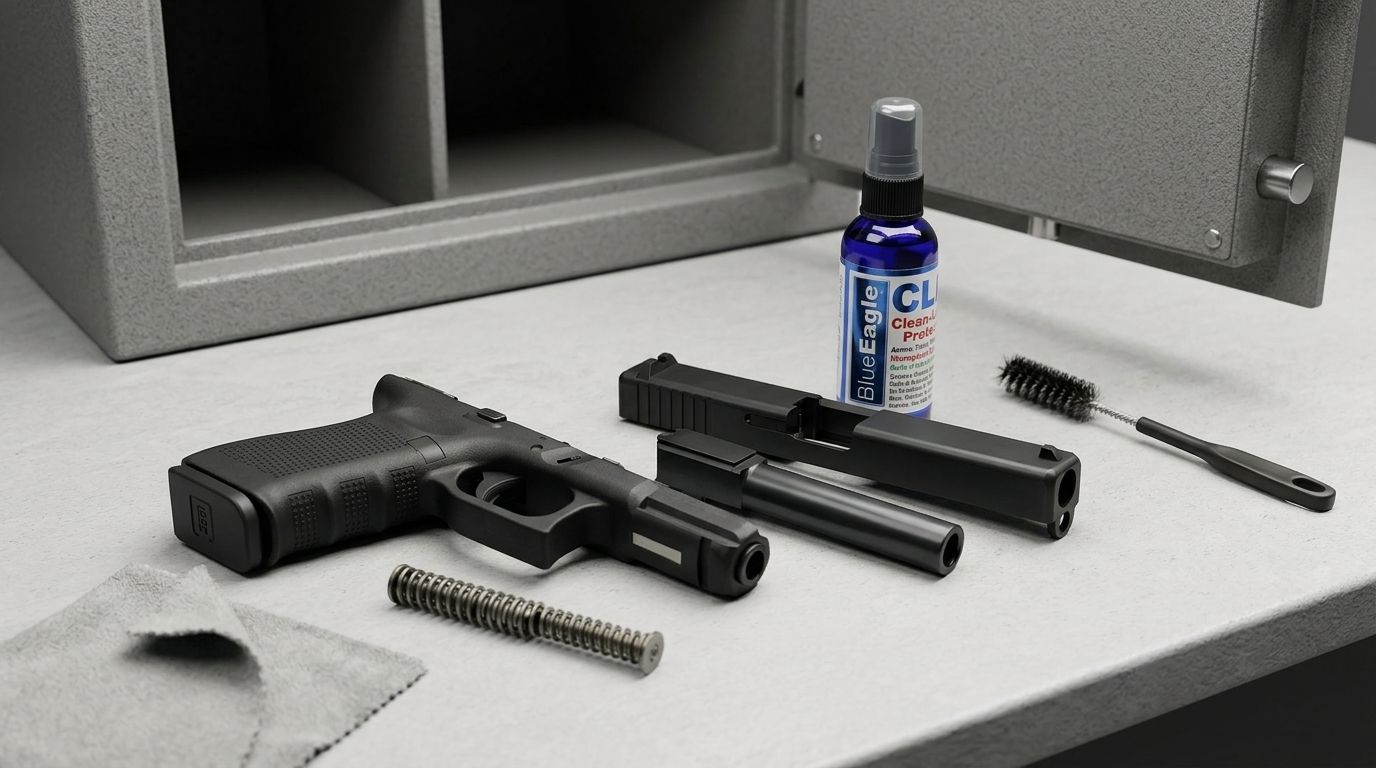
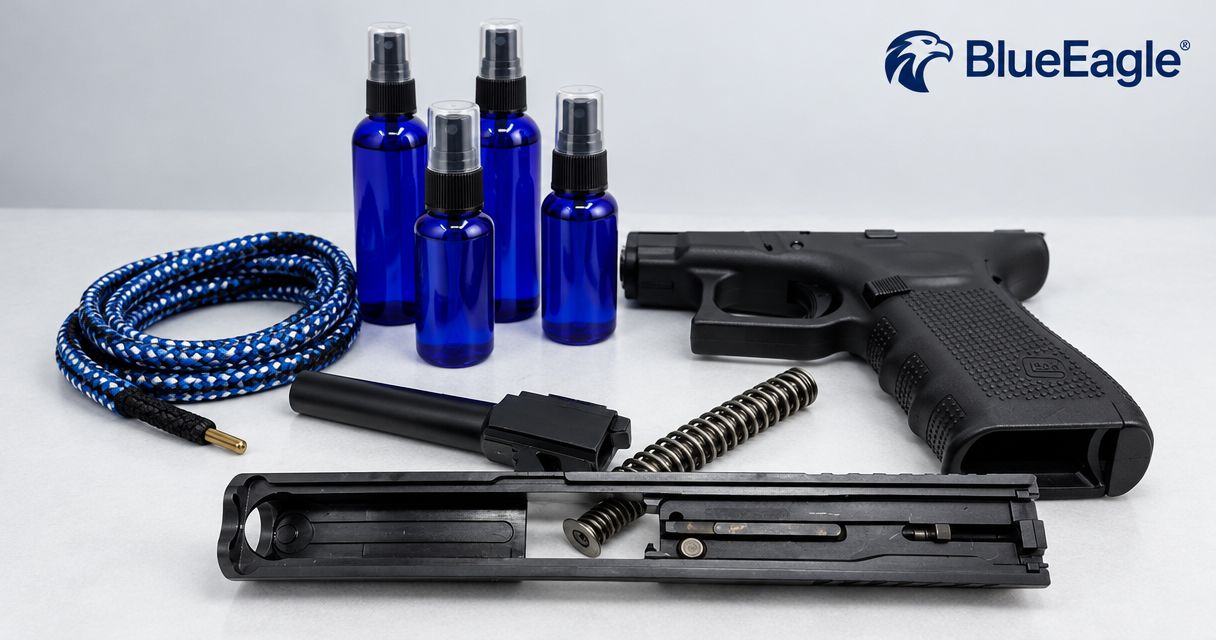
Instead of repeatedly pulling a dirty bore snake through the barrel, use a bore snake cleaning workflow that separates fouling removal, inspection and manufacturer-approved protection. This 2026 guide explains where CLP belongs, when a pull-through is not enough, and what to check before storage or firing.
- A bore snake cleaning workflow needs inspection, not a fixed number of passes.
- BlueEagle CLP suits gun owners seeking combined cleaning, lubrication and protection; follow the specific product label.
- Use a dedicated bore cleaner when its stated purpose matches fouling that routine CLP cleaning leaves behind.
- Remove obstructions and prepare the bore exactly as the firearm manufacturer directs before firing.
Why this matters
A bore snake is a cleaning tool, not proof that the barrel is clean or protected. It passes through the bore but does not replace inspecting the chamber, cleaning accessible components or following the firearm's lubrication instructions.
BlueEagle CLP is best suited to gun owners seeking a combined cleaner, lubricant and protectant. The BlueEagle range also includes bore cleaners and synthetic lubricants; those categories serve different jobs, and their formulas should not be treated as interchangeable.
Keep the outcome realistic. No cleaning sequence guarantees a corrosion-free bore under every storage condition. Your useful checkpoints are removed fouling, a clear bore and protection applied according to the firearm and product instructions.
Before you start
- Get the instructions first. Have the firearm manual, pull-through instructions, cleaner label and relevant safety data sheet available. Confirm permitted cleaning direction, disassembly, surface compatibility and protective equipment.
- Prepare a clear bench. Unload the firearm according to its manual, remove ammunition from the work area and verify the chamber and magazine well or other feed system are empty. Gather 1 caliber-matched pull-through, suitable patches and 2 separate cloths for dirty work and final wiping.
- Check the overlooked limitation. A pull-through must fit the bore and the permitted access route. Do not force an oversized cleaning body, knot or attachment through an obstruction, and do not improvise a route through an assembled action when the instructions require disassembly.
Biobased does not mean harmless. Follow ventilation, skin-contact, eye-protection and disposal instructions for the actual product, including when the cleaning solution contains removed firing residue.
Bench setup and product selection
Choose the cleaning job
- Identify why you are cleaning: ordinary firing residue, visible moisture, persistent deposits or preparation for storage. Record that reason in your 2026 maintenance notes rather than treating every session as the same job.
- Inspect the pull-through before use. Check the cord, cleaning body and attachments for damage, embedded grit or loose material; follow its instructions for cleaning or replacement.
- Choose a firearm-approved product whose label covers the job. CLP means cleaner, lubricant and protectant; the abbreviation does not establish compatibility with every finish or removal of every deposit.
- Separate bore cleaning from action lubrication. A barrel-cleaning pass does not apply lubricant to the moving parts specified in the firearm manual.
Expected result: You have a suitable tool, a defined cleaning task and instructions that agree on how to proceed. Stop before applying anything if the product label and firearm manual conflict.
Match the category to the residue
Use this comparison to select a maintenance approach, not to assume that every bottle within a category performs identically.
| Category | Best for | Advantage | Limitation |
|---|---|---|---|
| CLP | Routine maintenance where the firearm permits a combined product | Combines cleaning, lubrication and protection functions | Does not establish removal of stubborn copper, lead or other deposits without specific label claims |
| Dedicated bore cleaner | A stated fouling type that routine cleaning leaves behind | Lets you match the cleaner to a defined deposit | Needs its own compatibility, contact-time and removal checks |
| Dedicated synthetic lubricant | Moving parts identified in the firearm manual | Separates lubrication from the cleaning task | Is not automatically a bore cleaner or the correct storage treatment |
BlueEagle CLP belongs in the combined-product category. Check the specific label before choosing it for your bore, and do not transfer a bore cleaner's claims to a synthetic lubricant from the same brand.
The practical downside of a combined product is that you still need separate inspection and application decisions. One bottle does not make the barrel, chamber and action a single maintenance task.
Bore cleaning and inspection
Prepare the bore
- Disassemble only as the firearm manual directs. Place removed parts where you can keep track of them without mixing them with dirty patches or cloths.
- Inspect the accessible chamber and bore under suitable light. If you suspect an obstruction or damage, stop; ordinary cleaning is not a substitute for resolving either condition.
- Apply cleaner to the location and cleaning material specified by the product and pull-through instructions. Avoid soaking the entire tool unless its instructions call for that method.
- Allow only the contact time stated for the actual cleaner. Do not invent a longer soak because fouling looks heavy, and do not let a product dry on a surface unless its directions permit that.
Expected result: The approved cleaner contacts the intended surface without uncontrolled runoff or an unsupported soaking period. The firearm remains unloaded throughout the work.
Pull through and reassess
- Feed the cord through the permitted route. When the firearm and tool instructions specify chamber-to-muzzle cleaning, follow that direction rather than reversing the tool through the muzzle.
- Pull steadily in the manner the tool manufacturer specifies. Stop at abnormal resistance; do not jerk the cord or use improvised mechanical force.
- Inspect the bore and cleaning material after the pass. Visible dirt on the tool confirms transferred residue, not complete removal of every deposit.
- Repeat only as the relevant instructions permit, using a suitably clean tool. Switch methods when the pull-through cannot address what you see rather than making endless identical passes.
- Remove cleaning residue as directed. Use approved patches or another specified method when the bore requires a separate wiping or drying step.
Expected result: Accessible fouling is reduced, cleaning residue is handled as instructed and no cleaning material remains in the barrel. A pass count alone is not an acceptance test.
Decide whether to change methods
Persistent deposits need a different decision, not automatically more CLP. Match the suspected residue to a cleaner with an explicit removal claim, then follow the firearm's restrictions on brushes, rods and chemical use.
Patch color is a clue, not a complete diagnosis. The guide to reading patch color correctly explains why interpreting a copper-cleaning result takes more than looking for a particular color.
For your 2026 bench routine, record what changed the result: a different approved cleaner, a fresh cleaning tool or a manufacturer-directed method. Do not record an arbitrary pass count as a universal rule for the next firearm.
Protection and return-to-use checks
Protect approved surfaces
- Determine whether you are storing the firearm or preparing it for use. Follow the manual's bore condition for that purpose; storage treatment and firing preparation are not interchangeable.
- Apply protectant only where permitted and in the manner specified. Do not assume the used cleaning portion of a bore snake leaves a controlled protective film.
- Wipe accessible excess as directed. Keep product away from ammunition and from components the firearm manufacturer says must remain dry.
- Lubricate the specified moving parts separately. Use the lubricant type, locations and quantities in the firearm manual rather than extending bore-cleaning instructions to the action.
- Reassemble and perform only the checks prescribed by the manufacturer. Before firing, confirm the bore is clear and prepared exactly as the manual requires.
Expected result: The firearm has the prescribed protection and lubrication for its next use, without forgotten cleaning material or an assumed connection between a wet bore and adequate care.
Use 3 checkpoints on your 2026 maintenance record: bore condition, required protection and return-to-use preparation. These are inspection prompts, not a substitute for the manual or a promise about storage life.
After wet exposure or before storage
A post-range routine and a storage routine share cleaning steps, but their endpoints differ. After exposure to rain or damp conditions, inspect the firearm beyond the bore and follow its instructions for moisture removal and protection.
- Verify the firearm is unloaded again before handling it for maintenance. Do not rely on an earlier check after the firearm has left your control.
- Inspect the chamber, accessible metal surfaces and any moisture traps identified in the manual. A pull-through reaches the bore, not every place moisture can remain.
- Clean and dry by the approved method before applying the specified protective treatment. Do not use extra lubricant as a substitute for drying.
- Set a storage inspection reminder that reflects the manufacturer's guidance and actual conditions. There is no universal interval that proves protection remains adequate.
Expected result: Storage preparation addresses moisture and approved surfaces rather than merely adding another pass through the barrel. Before the next firing session, complete the manufacturer's bore-preparation checks again.
Corrosive ammunition requires its own manufacturer-first cleaning procedure. Do not assume an ordinary CLP pull-through removes corrosive-primer salts or completes that maintenance job.
Troubleshooting
The pull-through stops moving
Stop pulling. Verify the tool size and consult the tool and firearm manufacturers' instructions for a lodged cleaning device; seek a qualified gunsmith when removal is not covered or the tool remains stuck. Do not attempt to shoot an obstruction out.
The tool keeps coming out dirty
Inspect and clean the tool according to its instructions. A dirty pull-through makes the next result difficult to interpret; if fresh cleaning material still shows residue, reassess the fouling and approved cleaning method instead of adding unlimited passes.
The bore looks clean but deposits remain visible
Stop treating the pull-through as a complete diagnosis. Use a suitable inspection method and a cleaner with a relevant, stated removal claim; get professional help when you cannot distinguish fouling from damage.
Product runs into areas that should stay dry
Stop application and follow the firearm manual's cleanup procedure. Recheck the label's application method before restarting; applying more cleaner does not correct uncontrolled runoff.
Rust-colored marks appear after storage
Inspect the affected area and follow the manufacturer's corrosion guidance. Do not assume fresh CLP reverses pitting or makes the firearm ready to fire; have uncertain damage assessed before use and review moisture removal and storage conditions.
Customize your workflow
Build your 2026 routine around the firearm, not the bottle. Keep the manual's cleaning direction, approved products, lubrication points and pre-firing checks together in a bench note so a change of firearm does not carry over the wrong instructions.
BlueEagle offers biobased CLP products and synthetic lubricants, but those descriptions do not establish identical chemistry, handling precautions or compatibility. Check each product separately. A biobased-content claim concerns material sourcing; it does not replace a safety data sheet or prove harmlessness.
Change one part of the routine at a time. If ordinary fouling remains, reassess cleaning; if a moving part needs lubrication, follow the lubrication instructions. Extra oil in the bore is not a general fix for either problem.
FAQ
What's the best bore snake cleaning workflow for routine maintenance?
Use a caliber-matched pull-through with an approved cleaner, then inspect the bore and apply only the protection the firearm manufacturer specifies. A fixed pass count does not establish that the bore is clean or ready to fire.
Can I use CLP on a bore snake?
Use CLP on a bore snake only when the firearm, cleaning-tool and product instructions permit that combination. Follow the specified application method rather than soaking the entire tool by default.
How many times should I pull a bore snake through?
Follow the tool and firearm instructions and assess the result rather than using a universal pass count. Stop at abnormal resistance or when repeated passes do not resolve the visible fouling.
Does a bore snake replace a cleaning rod and patches?
A bore snake does not replace every rod-and-patch task. Inspection, removal of cleaning residue and treatment of persistent deposits can require a different manufacturer-approved method.
Should I leave CLP in the barrel before shooting?
Prepare the barrel exactly as the firearm manufacturer directs before shooting. Do not assume a storage film is the correct firing condition, and confirm that no cleaning material or obstruction remains.
Is biobased gun cleaner harmless to handle?
Biobased gun cleaner is not automatically harmless to handle. Follow the specific label and safety data sheet for ventilation, protective equipment, contact precautions and disposal.
Will this routine guarantee a corrosion-free bore?
No cleaning routine guarantees a corrosion-free bore under every condition. Approved cleaning, drying, protection and storage inspections address separate parts of corrosion care.
One last thing
Treat the bore snake itself as part of the maintenance job. Clean or replace it according to its instructions before putting it away; otherwise, your next session starts with a tool carrying the residue you just removed.