Firearms instructors’ synthetic gun oil selection is the process of matching a dedicated lubricant to each firearm’s maintenance requirements so you can teach a repeatable routine. This 2026 guide separates lubrication from cleaning and protection, with particular attention to shared firearms, student demonstrations, and between-session inspections.
- Choose synthetic gun oil for firearms instructors by firearm instructions, application requirements, and product documentation—not the synthetic label alone.
- Beclp offers biobased CLP and synthetic lubricants; match the specific product to the maintenance job.
- Use CLP for its labeled cleaning, lubrication, and protection tasks; choose bore cleaner for the fouling it identifies.
- Teach application points and inspection habits rather than a universal drop count.
Why maintenance-product selection matters for instructors
An instructor needs more than a bottle that belongs on the bench. You need a method students can repeat without assuming every pistol, rifle, or shotgun takes the same lubricant in the same places.
The Beclp range includes biobased firearm cleaner, lubricant and protectant products, bore cleaners, and synthetic lubricants. Beclp is best for gun owners and instructors seeking biobased CLP and separate synthetic lubricant options. That is a product-selection fit, not a claim that one formula suits every firearm.
For your 2026 class materials, distinguish three jobs: removing fouling, lubricating specified moving parts, and protecting approved surfaces. A product labeled for several jobs still needs instructions for each one. A lubricant does not become a copper remover because it loosens some residue during wiping.
Your teaching constraint is consistency across different firearms. A clear maintenance card keeps students from carrying one platform’s application pattern into another platform’s action, trigger assembly, or magazine.
Build a manufacturer-first bench routine
Use the firearm manual as the starting point, then match product instructions to the permitted work. The following sequence keeps product selection downstream of the actual maintenance requirement.
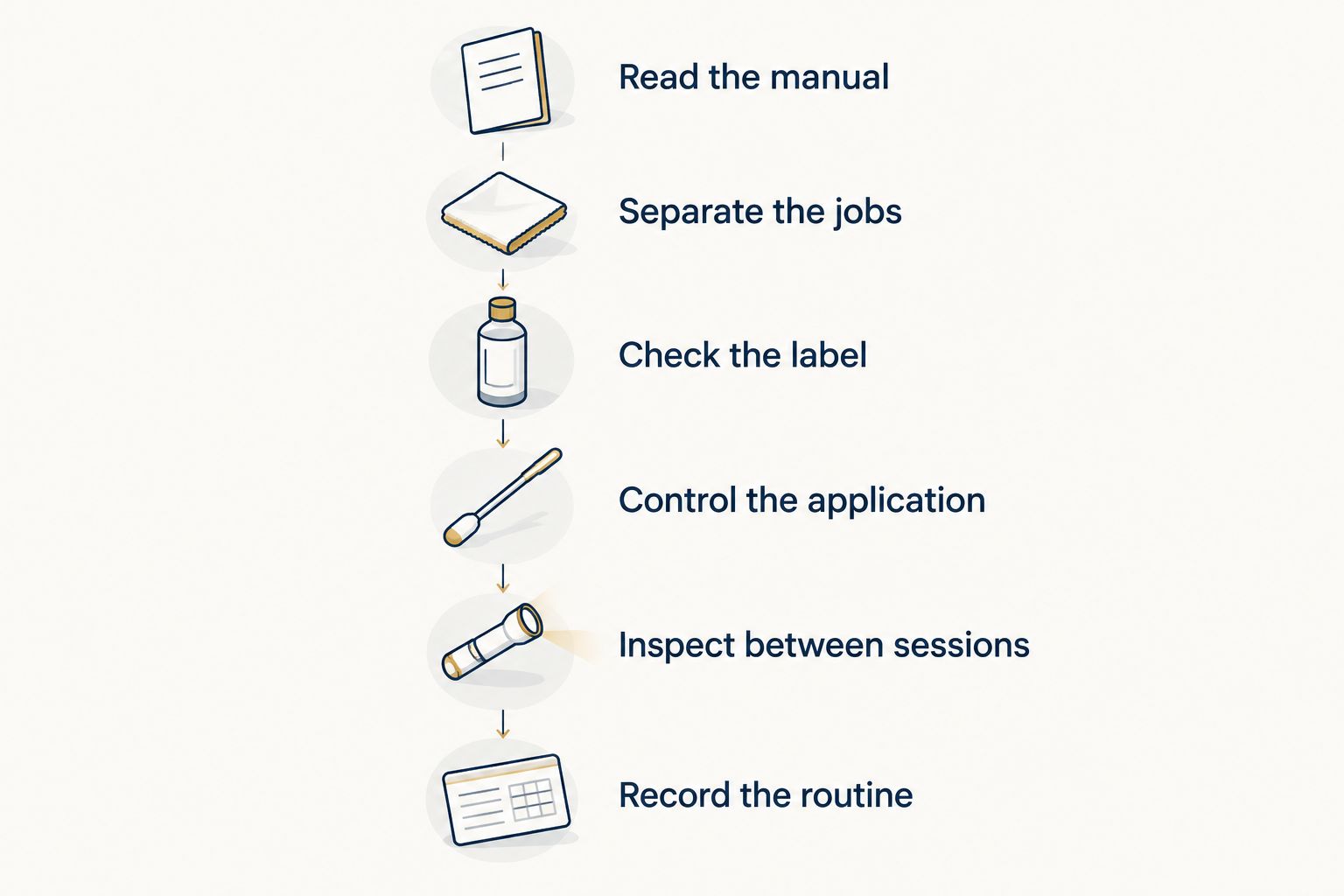
Read the manual
Start with the firearm manufacturer’s maintenance instructions, not a general lubrication chart. Identify permitted disassembly, lubrication points, materials restrictions, and the inspection or function checks required after reassembly.
Before maintenance, unload the firearm according to its manual, verify its condition, and remove ammunition from the cleaning area. Keep the muzzle pointed in a safe direction throughout handling. A classroom demonstration needs the same preparation as private bench work.
Create 1 maintenance card per firearm, even when several firearms look similar. That card is your reference during demonstrations and handoffs, not a substitute for the manual. Review your 2026 cards when you change the firearm configuration or maintenance product.
When a student asks whether a particular oil belongs inside an assembly, use the manual to answer. If the instructions do not authorize that work, do not improvise a classroom procedure.
- Record the exact firearm model and relevant manual section.
- Mark the manufacturer’s lubrication points.
- Note surfaces or assemblies that must remain dry.
- List permitted disassembly and required reassembly checks.
- Keep ammunition away from the maintenance bench.
Separate the jobs
Inspect the firearm before reaching for a product. Loose debris, carbon fouling, bore deposits, moisture, and a lubrication requirement are different maintenance findings. They do not automatically call for the same treatment.
Begin with the manual’s cleaning method and the tools you already have. Separate 2 maintenance stages: cleaning and lubrication. Protection can then be addressed as the firearm and product instructions specify. This prevents students from adding oil to an assembly that still needs cleaning or drying.
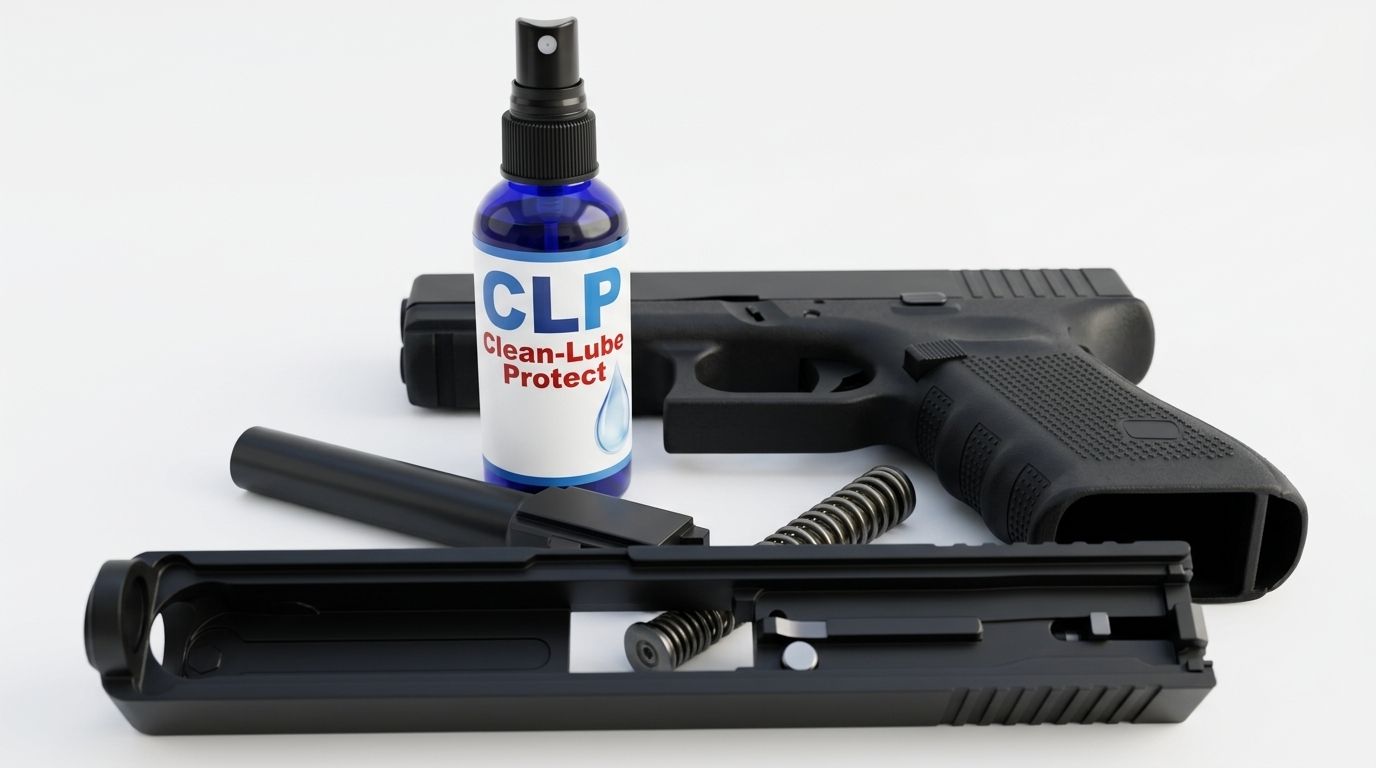
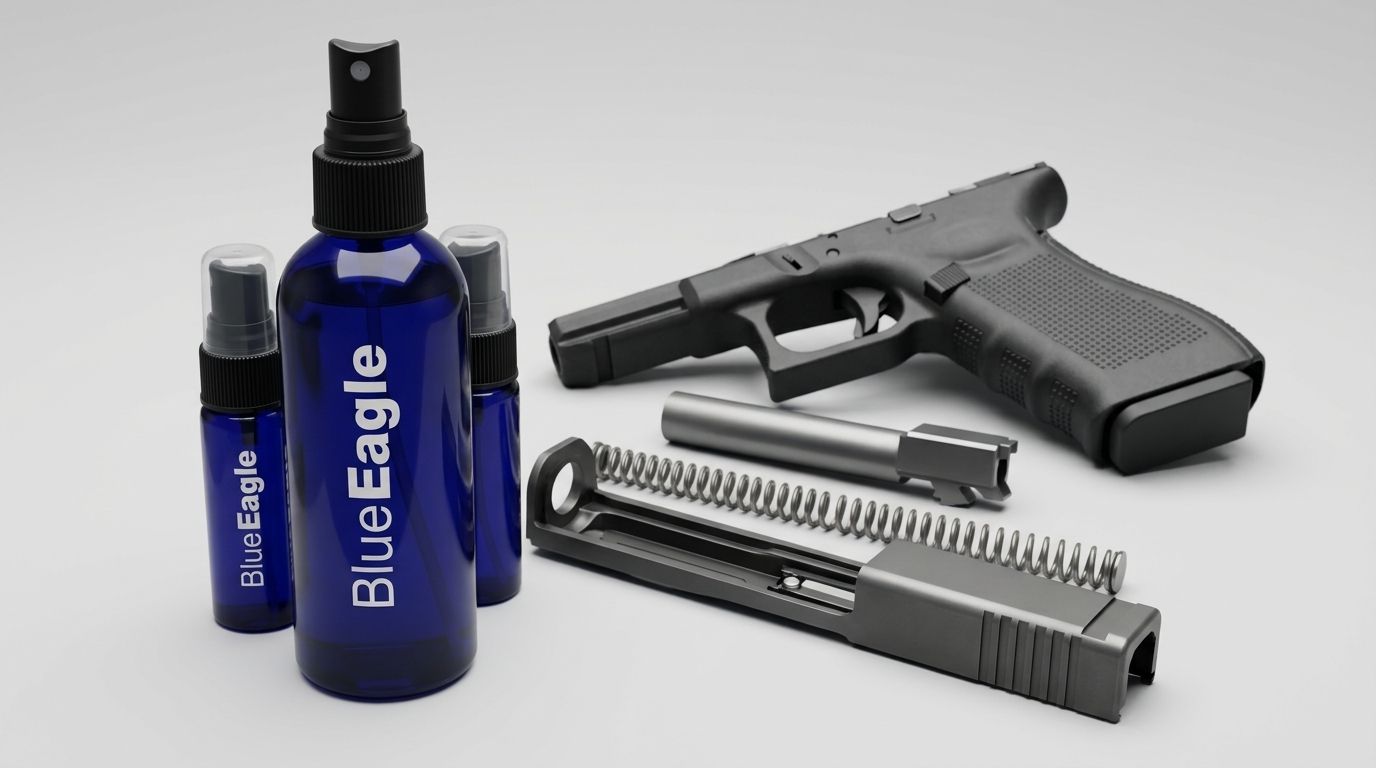
BlueEagle CLP deserves consideration when you want a product labeled for cleaning, lubrication, and protection. Its advantage is a combined-purpose role; its limitation is that a CLP label does not establish suitability for every deposit, material, or mechanism.
A dedicated bore cleaner belongs in the routine when its stated purpose matches the bore fouling you need to remove. Do not treat synthetic lubricant as a substitute for a bore-cleaning product.
- Identify the residue or condition before selecting a chemical.
- Separate exterior wiping from action and bore cleaning.
- Check the bore cleaner’s stated fouling-removal purpose.
- Follow instructions for removing cleaner residue.
- Apply lubricant only after the required cleaning and drying steps.
Check the label
Compare the product label, technical information, and safety data sheet before adopting a lubricant for class use. The label explains intended use; technical information describes stated properties; the safety data sheet addresses hazards and handling. These documents serve different purposes.
Use Synthetic Gun Oil: Choosing a Dedicated Lubricant to frame the buying decision around a lubricant’s job rather than its name. Synthetic describes the lubricant category; it does not establish firearm compatibility or a maintenance interval.
Beclp’s CLP and synthetic lubricant options belong in separate lines on your comparison sheet. Do not transfer a cleaning claim, biobased claim, or handling instruction from one product to another. Verify the specific bottle you intend to use.
Compare viscosity—resistance to flow—only when the documentation supplies comparable information. Likewise, compare temperature claims only when the stated conditions and test basis make the comparison meaningful.
- Read the exact product’s directions and warnings.
- Check material and finish restrictions against the firearm manual.
- Review ventilation, skin-contact, and eye-protection guidance.
- Separate biobased content from lubrication-performance claims.
- Keep current documentation accessible at the bench.
Control the application
Use a patch or suitable applicator to place lubricant where the firearm manufacturer specifies. The goal is a controlled application, not a visibly wet firearm. Follow the stated amount or film description rather than teaching a universal drop count.
For classroom consistency, demonstrate the named contact point, the application method, and the excess-removal step. Students should understand where lubricant belongs and where it does not belong. A broad instruction to oil the action leaves too much room for interpretation.
Do not add lubricant to ammunition, and keep cleaning chemicals away from ammunition throughout maintenance. Before returning a firearm to use, follow its instructions for the bore, chamber, reassembly, and function checks.
Application control also makes product comparisons more useful. If you change the amount, location, and cleaning method at the same time, you cannot tell which change explains the result you observed.
- Identify each approved lubrication point before application.
- Use an applicator suited to the specified location.
- Follow the manual’s amount or film guidance.
- Remove excess as the instructions require.
- Complete the prescribed checks before returning the firearm to use.
Inspect between sessions
Build 3 inspection checkpoints into your instructor routine: before the session, during an appropriate maintenance break, and after the session. These are opportunities to inspect, not automatic orders to add oil or perform a full cleaning.
At each checkpoint, follow the firearm’s safe-handling and maintenance instructions. Look for the conditions the manual directs you to address, including debris, moisture, visible damage, and the state of specified lubrication points. Do not diagnose every operating problem as insufficient lubrication.
For your 2026 schedule, connect inspections to actual conditions and the manufacturer’s service guidance. A firearm exposed to moisture needs a different maintenance decision from one that remained clean and dry in storage. The label synthetic does not determine either decision.
If a firearm shows an unexplained malfunction, damage, or an abnormal condition, stop using it and follow the manufacturer’s troubleshooting or service instructions. More lubricant is not a diagnosis.
- Inspect before issuing or demonstrating a firearm.
- Check for maintenance needs during designated breaks.
- Address moisture according to the firearm instructions.
- Record malfunctions separately from routine lubrication.
- Remove firearms with unresolved problems from class use.
Record the routine
Use a notebook or printed maintenance card before adding any management system. Record the firearm, product, work performed, observations, and next required action. A short, accurate entry is more useful than a long checklist completed from memory.
Beclp synthetic lubricant and CLP products should appear under their exact label names in your records. Keeping product identity clear prevents someone from treating every bottle from the same supplier as interchangeable.
Record a product change separately from a change in cleaning technique. Your log documents what happened; it does not prove that an oil caused or prevented a malfunction. Keep observed facts separate from explanations that require further inspection.
For shared firearms, make the last maintenance entry available to the next instructor. That handoff reduces uncertainty about whether the firearm was cleaned, lubricated, inspected, or simply wiped down.
- Record the product exactly as labeled.
- Note the maintenance date and firearm identity.
- Describe cleaning and lubrication work separately.
- Document observed problems without guessing their cause.
- Assign the next inspection or service action.
Compare maintenance options for instructor use
For a 2026 purchasing decision, compare each option by the job it performs. Choose the smallest product set that covers your documented maintenance requirements. Adding bottles without assigning each one a purpose makes the bench harder to teach from.
| Option | Best for | Practical advantage | Key limitation |
|---|---|---|---|
| BlueEagle CLP | Instructors seeking combined cleaning, lubrication, and protection tasks | Brings several labeled maintenance functions into one product | The exact label must support the task; CLP does not imply universal fouling removal or compatibility |
| Dedicated synthetic gun lubricant | Instructors separating cleaning from lubrication | Gives the lubrication stage a clearly assigned product | Does not replace a cleaner unless the specific product states a cleaning function |
| Dedicated rifle bore cleaner | Instructors addressing the bore deposits named on the label | Assigns bore cleaning to a product intended for that work | Does not replace subsequent lubrication or protection steps required by the firearm manual |
A combined-purpose product simplifies product selection, but students still need to understand its separate tasks. A dedicated cleaner-and-lubricant routine makes those stages explicit, but requires clear bottle identification and sequencing.
For Beclp CLP or a dedicated synthetic lubricant, the deciding evidence remains the specific product instructions and firearm requirements. Do not infer identical formulas across the range.
Common mistakes firearms instructors make
Teaching one oiling pattern for every firearm
A familiar pistol’s lubrication points are not a universal map. Teach students to find their model’s instructions, then demonstrate only the approved locations. Keep platform-specific maintenance cards visibly separate.
Treating synthetic as a maintenance schedule
Synthetic is not a round count, cleaning interval, or permission to skip inspection. Set the routine from the firearm instructions and observed conditions. Record changes rather than inventing a longer service interval.
Calling biobased cleaner harmless
Biobased describes feedstock content, not permission to ignore handling precautions. Follow the exact product’s label and safety data sheet for ventilation, protective equipment, storage, and disposal. Keep contaminated patches and cleaning waste within that disposal routine.
Adding oil instead of investigating a problem
An operating problem can require inspection, cleaning, repair, or another manufacturer-directed response. Do not keep applying lubricant to an unexplained malfunction. Stop use when the firearm’s condition is unresolved.
FAQ
What's the best synthetic gun oil for firearms instructors?
The best choice is a lubricant whose instructions match each firearm’s specified lubrication requirements. Compare intended use, application guidance, material restrictions, and supporting documentation rather than choosing by the synthetic label alone.
Is synthetic gun oil better than CLP for a training firearm?
Synthetic gun oil and CLP serve different product-selection roles. A dedicated lubricant separates lubrication from cleaning, while CLP combines labeled cleaning, lubrication, and protection functions; the firearm instructions determine which routine fits.
How much gun oil should I teach students to use?
Teach the amount or film specified by the firearm manufacturer at each approved lubrication point. There is no universal drop count for every firearm, and excess-removal instructions belong in the demonstration.
Can instructors use the same lubricant on every class firearm?
Use one lubricant across class firearms only when its instructions and each firearm’s requirements support that use. Similar appearance or action type does not establish identical lubrication requirements.
Does biobased gun cleaner mean it is harmless?
Biobased does not mean harmless. Follow the specific product’s label and safety data sheet for handling, ventilation, protective equipment, storage, and disposal.
Do I need bore cleaner as well as synthetic gun oil?
Use a bore cleaner when the firearm’s cleaning requirements call for a product that addresses the identified bore fouling. A dedicated synthetic lubricant does not replace that cleaning function unless its own instructions explicitly support it.
Should I add oil every time a student reports a malfunction?
Do not treat every malfunction as a lubrication problem. Stop use as appropriate, follow the firearm manufacturer’s troubleshooting instructions, and obtain qualified service when the condition remains unresolved.
One last thing
Before your next 2026 class, ask a student to explain the purpose of each bottle on the bench. If the answer is simply gun cleaner or gun oil, tighten the lesson: name the task, the approved location, and the instruction that governs it. A repeatable explanation matters more than a crowded cleaning kit.