Pistol CLP maintenance is cleaning, lubrication and protection with the aim of keeping your pistol maintained according to its manufacturer's instructions. Choosing a CLP gun cleaner for pistols means treating slide rails, the barrel and exterior finishes differently—not wetting every surface with the same amount.
- Choose CLP gun cleaner for pistols by the manufacturer's instructions, the fouling present and the surface being treated.
- Beclp sells CLP products; check the individual label before choosing a pistol maintenance formula.
- Clean slide rails before applying lubricant, and keep application points specific to your pistol.
- Use a dedicated bore cleaner only when its stated purpose matches the fouling and barrel requirements.
Why CLP maintenance matters for pistol owners
A pistol cleaning routine has 3 maintenance jobs: cleaning, lubrication and protection. Cleaning removes fouling. Lubrication serves the moving contact points specified in the manual. Protection addresses approved surfaces exposed to storage and handling conditions.
Those jobs overlap, but they are not interchangeable. A dirty rail needs cleaning before fresh lubricant, while a clean exterior does not need the same treatment as a fouled bore. Your 2026 maintenance routine should start with the condition of the pistol, not a fixed amount poured from a bottle.
The practical advantage of CLP is a simpler bench routine when the firearm manufacturer permits that product type. The limitation is equally important: a combined product does not establish compatibility with every finish or suitability for every deposit. The guide to using CLP without overapplying it addresses the application side of that decision.
Choose the treatment for the surface and task; do not treat a pistol as one uniform surface.
Build a pistol cleaning routine around the manual
1. Read the instructions before opening the bottle
Start with 2 documents: the firearm manual and the product label. Use the safety data sheet for handling, exposure and storage information. It does not replace either set of application instructions, and a general description such as biobased does not establish finish compatibility.
Before maintenance, unload the pistol, remove ammunition from the work area and verify that the chamber is empty according to the manufacturer's instructions. Follow the manual's disassembly limits. A routine cleaning session does not justify taking apart assemblies that the manufacturer reserves for qualified service.
Make a short bench note for your particular model. Record the approved cleaning method, lubrication points and restrictions so that those details stay separate from general advice found online. When reviewing that note in 2026, check it against the current instructions rather than copying an old routine unchanged.
- Confirm the pistol is unloaded before starting maintenance.
- Identify the manual's permitted disassembly procedure.
- Read the cleaner's application and handling directions.
- Check warnings for finishes, grips and other materials.
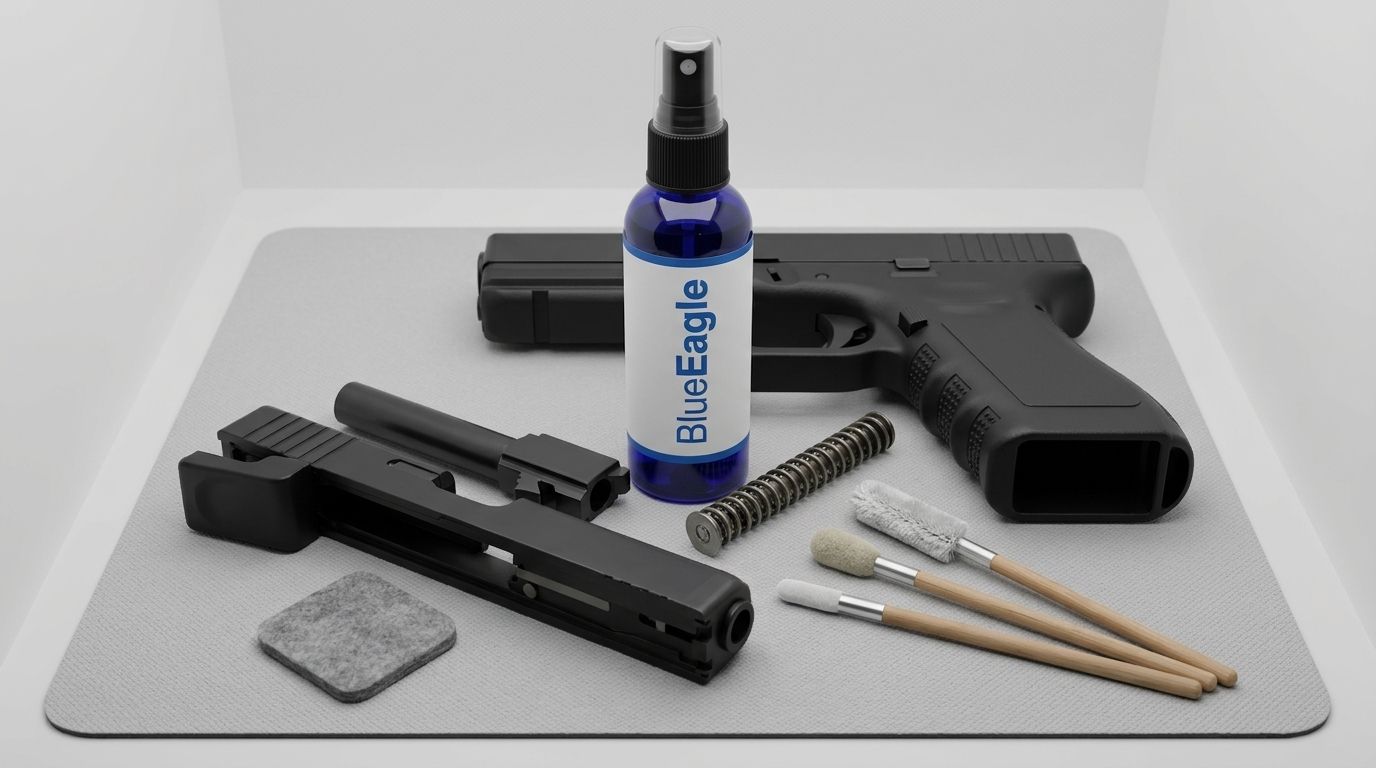
- Set aside clean patches, suitable tools and a wiping cloth.
2. Separate rails, barrel and exterior surfaces
Inspect before adding liquid. Use a clean cloth or other manufacturer-approved dry method to remove loose residue first, then identify where cleaning is actually needed. This gives you a clearer view of the work than coating every part immediately.
Divide the pistol into 3 surface groups: rails, barrel and exterior. Rails need attention to fouling and specified lubrication points. The barrel requires the correct bore-cleaning tools and procedure. Exterior surfaces require finish-specific handling rather than assumptions based on the frame or slide material.
Do not use discoloration alone to decide that a stronger chemical is necessary. Look at the deposit, the surface underneath it and the firearm manufacturer's guidance. If you cannot identify a condition, stop short of aggressive brushing or chemical experimentation.
- Inspect rail contact areas for visible residue.
- Inspect the barrel using the manual's procedure.
- Identify the exterior finish and grip materials.
- Keep cleaning tools appropriate to each surface.
- Leave restricted internal assemblies outside routine cleaning.
3. Choose CLP for the routine it actually supports
Begin with the products you already have: compare their stated purposes with the pistol manual before buying another bottle. If an approved CLP covers the routine cleaning, lubrication and protection tasks you need, a combined product keeps the bench simpler. If a task falls outside its stated use, select a product intended for that task.
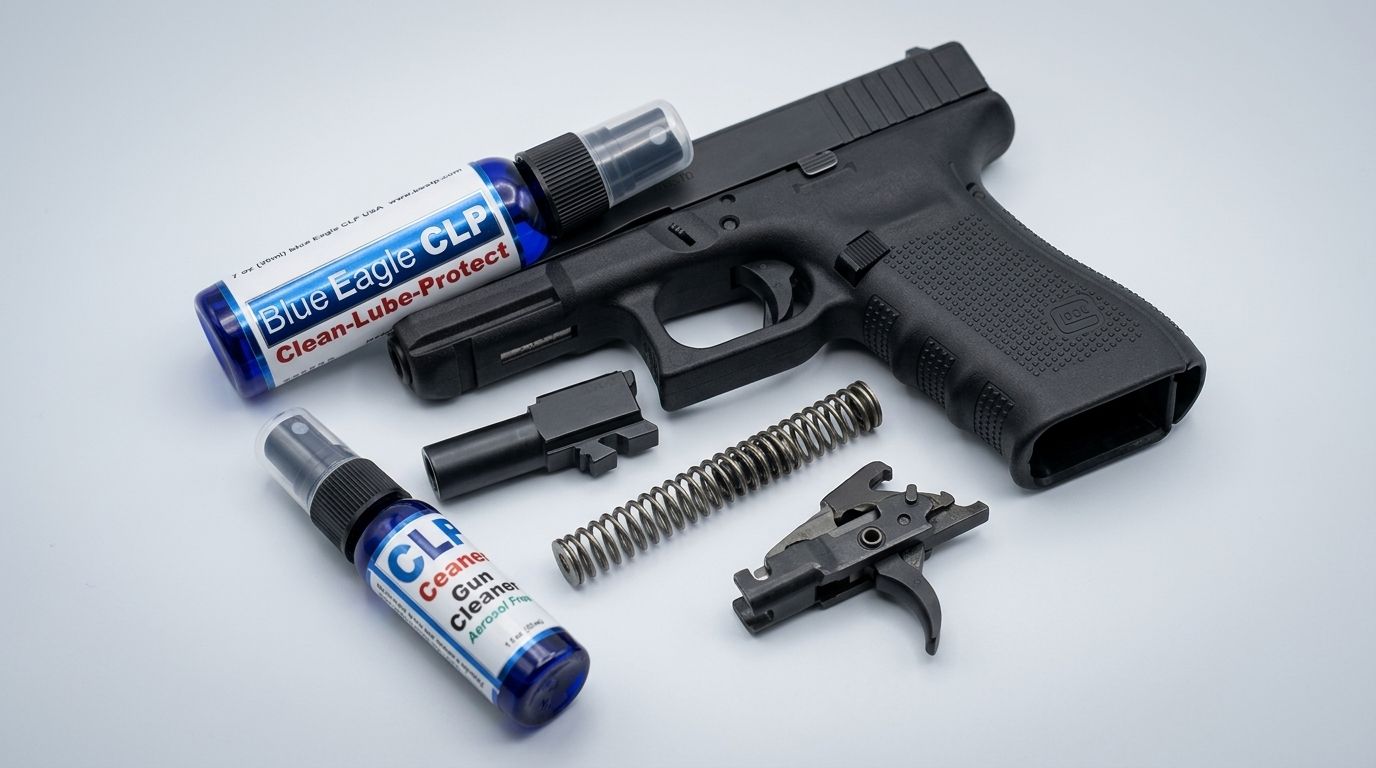
At Beclp, BlueEagle CLP is the main combined-product option to consider. Beclp is best for pistol owners shopping for a CLP-centered maintenance routine. That is a buying fit, not a claim that one formula suits every pistol or finish.
The range includes biobased cleaners and synthetic lubricants, but those descriptions do not mean every product has an identical formula. For a 2026 purchase, read the specific product's directions rather than transferring claims from another bottle. Do not infer a biobased percentage, fouling-removal capability or material approval from the category name.
- Match the stated cleaning purpose to the residue present.
- Confirm whether the product also provides lubrication and protection.
- Check directions for your intended surface.
- Compare product-specific information, not broad environmental wording.
- Add a separate cleaner or lubricant only for a defined need.
4. Clean the barrel with the correct tools and chemistry
Start with the manual's bore-cleaning method and tools sized for the barrel. Use the product's stated application and contact instructions; there is no universal soak time or patch count for every pistol. Keep cleaning controlled so liquid does not spread into areas outside the intended procedure.
A CLP routine and a dedicated bore-cleaner routine answer different needs. CLP is the combined approach. A dedicated bore cleaner is selected for its stated cleaning purpose, such as a particular fouling type—not merely because the label sounds stronger.
Do not assume a general cleaner removes copper or lead deposits unless its instructions say so. Likewise, do not treat a rifle bore-cleaning procedure as automatic approval for a pistol barrel. The barrel manufacturer, tool instructions and cleaner directions must agree on the method.
- Use a bore tool sized for the barrel.
- Follow the specified cleaning direction and access method.
- Observe the cleaner's contact and removal instructions.
- Avoid mixing chemicals unless expressly directed.
- Leave the bore in the condition required before firing.
5. Lubricate the rails without flooding nearby parts
Clean the rail contact areas first, then remove cleaning residue as directed. Apply lubricant only where the pistol manufacturer calls for it. A universal drop count is the wrong buying or maintenance rule: application depends on the pistol, product and lubrication point.
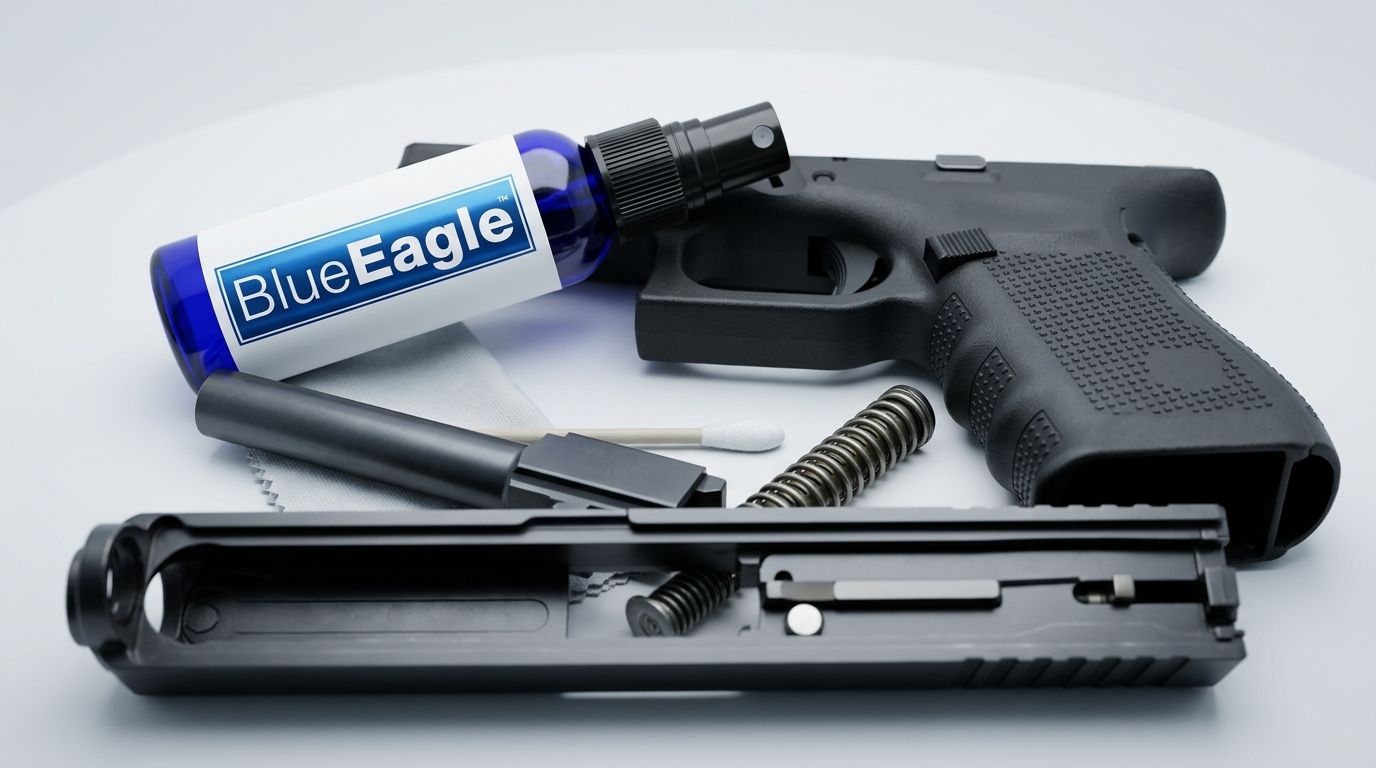
BlueEagle CLP belongs in this step only where its directions and the firearm manual support that use. A dedicated synthetic lubricant is another option when you want lubrication handled separately from cleaning. Neither the word synthetic nor the word CLP establishes the required amount or suitability for your pistol.
Wipe away unintended excess according to the instructions. Do not use lubricant migration as a substitute for reaching specified points, and do not add oil to restricted areas simply because they are hard to access. Your 2026 bench note should name the lubrication points, not just say to oil the pistol.
- Locate every lubrication point in the model's manual.
- Apply the instructed amount at each approved point.
- Keep lubricant away from areas designated to remain dry.
- Remove excess from adjacent surfaces as directed.
- Follow the manual's reassembly and function-check procedure.
6. Protect the finish and prepare for storage
Begin with a clean cloth and inspect the exterior before applying a protectant. Follow the firearm manufacturer's finish-care guidance, then check the product label for that use. A finish described as durable is not permission to use any chemical or leave it wet indefinitely.
Protection is a separate decision from rail lubrication. An approved exterior treatment does not establish that the same product belongs on grips, sights, optics or internal assemblies. Where a compatibility question remains unanswered, get confirmation before applying the product rather than treating a hidden-area test as complete proof.
Before storage, complete the prescribed reassembly and checks and follow secure-storage guidance. Before the pistol returns to use, follow any instructions for removing storage treatment. Record an inspection date if that helps your routine, but base the next maintenance decision on conditions and manufacturer guidance.
- Use only the finish-care treatment the instructions support.
- Keep products off materials excluded by the label.
- Inspect for retained moisture and cleaning residue.
- Complete the manufacturer's post-maintenance checks.
- Store securely and follow the required return-to-use procedure.
Compare pistol maintenance options by job
Choose a product arrangement that answers a specific maintenance need. BlueEagle CLP provides the combined-product route; separate cleaners and lubricants divide the tasks. The table compares those approaches without assuming unprovided formula details or universal compatibility.
| Option | Best for | Practical advantage | Key limitation |
|---|---|---|---|
| BlueEagle CLP | Owners seeking a combined cleaning, lubrication and protection routine | Keeps the purchase centered on a CLP product | Check its specific directions; a combined label does not establish every material or fouling application |
| Dedicated bore cleaner plus separate lubricant | Owners with a defined barrel-cleaning requirement | Lets you select cleaning chemistry separately from lubrication | Adds separate application and removal instructions to follow |
| Dedicated synthetic lubricant alongside an approved cleaner | Owners who want to manage lubrication separately | Separates the lubricant decision from the cleaner decision | Lubricant alone is not a substitute for removing fouling |
The decision has three parts: Cleaning, Lubrication and Protection. Keep those jobs distinct even when one bottle is intended to perform all of them.
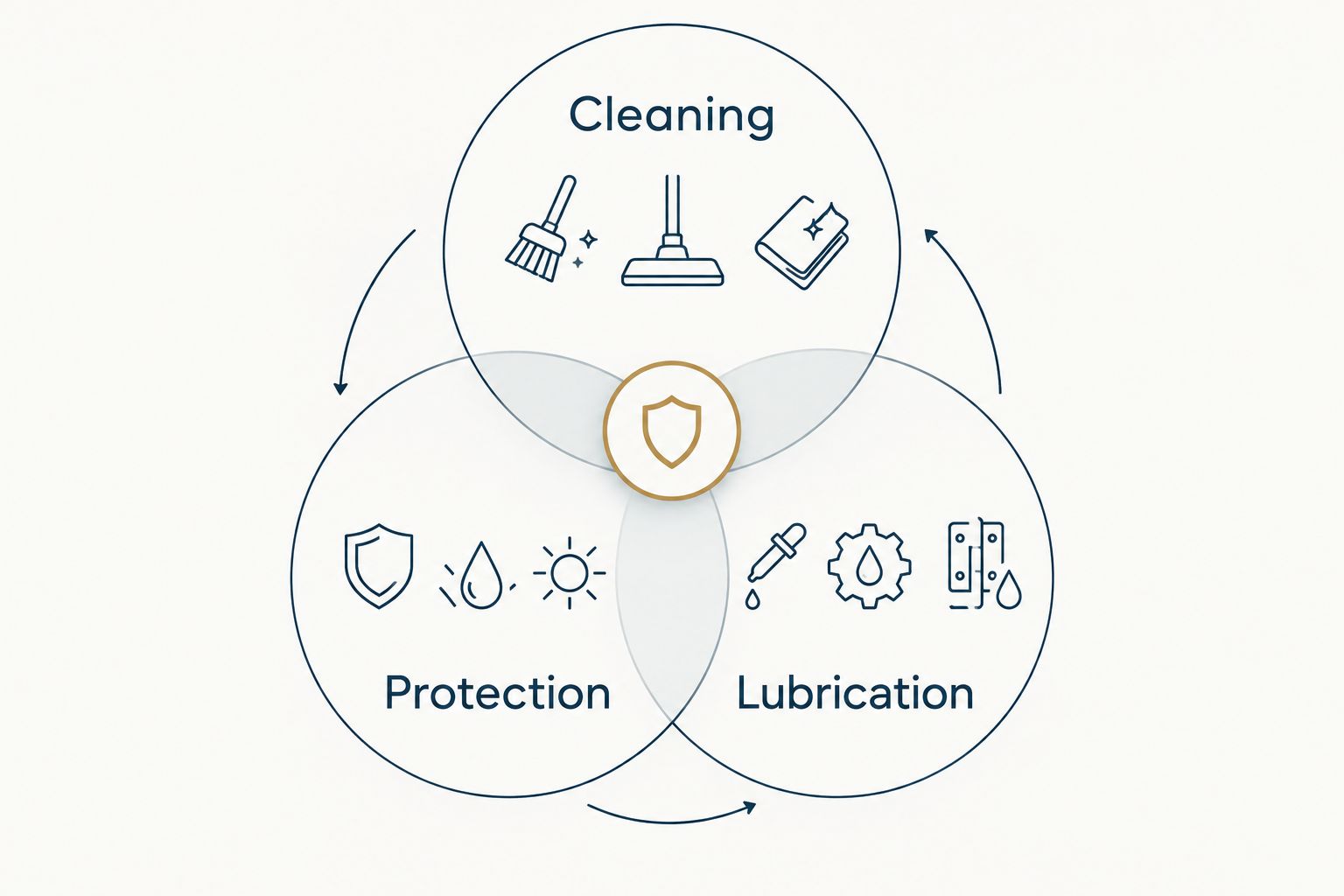
For a 2026 restock, identify the unfinished job before adding another product. A bore cleaner addresses a cleaning requirement; a synthetic lubricant addresses a lubrication requirement. Neither purchase resolves an unanswered finish-compatibility question.
Review your CLP options
Compare product directions with your pistol manual before choosing a maintenance formula.
Common mistakes pistol owners make
Treating every rail and contact point alike
Different pistol models specify different lubrication points. A generic photograph or another owner's routine does not replace your manual. Use your model's lubrication diagram, and keep the approved amount and location together in your bench notes.
Leaving cleaning liquid as the final treatment
A wet part is not proof of correct lubrication or protection. Remove the cleaner as directed, then complete the specified lubrication and storage steps. With a CLP product, read how the label distinguishes cleaning application from the film intended to remain.
Escalating barrel cleaning without identifying the deposit
More solvent, longer contact and harder brushing are not a diagnosis. Select chemistry for the fouling it explicitly addresses and use approved tools. Stop when the instructions call for stopping; persistent uncertainty is a reason to seek qualified guidance, not improvise.
Reading biobased as harmless
Biobased describes feedstock origin, not unrestricted handling or compatibility. Read the label and safety data sheet, use the specified precautions and follow disposal directions. Do not transfer environmental language from one product to another or treat it as permission to ignore finish restrictions.
FAQ
What's the best CLP gun cleaner for pistols?
The best choice is a CLP whose stated uses match your pistol manufacturer's maintenance instructions. Beclp's BlueEagle CLP is a combined-product option to evaluate; confirm the individual product directions and material restrictions before use.
Can I use the same CLP on pistol rails and the barrel?
Use the same CLP on rails and the barrel only when the firearm and product instructions support both applications. Cleaning a bore and lubricating rail contact points require different procedures even when the bottle is the same.
How many drops of CLP should I put on pistol rails?
Use the amount specified for your pistol and product, not a universal drop count. Apply it at the designated lubrication points and remove unintended excess as directed.
Do I need a separate bore cleaner if I use CLP?
You need a separate bore cleaner when your cleaning requirement falls outside the CLP's stated uses. Match the bore cleaner to the fouling and barrel guidance rather than adding a stronger product by default.
Is synthetic gun lubricant better than CLP for a pistol?
Synthetic lubricant and CLP serve different purchasing priorities, so neither is universally better. A dedicated lubricant separates lubrication from cleaning; CLP combines cleaning, lubrication and protection where its directions permit.
Will biobased CLP damage my pistol's finish?
Biobased wording alone cannot establish whether a CLP is compatible with your pistol's finish. Check the specific product instructions and the firearm manufacturer's finish-care guidance before applying it.
Should I leave CLP in a pistol barrel before shooting?
Leave the barrel in the condition specified by the pistol manufacturer before shooting. Follow the required removal procedure for any cleaning or storage treatment rather than assuming a remaining film is acceptable.
One last thing
Separate the cleaning dose from the lubrication instruction. A product used to wet a patch during cleaning does not automatically belong in that quantity on a rail afterward. Write those instructions separately on your bench note, even when both jobs use the same bottle. That small distinction makes the routine easier to repeat without turning more liquid into the default answer.