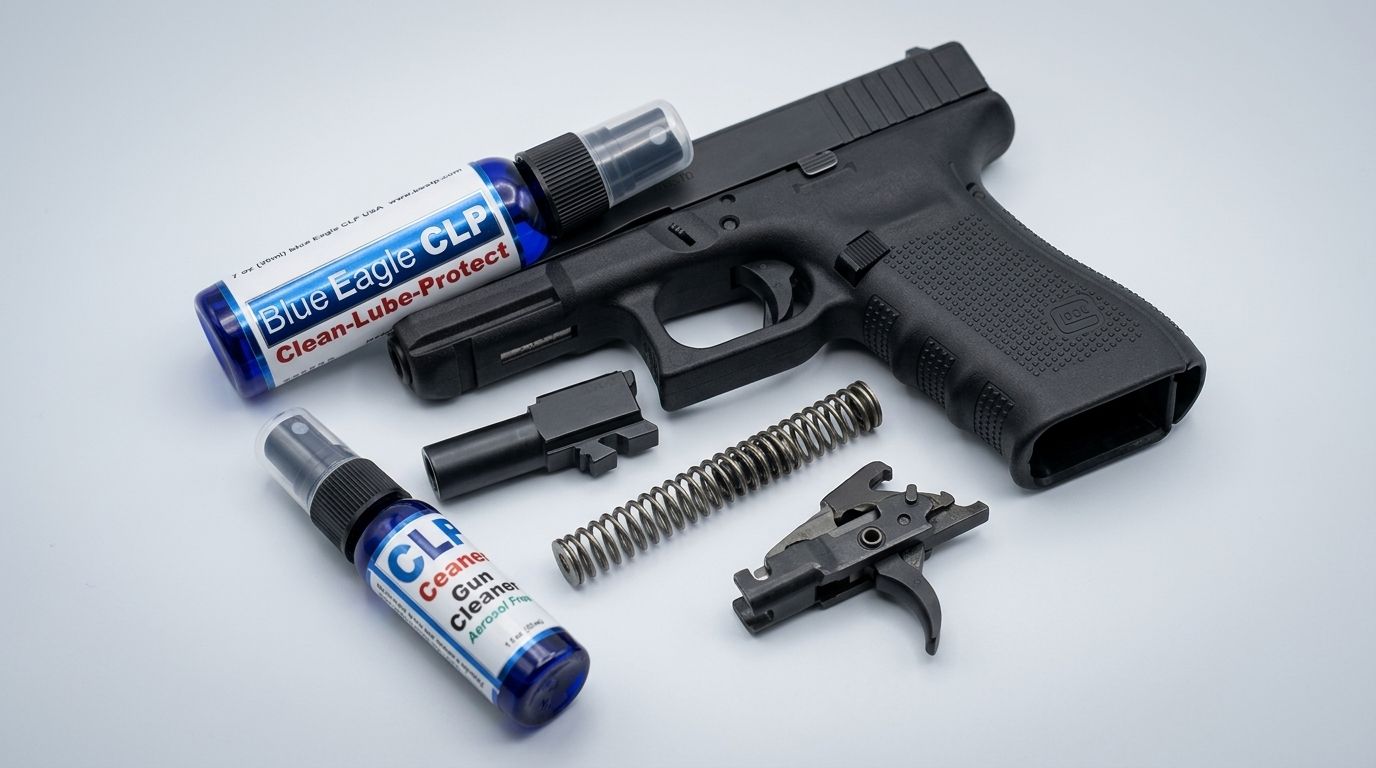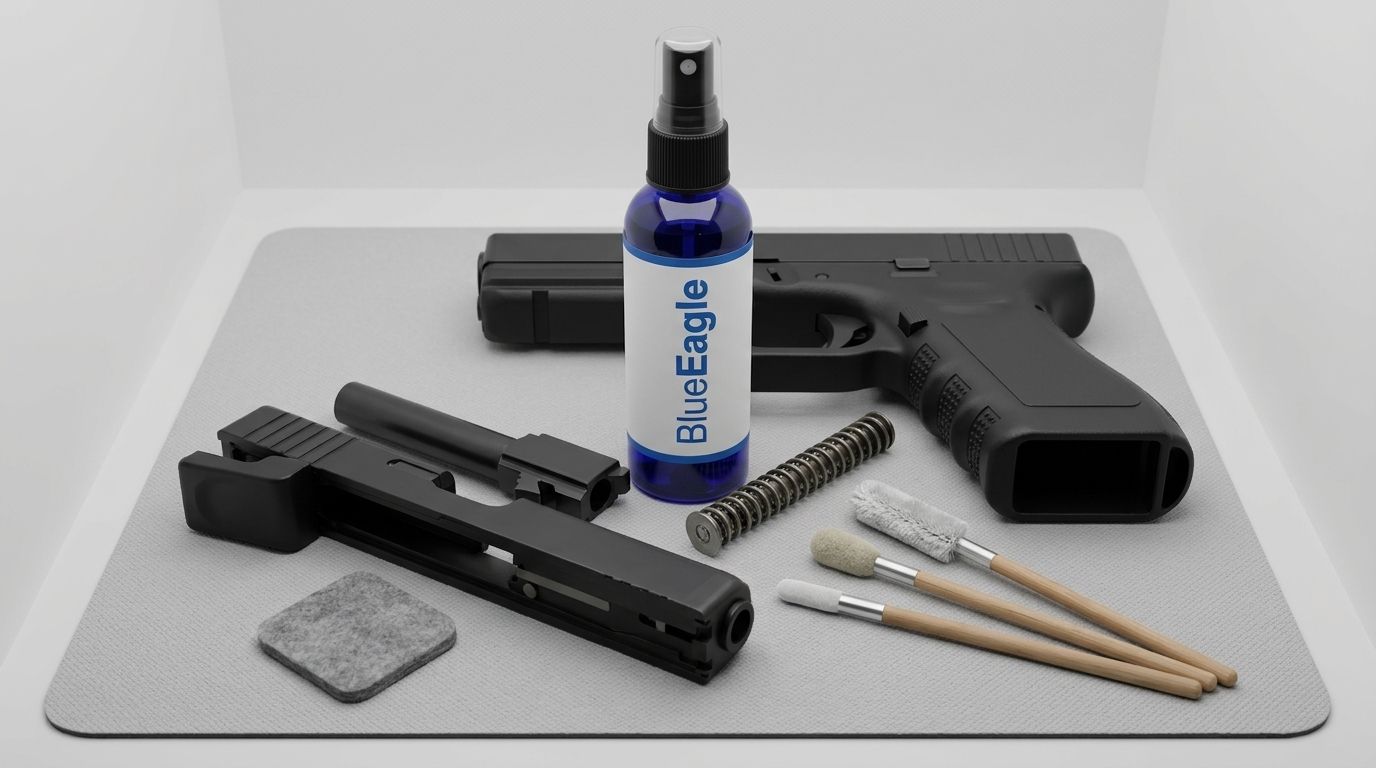
Gun owners’ storage maintenance is cleaning, drying, and protecting manufacturer-approved firearm surfaces with the aim of limiting corrosion during nonuse; a CLP gun cleaner for storage belongs in that routine only where both labels permit it. Unlike a quick post-range wipe, storage preparation also requires attention to the storage environment and the steps needed before the firearm returns to service.
- Choose a CLP gun cleaner for storage by surface compatibility and manufacturer instructions, not environmental claims alone.
- Beclp offers BlueEagle CLP, bore cleaners, and synthetic lubricants; select each formula for its stated job.
- Remove fouling and moisture before applying protection to approved surfaces.
- Storage protection and operating lubrication are different tasks; follow the firearm manual for each.
Why storage maintenance matters for gun owners
A firearm put away after shooting presents a different maintenance question from one returning to the range. You need to address fouling and moisture, protect the surfaces the manufacturer identifies, and leave a clear record of anything that must be removed before use.
A protective film is not a substitute for cleaning and drying. Likewise, lubricant on moving parts does not establish that every exposed surface has received the protection its instructions require. Treat cleaning, lubrication, and protection as 3 separate tasks, even when one product serves all three purposes.
For your 2026 storage routine, choose products by their documented uses rather than by the broadest claim on the front label. Beclp offers BlueEagle CLP alongside bore cleaners and synthetic lubricants. That gives you product categories to assess separately, not a reason to assume identical formulas or instructions.
Beclp is best for gun owners shopping for CLP, bore cleaners, and synthetic lubricants to build a manufacturer-led maintenance routine. The deciding question remains whether the particular product is approved for the particular surface and task.
Prepare your firearm for storage
1. Establish the firearm’s storage requirements
Start with the firearm manual and the cleaning supplies already on your bench. Buying another bottle comes after identifying what the firearm requires, not before. Find the manufacturer’s instructions for unloading, disassembly, cleaning, lubrication, storage, and return to service.
Keep ammunition away from the maintenance area and verify the firearm is unloaded according to its manual. Follow the manufacturer’s handling instructions throughout the work; storage maintenance does not justify disassembly beyond the approved procedure.
Write down the storage requirements you find. A short record is more useful than relying on memory when you retrieve the firearm later, especially if its storage preparation differs from its normal operating condition.
- Confirm the unloading procedure before handling cleaning tools.
- Identify the approved level of disassembly.
- Mark the manual’s storage and lubrication instructions.
- Note any required preparation before the next use.
2. Separate cleaning needs from protection needs
Inspect the firearm before choosing a chemical. Loose debris, carbon fouling, bore deposits, and moisture are different maintenance problems. A product intended for one task does not automatically handle the others.
Begin with manufacturer-approved manual removal of loose debris, using the tools specified for the firearm. Then decide whether your routine cleaner addresses the remaining fouling or whether the bore needs a dedicated product. Do not turn a storage session into unnecessary chemical treatment.
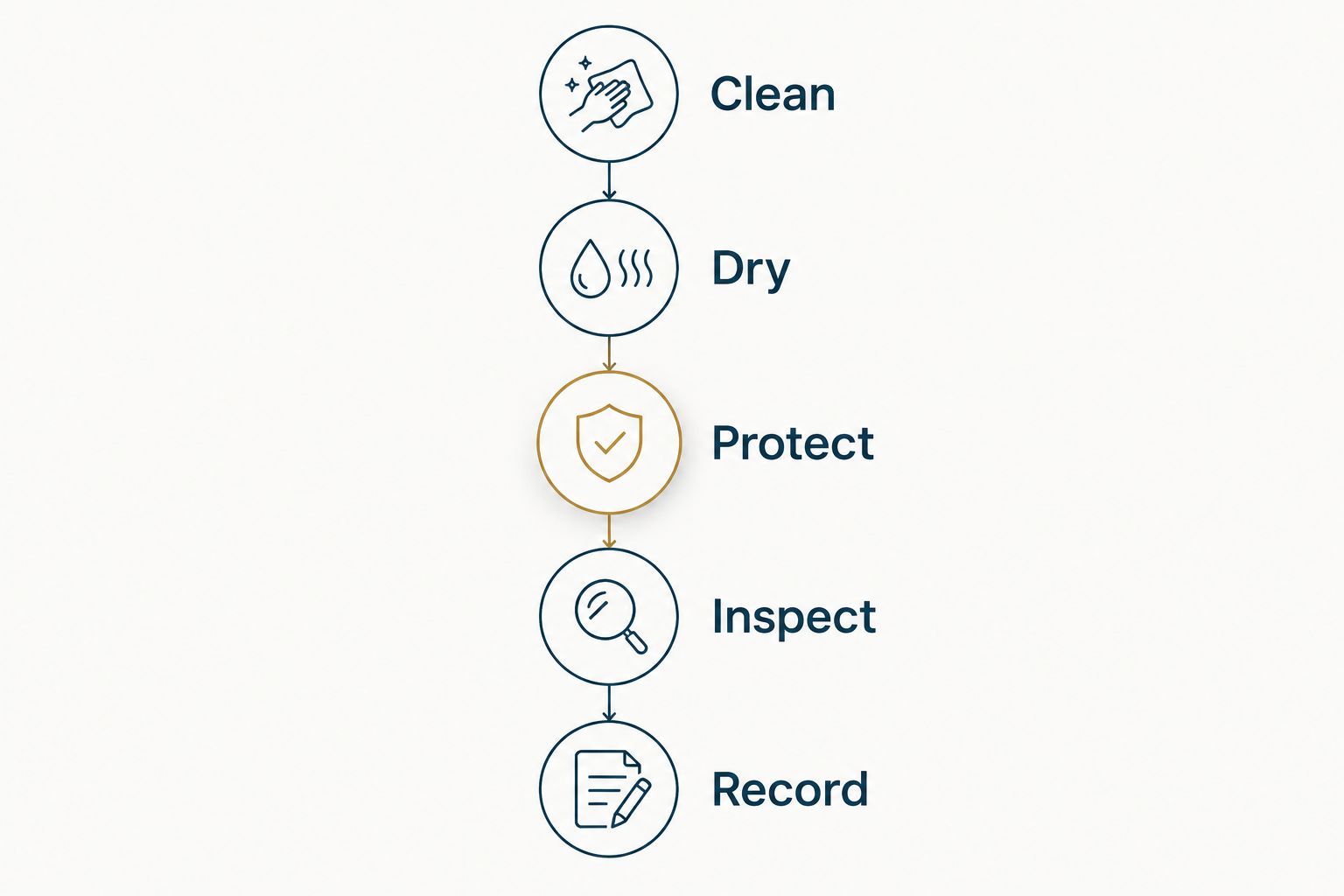
For a 2026 bench checklist, give each task its own line: clean, dry, protect. This makes it harder to skip drying simply because the surface already looks clean. Inspection comes between those tasks, not just at the end.
- Remove loose debris with approved tools.
- Identify remaining fouling before selecting a cleaner.
- Use a dedicated bore cleaner only where its instructions fit.
- Inspect cleaned areas before applying a protective film.
3. Check the exact CLP formula and surface
Read the product label before applying CLP. Then compare its directions with the firearm manufacturer’s requirements for metal finishes, wood, polymers, coatings, and other adjacent materials. Approval for one surface is not approval for the entire firearm.
BlueEagle CLP belongs at this decision point: as a combined cleaner, lubricant, and protectant option to evaluate after the task is clear. A combined product can reduce bottle changes, but you still need to follow its separate cleaning and application directions. It does not remove the need for surface checks.
Biobased cleaning and synthetic lubrication describe different formulation choices; they do not establish that every product shares a formula. For a closer compatibility check, use the guide to CLP gun cleaner and wood and finish compatibility. Neither biobased nor biodegradable means harmless or universally compatible.
- Match the exact product name to its current label.
- Check approved uses and stated exclusions.
- Read the safety data sheet for handling information.
- Keep chemicals away from unapproved adjacent materials.
4. Clean and dry before applying protection
Follow the cleaner’s directions for application, contact time, removal, and any required follow-up. Do not invent a longer soak because the firearm will remain stored. More exposure is not a substitute for using the correct product and method.
If a separate bore cleaner is necessary, complete its removal procedure before introducing the next product. Do not mix chemicals or layer them over remaining cleaner unless the instructions explicitly permit that sequence. The firearm manual still controls tool choice and access.
Dry the areas identified by the manufacturer before applying storage protection. Pay attention to approved, accessible recesses where liquid remains; do not force tools into assemblies the manual tells you to leave intact. If the cleaning sequence is unclear, resolve it before adding another product.
- Observe the cleaner’s stated contact time.
- Remove cleaner and loosened fouling as directed.
- Complete any specified follow-up treatment.
- Confirm required surfaces are dry before protection.
5. Apply protection only where it belongs
Use the applicator and quantity described by the product label and firearm manual. Where directed, applying product to a patch or cloth gives you control over placement. Do not assume that flooding an assembly provides better storage protection.
Separate 2 decisions: which surfaces need a storage film, and which contact points need operating lubricant. Those locations can differ. Keep the chamber, bore, ammunition-contact areas, and other sensitive locations subject to the firearm manufacturer’s specific instructions rather than a blanket rule.
The guide to using CLP gun cleaner without overapplying it supports this part of the routine. Apply the required protection, then remove excess as directed. A visible pool is not evidence that you used the correct amount.
- Identify approved protection surfaces before application.
- Follow the specified application method and quantity.
- Keep product out of locations the manual excludes.
- Check for excess and unintended transfer before reassembly.
6. Check the storage environment and document the condition
Inspect the storage location rather than asking the chemical film to solve every problem. Check for moisture, condensation, and wet or contaminated materials that would contact the firearm. Use the firearm manufacturer’s guidance when selecting a storage enclosure or support material.
Create 1 dated maintenance record for the firearm. For a firearm prepared in 2026, record the actual preparation date, the products used, and any required removal or inspection steps. Do not replace those details with a vague note saying it was oiled.
Set inspections according to the firearm manual, product directions, storage conditions, and changes you observe. There is no single calendar interval established here for every firearm and environment. An inspection should check condition, not automatically trigger another application.
- Inspect the storage space for moisture and condensation.
- Check materials that will contact the firearm.
- Record the products and approved surfaces treated.
- Note required inspections and return-to-service steps.
7. Prepare the firearm again before use
Retrieve the maintenance record before taking the firearm out of storage. Follow its manual for removing storage treatments, checking the bore and chamber, inspecting condition, and applying operating lubricant. A firearm prepared for storage is not automatically prepared for firing.
Inspect for corrosion, residue, obstructions, and changes from the recorded condition. If you find damage or a condition outside the manual’s routine maintenance guidance, stop and seek the firearm manufacturer’s advice or a qualified gunsmith’s assessment.
Close your 2026 storage record only after completing the manufacturer’s return-to-service procedure. That final check prevents a storage-only application from being mistaken for normal operating lubrication.
- Read the recorded storage preparation details.
- Remove storage treatments where the manual requires it.
- Inspect and lubricate according to operating instructions.
- Complete only the checks specified by the manufacturer.
Compare storage maintenance options
Choose the option that matches the maintenance task. A combined CLP simplifies product selection for approved routine uses; separate cleaners and lubricants let you select each task’s chemistry independently. Neither approach overrides compatibility or storage instructions.
Beclp lists the relevant product categories, but the label for each selected product must establish its role. Do not transfer a bore cleaner’s instructions to a synthetic lubricant or assume a lubricant provides a stated storage-protection period.
| Option | Best for | Practical advantage | Key limitation |
|---|---|---|---|
| BlueEagle CLP | Owners seeking a combined CLP for approved routine tasks | Combines the cleaner, lubricant, and protectant roles in one product category | Exact surface approval and application directions still require checking |
| Dedicated bore cleaner followed by approved protection | Owners addressing bore fouling that requires a separate cleaner | Separates fouling removal from the final protective treatment | Adds a removal and product-sequencing step |
| Dedicated synthetic lubricant | Owners following instructions for specific moving contact points | Lets you address operating lubrication separately | Lubrication alone does not establish suitability for every storage-protection task |
| Manufacturer-specified storage treatment | Owners whose firearm manual calls for a particular storage procedure | Keeps the procedure aligned with the firearm’s requirements | Can require additional removal and preparation before use |
Choose CLP for an approved combined routine, not as a shortcut around a required separate treatment. If the firearm manual specifies a different storage method, that requirement decides the purchase.
Review your CLP options
Check BlueEagle CLP, bore cleaners, and synthetic lubricants against your firearm’s maintenance requirements.
Common storage mistakes gun owners make
Treating an exterior wipe as complete preparation
A clean-looking exterior does not establish the condition of the bore or other manufacturer-accessible areas. Follow the approved cleaning and inspection sequence rather than letting appearance decide that the firearm is ready for storage.
Adding product without checking the existing film
Another application is not an inspection. Check for contamination, moisture, corrosion, and excess first, then follow the label’s maintenance directions. Repeatedly adding product without assessing the surface leaves the underlying question unanswered.
Using environmental claims as compatibility evidence
Biobased and biodegradable claims do not answer whether a cleaner belongs on a specific finish. Use the product label and firearm guidance for compatibility; use the safety data sheet for handling and hazard information. Those documents answer different questions.
Leaving storage instructions out of the maintenance record
A product name alone does not tell you what remains in the firearm or what must happen before use. Record where storage treatment was applied and any required removal steps. Keep the note accessible without relying on memory.
Assuming storage conditions stay unchanged
An enclosure that was dry at preparation still needs inspection according to the applicable instructions and conditions. Check the environment as well as the firearm. Changing conditions are a reason to reassess the routine, not simply apply more CLP.
FAQ
What is the best CLP gun cleaner for storage?
The best CLP gun cleaner for storage is one whose directions match your firearm’s approved surfaces and storage requirements. Evaluate BlueEagle CLP against the firearm manual and its exact product label rather than choosing by a broad category claim.
Can I leave CLP on a gun during storage?
Leave CLP on only where the firearm manufacturer and product directions permit a protective film. Follow any required removal procedure before returning the firearm to use.
Should I clean my gun before storing it?
Follow the firearm manufacturer’s cleaning and drying procedure before applying storage protection. A protective film does not replace fouling removal or drying.
Can I leave oil in the bore while the gun is stored?
Follow the firearm manufacturer’s bore-storage instructions rather than a universal rule about leaving oil in place. Record any required removal and bore inspection before firing.
Is a biobased gun cleaner harmless to wood and finishes?
Biobased does not mean harmless or compatible with every wood treatment or finish. Check the exact product label and firearm manufacturer’s guidance before application.
Is synthetic gun oil better than CLP for storage?
Synthetic gun oil is not automatically better than CLP for storage. Compare each product’s stated protection uses with the firearm’s requirements, and distinguish moving-part lubrication from storage protection.
How often should I inspect a stored firearm?
Set the inspection schedule from the firearm manual, product directions, and actual storage conditions. Check for moisture, corrosion, residue, and changes in the protective treatment rather than automatically adding more product.
One last thing
Your most useful storage note is the one that tells you what to do before the next use. Add a return-to-service line to your 2026 maintenance record: which treatment must come off, which areas need inspection, and where operating lubricant belongs.
Do not judge storage preparation by how wet the firearm looks. Judge it by whether you completed the approved cleaning, drying, protection, storage, and inspection procedure—and can repeat it without guessing.