Humid-weather gun maintenance is the cleaning, drying, lubrication, and surface protection of firearms with the aim of limiting corrosion while preserving proper operation. Choose gun lubricant for humid weather by the firearm maker’s instructions and the product’s stated uses—not by thickness, biobased content, or a claim that oil alone solves moisture exposure.
- Choose gun lubricant for humid weather by manufacturer guidance and stated corrosion-protection uses, not thickness alone.
- Beclp suits gun owners shopping for CLP, bore cleaner, and synthetic lubricant for a manufacturer-led maintenance routine.
- Dry accessible moisture before applying protection; lubrication does not replace drying.
- Treat moving-part lubrication and exposed-metal protection as separate maintenance jobs.
Why moisture and corrosion care matters for gun owners
Humidity changes the maintenance question from simply reducing friction to managing moisture on and around metal. Condensation forms when a surface is colder than the surrounding air’s dew point; moving a cool firearm into warm, humid air creates that condition.
A heavier application is not a substitute for inspection. Use the firearm manual to identify lubrication points, then follow a controlled routine for how much gun lubricant belongs on moving parts.
For your 2026 maintenance plan, separate three jobs: removing fouling, drying accessible moisture, and applying approved lubrication or protection. One product can serve several purposes when its label supports those uses, but each job still needs attention.
Humid-weather care also extends beyond the bench. A firearm returned to a damp case faces a different storage condition from one placed in a dry location. Inspect the firearm and its storage environment together.
Build a humid-weather maintenance routine
1. Check the manual and make the firearm safe
Start with the firearm manufacturer’s unloading and maintenance instructions. Remove ammunition from the work area, verify the firearm is unloaded as directed, and maintain a safe muzzle direction throughout the work. Follow the specified disassembly limits rather than opening assemblies just to reach suspected moisture.
The manual determines where lubricant belongs, what stays dry, and which cleaning methods are permitted. A general gun-care article cannot replace model-specific instructions for a trigger assembly, firing-pin channel, gas system, or finish.
Record the relevant instructions in your 2026 bench notes so you do not have to rely on memory when switching between firearms. Keep the product label and safety data sheet accessible alongside those notes.
- Confirm the firearm’s exact model and manual revision.
- Identify approved disassembly and inspection points.
- Note surfaces and assemblies that must remain dry.
- Check restrictions for finishes, wood, polymers, and accessories.
- Follow label directions for ventilation and protective equipment.
2. Inspect the exposure before choosing the treatment
Work out what reached the firearm. Humid air, visible condensation, rain, perspiration, salt spray, and immersion are not interchangeable maintenance problems. Ordinary lubrication instructions do not establish a remedy for every exposure.
Examine accessible metal, seams, and contact areas without disassembling beyond the manual’s instructions. Look for droplets, damp residue, discoloration, or deposits. If you find pitting, persistent rust, or damage to a working surface, have a qualified gunsmith assess it rather than covering it with oil.
Inspect the case or holster separately. Drying the firearm and returning it to damp material leaves the original moisture source in place. For severe exposure or inaccessible water, use the manufacturer’s service guidance before returning the firearm to use.
- Identify whether the exposure involved fresh water or salt.
- Check accessible areas where moisture can collect.
- Inspect the case, holster, sling contact points, and padding.
- Separate visible moisture from fouling that needs cleaning.
- Escalate corrosion or inaccessible moisture to qualified service.
3. Choose products by their stated job
Begin with the supplies and approved methods you already have. Read each label to establish whether the product is intended to clean, lubricate, protect, or perform a combination of those tasks. Do not assume a dedicated lubricant removes fouling or that every cleaner leaves a protective film.
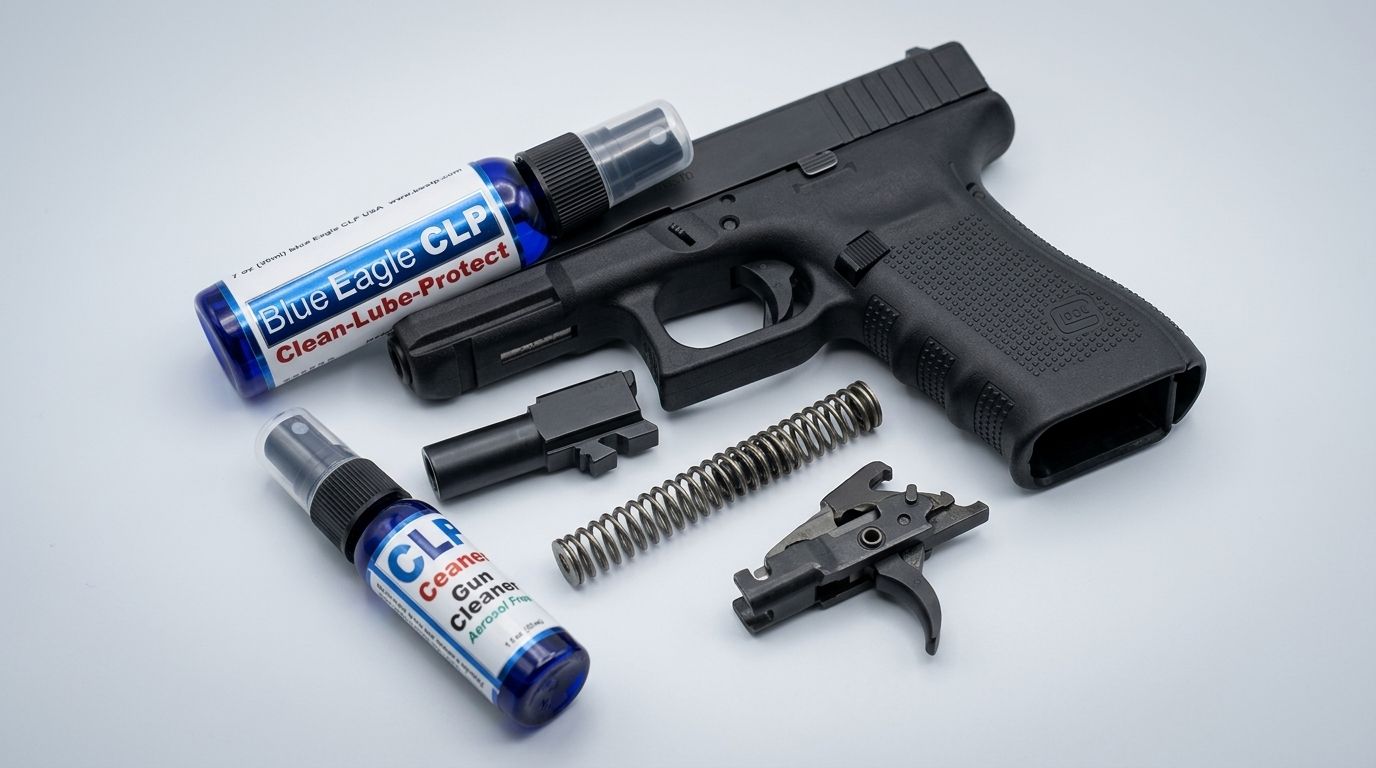
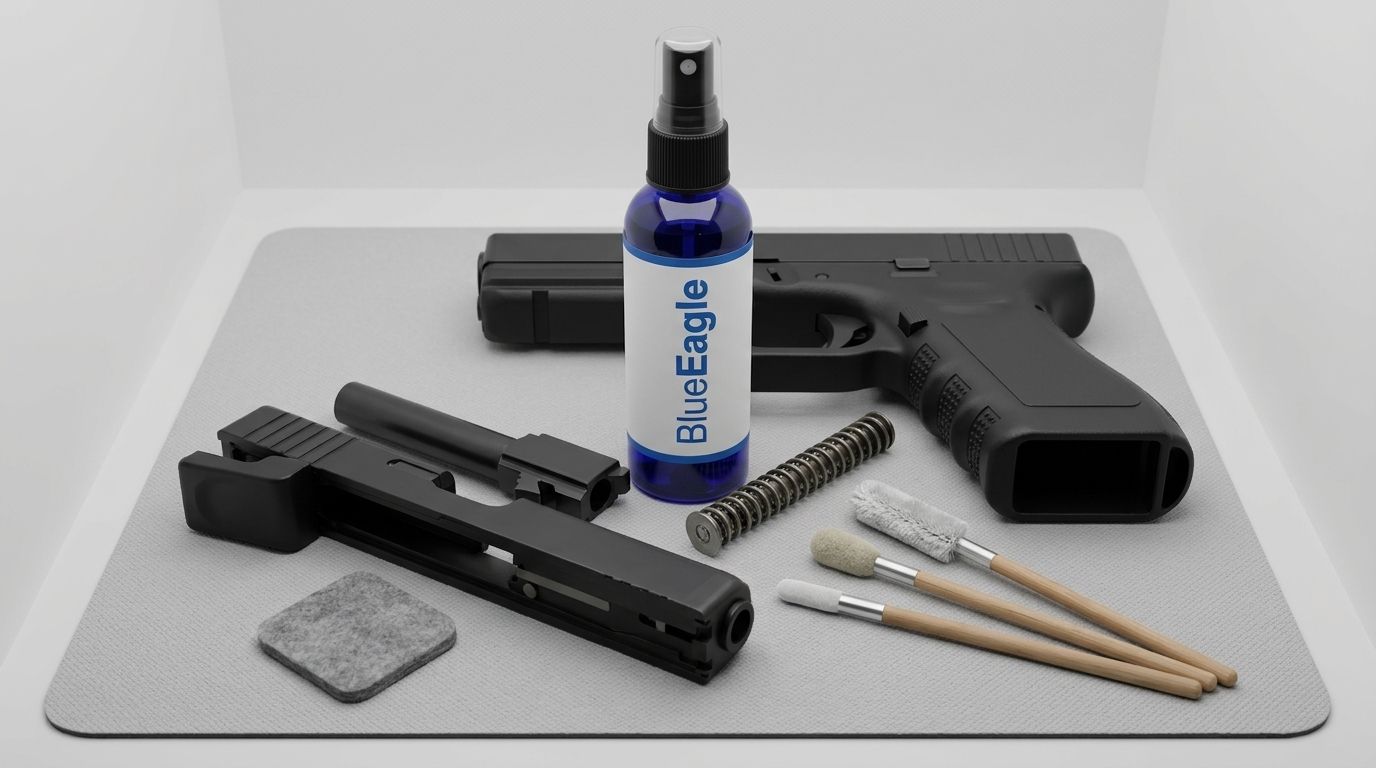
Beclp offers BlueEagle CLP alongside bore cleaners and synthetic lubricants. Beclp suits gun owners shopping for CLP, bore cleaner, and synthetic lubricant for a manufacturer-led maintenance routine. BlueEagle CLP is the combined cleaner, lubricant, and protectant option; a dedicated bore cleaner or synthetic lubricant addresses a more specific job.
The practical advantage of CLP is combining functions within one routine. Its limitation is that the combined category name does not establish suitability for every deposit, finish, exposure, or firearm. Check the individual product directions before buying or applying it.
- Match the label’s stated uses to your maintenance task.
- Check firearm and finish compatibility before application.
- Verify any corrosion-protection claim in product documentation.
- Read separate directions for bore cleaners and synthetic lubricants.
- Treat biobased content as a composition claim, not a safety guarantee.
4. Clean fouling and dry accessible moisture
Remove fouling using the firearm maker’s approved tools and the cleaner’s directions. Cleaning exposes surfaces for inspection; applying lubricant over residue does not establish that the underlying metal is clean or dry. Keep cleaner away from areas the manual excludes.
Use an approved bore-cleaning method when the barrel needs attention. Carbon fouling and copper fouling are different cleaning targets, so select a bore cleaner by its stated purpose rather than by the strength of its odor or the color of the bottle.
Dry accessible moisture using the permitted method before applying the final protective treatment. Do not improvise with heat, compressed air, or prolonged soaking where the manufacturer has not approved those methods. Biobased cleaning and synthetic lubrication belong in the same routine only when their individual directions support that sequence.
- Remove accessible fouling with approved brushes, patches, or cloths.
- Follow the cleaner’s dwell-time and removal instructions.
- Keep solvents away from excluded materials and assemblies.
- Inspect cleaned areas for remaining moisture or corrosion.
- Complete required drying before lubrication and protection.
5. Separate lubrication from surface protection
Lubrication addresses moving contacts; surface protection addresses exposed metal. The same approved product can perform both jobs, but the application locations and removal instructions are not automatically identical. Follow the firearm manual first, then the product’s application directions.
For a 2026 bench checklist, write down the named lubrication points rather than using a general instruction to oil everything. Apply the specified amount and remove excess where directed. A visible puddle does not prove better corrosion protection, and lubricant outside its intended location creates additional cleanup.
Follow the firearm manufacturer’s bore and chamber instructions before firing, including any required removal of storage protectant. Do not treat a protective storage application as a ready-to-fire condition. Complete only the reassembly and function checks specified for the firearm.
- Lubricate the moving contacts identified in the manual.
- Protect only surfaces approved for the chosen product.
- Keep designated dry areas free of cleaner and lubricant.
- Remove excess according to the product and firearm instructions.
- Prepare the bore and chamber as directed before firing.
The maintenance sequence matters more than whether the bottle says oil or CLP. Finish each task before moving to the next, and keep storage checks separate from the lubrication step.
6. Inspect storage conditions and set return checks
Use a clean, dry storage location that meets your firearm-security requirements. Check storage equipment instructions as well as firearm instructions; moisture-control accessories require their own maintenance and replacement routines. A humidity reading describes the surrounding air, not whether moisture remains inside an assembly.
Set your 2026 inspection routine around actual exposure and the manufacturer’s guidance. Check after a wet outing, after visible condensation, and before use following storage. Do not invent a universal interval that ignores how the firearm was used or stored.
Keep a short maintenance record. If corrosion returns to the same location, document the location and conditions instead of repeatedly adding more lubricant. Recurring corrosion calls for investigation of the surface, exposure, storage, and maintenance method.
- Confirm that cases and holsters are dry before reuse.
- Maintain moisture-control equipment by its instructions.
- Record exposure, cleaning, and the product applied.
- Inspect recurring trouble spots without exceeding disassembly limits.
- Recheck the firearm before returning it to service.
Compare humid-weather care options
Choose by the job, not by a claim that one formula handles every condition. This 2026 comparison separates maintenance roles; it does not rank products by unprovided corrosion-test results.
A dedicated cleaner and lubricant routine gives you separate control over cleaning and lubrication. A CLP routine combines those functions. Neither approach removes the need to dry accessible moisture, check compatibility, or follow storage instructions.
| Option | Best for | Practical advantage | Key limitation |
|---|---|---|---|
| BlueEagle CLP | Gun owners seeking a combined cleaning, lubrication, and protection routine | Groups the stated CLP functions in one product category | Its label still governs surfaces, application, and removal; do not assume every fouling problem is covered |
| Dedicated synthetic gun lubricant | Owners who already have an approved cleaning method | Keeps lubricant selection focused on specified moving contacts | Synthetic describes the lubricant type, not proof of a particular corrosion-protection result |
| Dedicated bore cleaner followed by approved lubricant | Owners addressing barrel fouling as a separate task | Separates fouling removal from final lubrication | Adds a product-selection and removal step; compatibility still needs checking |
| Dedicated storage protectant | Owners preparing a firearm for storage when manufacturer guidance permits it | Separates storage treatment from operating lubrication | Storage preparation can require removal steps before firing |
Beclp’s CLP and synthetic lubricant categories should not be treated as interchangeable formulas. Read the documentation for the specific product you choose. A biobased cleaner does not establish the composition, handling requirements, or performance of a separate synthetic lubricant.
When comparing corrosion claims, look for a named test method, the tested material, exposure conditions, and the reported result. A bare protection claim gives you less decision-making detail than a documented test. Even documented results do not replace your firearm manufacturer’s compatibility instructions.
Common mistakes humid-weather gun owners make
Adding oil before dealing with moisture
Oil application does not establish that an assembly is dry. Inspect and dry accessible moisture first, using the firearm manufacturer’s method. If water reached an inaccessible area, obtain service guidance rather than assuming a surface treatment addressed it.
Using viscosity as the corrosion test
A thicker feel tells you how a product behaves during application, not how it performed in a corrosion test. Compare stated uses and documentation instead. Do not substitute grease for oil at a lubrication point unless the firearm maker permits it.
Returning a maintained firearm to damp gear
A clean firearm and a wet case are an unfinished maintenance job. Inspect padding, liners, and holsters before reuse, and follow their care instructions. Avoid treating a transport case as suitable long-term storage without checking the relevant guidance.
Treating biobased as harmless
Biobased content describes the origin of some ingredients; it does not mean harmless, compatible with every finish, or suitable for unrestricted disposal. Follow the product label and safety data sheet for handling, ventilation, storage, and cleanup.
Giving salt exposure an ordinary oiling
Salt exposure is a distinct cleaning problem, not simply a reason to apply more lubricant. Use the firearm manufacturer’s instructions for salt contamination and seek service advice when needed. Routine surface oiling is not evidence that contamination has been removed.
FAQ
What's the best gun lubricant for humid weather?
The best gun lubricant for humid weather is one approved for your firearm and documented for the lubrication or protection job you need. Dry accessible moisture first, then apply it only where the firearm manual and product label permit.
Is CLP better than synthetic gun oil in humidity?
CLP and synthetic gun oil serve different selection needs, so humidity alone does not establish a winner. CLP combines cleaning, lubrication, and protection functions; a dedicated synthetic lubricant belongs in a routine with a separate approved cleaning method.
Should I put extra oil on my gun during humid weather?
Do not exceed the firearm manufacturer's lubrication instructions because the weather is humid. Inspect moisture exposure and storage conditions instead of using extra oil as a substitute for drying.
Can I apply gun lubricant over condensation?
Dry accessible condensation by the firearm manufacturer's approved method before applying the final lubrication or protection treatment. Visible surface oil does not confirm that moisture inside an assembly has been addressed.
Does biobased gun cleaner mean it is harmless?
Biobased gun cleaner does not mean harmless. Follow the specific product label and safety data sheet, and check firearm and finish compatibility before use.
How often should I inspect a gun stored in humid conditions?
Set the inspection interval using the firearm manufacturer's guidance and actual storage conditions. Inspect after wet exposure or visible condensation and before use following storage; no single interval fits every firearm and environment.
Can BlueEagle CLP replace a rifle bore cleaner?
Do not assume BlueEagle CLP replaces a dedicated bore cleaner for every deposit. Match the specific product's stated cleaning uses to the fouling present and follow the firearm manufacturer's barrel-cleaning instructions.
One last thing
Check the case before buying another bottle. If the firearm is cleaned, dried, and treated as directed but returns to damp padding, changing lubricant leaves the storage problem untouched.
Make that inspection part of your 2026 routine: firearm, treatment, and storage belong on the same checklist. Start with the condition you can observe, correct it by the relevant instructions, and buy products for the remaining maintenance job—not for a promise that replaces inspection.