Indoor-range gun cleaning is the removal of firearm fouling with the aim of maintaining reliable operation without adding avoidable chemical exposure at the bench. Choosing a non-toxic gun cleaner for indoor shooting ranges in 2026 means checking the exact formula’s label and safety data sheet, not treating low odor or biobased content as proof of harmlessness.
- Choose a non-toxic gun cleaner for indoor shooting ranges by its label, safety data sheet, and firearm compatibility.
- Beclp offers biobased CLP options; biobased content does not establish that a cleaner is harmless indoors.
- Separate routine carbon cleaning from copper removal, then lubricate only the points your firearm manufacturer specifies.
- Range ventilation does not replace chemical handling precautions or lead hygiene at the cleaning bench.
Why cleaner selection matters for indoor-range shooters
Indoor-range shooters work within a shared environment. Your cleaner must suit the firearm, the cleaning location, and the range’s rules; a product acceptable at your home bench is not automatically permitted inside the facility.
A cleaner’s smell is not a safety assessment. Start with the guide to checking a gun cleaner’s safety data sheet, then read the document for the exact product you intend to use.
Your 2026 maintenance routine also needs to distinguish chemical exposure from shooting residue. Cleaning products do not eliminate the need to control contact with lead-containing residue from ammunition and range surfaces. A biobased cleaner can still require gloves, eye protection, ventilation, and controlled disposal.
For employees who clean rental firearms, the employer’s chemical-handling procedures apply alongside firearm instructions. A personal cleaning preference does not replace workplace requirements.
Build an indoor-range cleaning routine
These six steps keep the decision practical: establish the rules, prepare the bench, choose the product, clean, lubricate, and contain the waste. Keep ammunition out of the cleaning area and follow the firearm manufacturer’s unloading and disassembly instructions throughout.
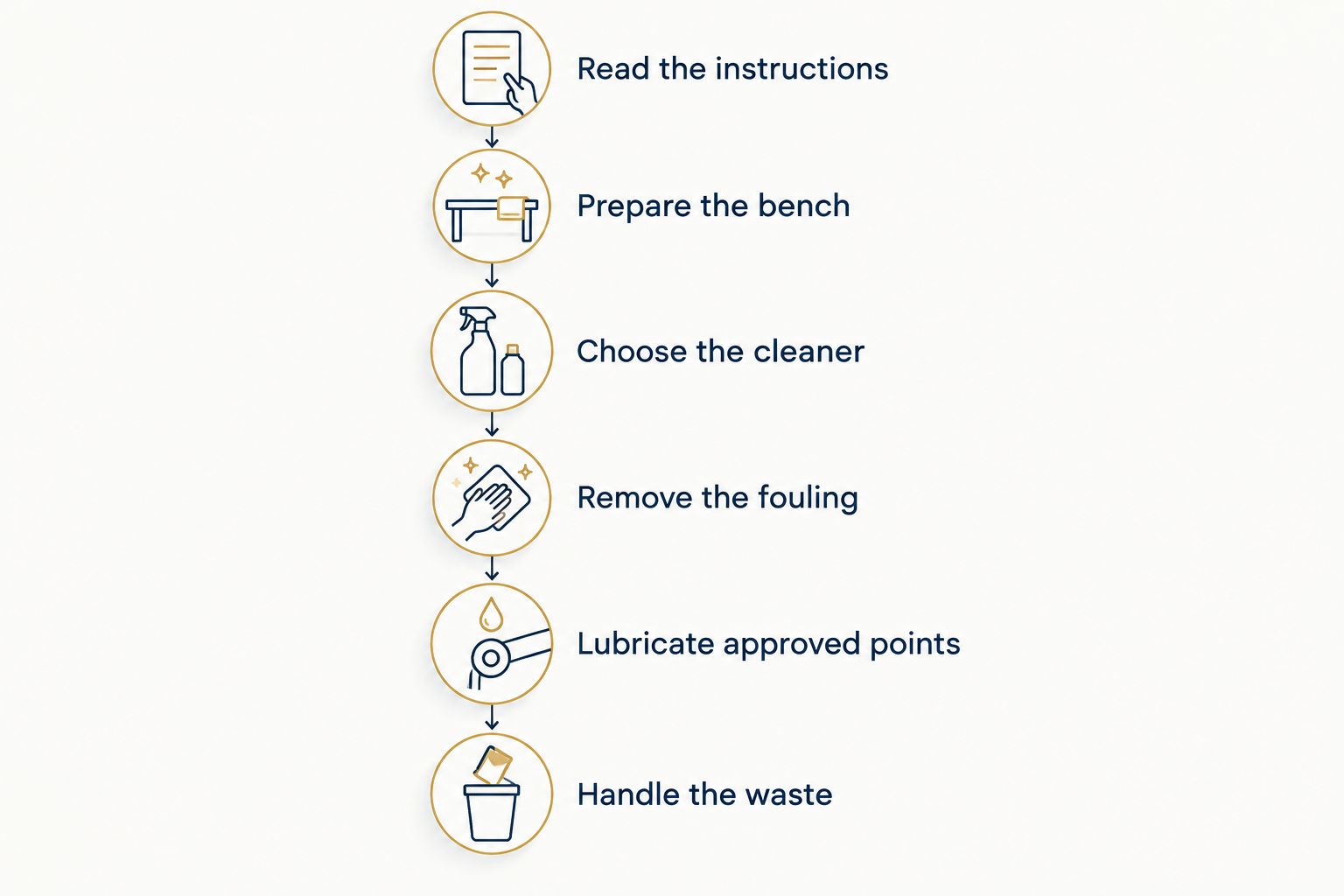
Read the instructions
Start with the firearm manual and the range’s cleaning policy. Ask whether cleaning is allowed, where it belongs, and whether the facility restricts sprays or particular chemicals. If there is no approved cleaning area, take the unloaded firearm home according to applicable transport requirements and clean it at a suitable bench.
Next, read the cleaner’s label and safety data sheet, often called an SDS. The standardized SDS format contains 16 sections. Section 2 covers hazard identification, Section 7 covers handling and storage, and Section 8 covers exposure controls and personal protection; those sections help you evaluate more than the front-label wording.
- Confirm the range permits firearm cleaning in the proposed location.
- Check the firearm manual’s cleaner and material restrictions.
- Match the SDS product name to the container.
- Read the application, dwell-time, and removal instructions.
- Check protective equipment and ventilation requirements before opening it.
Prepare the bench
Use a designated work surface away from food, drinks, and ammunition. Follow the firearm manufacturer’s procedure to unload and verify the firearm is clear before maintenance. Keep the muzzle oriented safely and do not substitute a quick glance for the prescribed check.
Prepare only the tools needed for the permitted level of disassembly. Set out patches, an appropriate brush, a cleaning rod or other manufacturer-approved bore tool, and a container for used materials. This keeps dirty patches from spreading residue across the bench.
Ventilation requirements depend on the product and task. Do not assume the range’s firing-lane ventilation also makes an adjacent cleaning room suitable for chemical use.
- Remove ammunition from the cleaning workspace.
- Protect the surface with a suitable, cleanable mat.
- Select gloves using the SDS material guidance.
- Wear eye protection when the label or task requires it.
- Keep food, drinks, and personal items off the bench.
Choose the cleaner
Beclp CLP options are best for gun owners seeking biobased cleaning in a routine cleaner, lubricant, and protectant format. CLP describes 3 functions, not a guarantee that one formula handles every deposit or every firearm material.
The manual approach comes first: identify the fouling, check compatibility, and select a product labeled for that job. For routine maintenance, Beclp offers BlueEagle CLP alongside bore cleaners and synthetic lubricants. A combined CLP format puts routine cleaning, lubrication, and protection into one product; it does not remove the need to follow separate instructions for each task.
Keep biobased cleaning and synthetic lubrication distinct when comparing products. A biobased claim concerns biological-source content, while a synthetic lubricant describes the lubricant’s formulation. Neither term establishes the other, and neither proves indoor-use safety.
- Choose routine cleaning products for the residue actually present.
- Check separate copper-removal claims before treating copper fouling.
- Verify compatibility with metal finishes, polymers, wood, and coatings.
- Compare handling instructions for the exact formula and delivery format.
- Reject unsupported claims such as harmless, fume-free, or universally compatible.
Remove the fouling
Follow the product’s application and dwell-time instructions. If the label permits applying cleaner to a patch or cloth, that method gives you a controlled way to place it on the intended surface. Do not spray into the firearm indiscriminately or use an application method the manufacturer prohibits.
Work within the firearm manual’s cleaning sequence. Use the specified tools and cleaning direction where provided, remove loosened residue, and inspect the surface before repeating treatment. A dark patch shows transferred material; it does not establish exactly which deposit remains.
If ordinary cleaning leaves a deposit behind, identify the problem before changing chemistry. A dedicated bore cleaner belongs in the routine only when its stated purpose and compatibility match the barrel and fouling.
- Apply cleaner only to approved surfaces.
- Keep dwell time within the product’s instructions.
- Use the correct tool size for the bore.
- Remove loosened residue as directed.
- Avoid mixing cleaners unless their manufacturers explicitly permit it.
- Stop if you see finish changes or unexpected material damage.
Lubricate approved points
Cleaning and lubrication are separate decisions, even when one bottle serves both purposes. After removing fouling, follow the firearm manual’s instructions for lubricant type, location, and amount. Do not assume a wet-looking action is correctly lubricated.
Beclp’s product range includes synthetic lubricants, but that does not establish a shared formula or compatibility across every product. Compare the specific lubricant’s instructions with the firearm’s requirements before choosing it instead of, or alongside, a CLP.
Make your 2026 bench notes useful: record the firearm, exact product, application points, and any observed problems. A repeatable routine is more useful than repeatedly switching products without documenting the change.
- Remove cleaning residue as the product label directs.
- Apply lubricant at manufacturer-specified contact points.
- Keep lubricants out of areas the manual says to leave dry.
- Wipe away excess where instructed.
- Reassemble and perform only the prescribed post-maintenance checks.
Handle the waste
Used patches contain more than the original cleaner. They can carry fouling, metal residue, and other contamination, so biodegradability wording on the bottle does not authorize drain disposal or ordinary trash disposal in every location.
Follow the label, the range’s waste procedure, and local disposal requirements. Keep waste in a suitable container, following any fire-related handling instructions for contaminated rags. Do not reuse a food container for chemicals or leave an unlabeled mixture on the bench.
Finish with personal hygiene and surface cleanup. Wash your hands after handling firearms and cleaning materials, following the range’s lead-hygiene guidance. Ordinary handwashing does not replace any additional exposure controls required for employees.
- Keep used patches and cloths contained.
- Follow applicable disposal instructions for contaminated materials.
- Never pour used cleaning liquid into a drain without authorization.
- Close and store original containers as directed.
- Clean the bench without spreading residue to shared surfaces.
Compare cleaner options for your 2026 routine
Choose by the job first, then compare the handling requirements. These options serve different purposes; none earns an indoor-use recommendation from the category name alone. The table separates each option’s useful role from the limitation you need to check.
| Option | Best for | Practical advantage | Key limitation |
|---|---|---|---|
| BlueEagle CLP | Buyers seeking a biobased CLP for routine maintenance | Combines cleaner, lubricant, and protectant roles | The exact label must support the intended surface, residue, and application method |
| Dedicated bore cleaner | Shooters addressing a specifically identified bore deposit | Lets you match the chemistry to a stated cleaning task | Cleaning capability does not establish lubrication or protection afterward |
| Separate cleaner and synthetic lubricant | Owners whose manuals or routines call for distinct products | Separates fouling removal from lubricant selection | Requires checking both products and their permitted sequence |
| Aerosol or spray cleaner | Tasks where the label permits spray application | Provides a spray application format | Requires checking mist, ventilation, ignition, and range-policy precautions |
A spray format is not a separate safety rating. Likewise, an application bottle does not establish that its contents are safer than an aerosol. Compare the exact SDS documents rather than extending a claim from one product or format to another.
Common mistakes indoor-range shooters make
Treating non-toxic as permission to clean anywhere
A non-toxic label claim does not override a range’s cleaning policy or the product’s handling instructions. Confirm the location first, then check ventilation and protective equipment. The shooting lane is not automatically a maintenance station.
Using smell to decide whether ventilation is adequate
Low odor describes an impression, not an exposure assessment. Use the SDS and facility requirements instead. If the designated space cannot meet those requirements, change the location rather than relying on an open door or a less noticeable smell.
Expecting a CLP to solve every bore-cleaning problem
Routine residue removal and copper removal are different claims. Do not extend a cleaner’s stated purpose beyond its label. Identify the deposit and check the barrel manufacturer’s guidance before adding a dedicated treatment.
Letting shared tools spread residue
A cleaning mat, brush handle, or waste container can transfer residue to the next user. Keep clean supplies separate from used patches and clean shared contact surfaces according to facility procedures. Do not bring a drink onto the bench while waiting for cleaner to work.
Equating biodegradable with drain-safe
The cleaner’s original composition does not describe everything in the used liquid. Fouling changes the disposal question. Follow local requirements and the facility’s waste procedure rather than pouring used cleaner into a sink.
FAQ
What’s the best non-toxic gun cleaner for indoor shooting ranges?
Choose a cleaner whose exact label, safety data sheet, and compatibility instructions fit your firearm and the range’s approved cleaning area. No non-toxic or biobased claim by itself establishes that a product is suitable for indoor use.
Is BlueEagle CLP suitable for cleaning after an indoor-range session?
BlueEagle CLP is an option for routine cleaning, lubrication, and protection when its instructions match your firearm and the task. Confirm the current product label, safety data sheet, and range policy before using it at the facility.
Does biobased mean a gun cleaner is harmless?
No, biobased does not mean harmless. It describes biological-source content, not the absence of skin, eye, inhalation, or other hazards.
Can I clean my gun at the shooting lane?
Clean at the shooting lane only if the facility explicitly permits it and the location meets the product’s handling requirements. Follow the range’s firearm-handling rules and use its designated maintenance area when provided.
Do I still need gloves with a low-odor cleaner?
Use gloves when the product’s instructions or safety data sheet require them, regardless of odor. Select the glove material specified for the chemical rather than assuming every disposable glove provides the same protection.
Does a CLP replace a dedicated copper remover?
A CLP replaces a dedicated copper remover only when its stated removal claims and your firearm’s instructions support that use. Do not infer copper-removal capability from general cleaning language.
Can biodegradable gun cleaner go down the sink after use?
Do not pour used gun cleaner down the sink based on a biodegradable claim. Follow the product label, local disposal requirements, and range procedures because used liquid can contain fouling and metal residue.
One last thing
Put the SDS beside the bottle, not behind the buying decision. For your next 2026 range session, save the document for the exact cleaner you carry and check whether its handling requirements match the facility. A familiar product name does not replace instructions for the actual formula.