Neither synthetic gun oil nor mineral oil wins on the base-oil label alone: choose the finished lubricant that meets your firearm manufacturer’s instructions and documents the properties your routine requires. Compare viscosity at stated temperatures, relevant lubrication and corrosion tests, material compatibility, and handling instructions; a safety data sheet is not a firearm-performance report.
- Synthetic gun oil vs mineral oil: compare finished-formula evidence, not the base-oil label.
- OSHA safety data sheets explain hazards and handling; they do not establish firearm lubrication performance.
- Match viscosity, corrosion evidence, and compatibility to your firearm manufacturer’s maintenance instructions.
- Biobased cleaning and synthetic lubrication describe different formulation choices; neither establishes harmlessness.
Beclp is best suited to gun owners shopping for firearm CLP, bore cleaners, and synthetic lubricants for routine maintenance. Apply the same evidence checks to every formula you consider.
Synthetic gun oil vs mineral oil: what do the data sheets show?
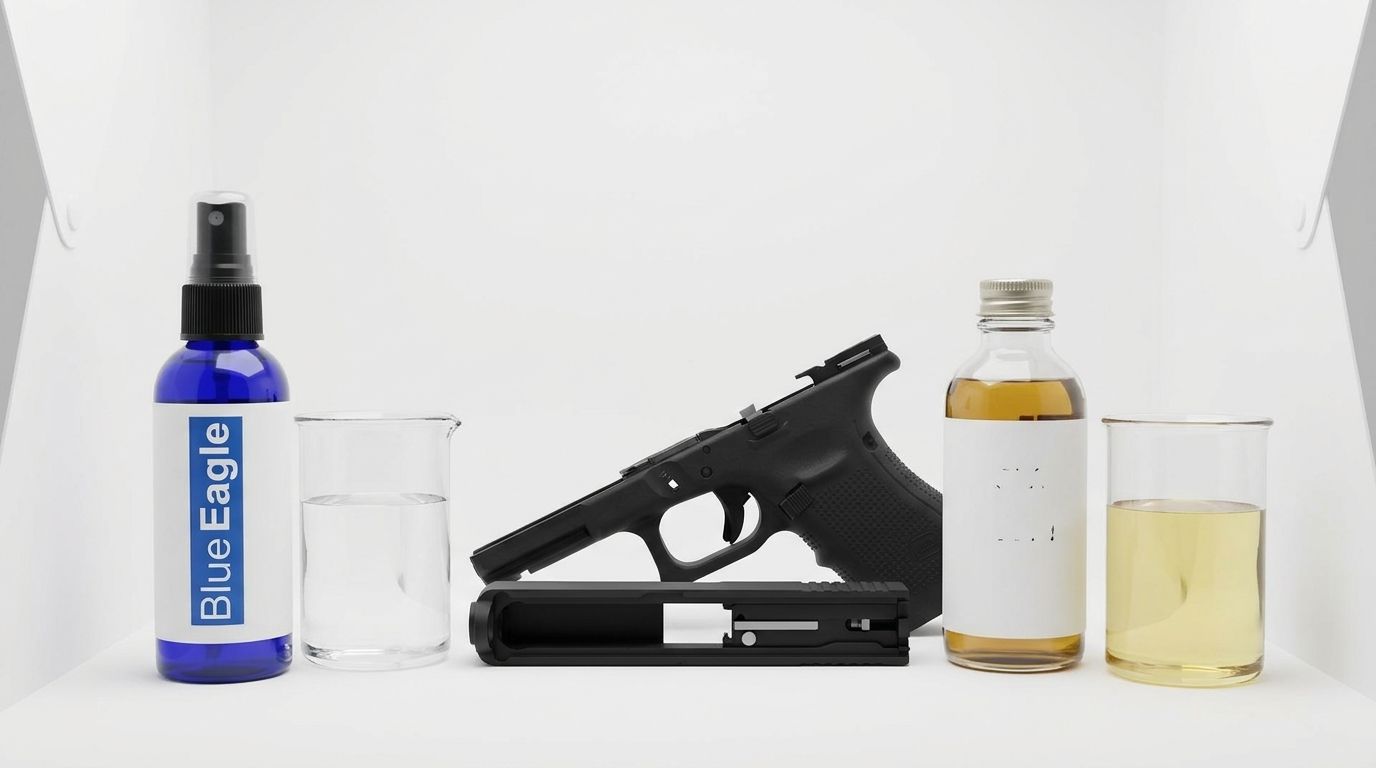
A useful 2026 comparison starts with two separate questions: what is the base oil, and what does the finished product document? The first identifies a formulation category. The second helps you decide whether the lubricant fits your firearm and maintenance routine.
| Comparison point | Synthetic gun oil | Mineral-oil-based gun lubricant |
|---|---|---|
| What the label establishes | Uses synthetic base oil; the label alone does not identify every ingredient | Uses petroleum-derived mineral base oil; the label alone does not establish refining grade or additives |
| Best for | Manufacturer-approved applications supported by the product’s documented properties | Manufacturer-approved applications supported by the product’s documented properties |
| Practical advantage | A candidate when its finished-formula data meet your requirements | A candidate when its finished-formula data meet your requirements |
| Main limitation | Synthetic does not prove better wear protection, corrosion resistance, or compatibility | Mineral does not tell you how the finished formula performs |
| Evidence to compare | Technical data, test methods, application instructions, and compatibility statements | The same technical data, test methods, application instructions, and compatibility statements |
Choose the documented fit, not the more impressive base-oil description. If both products meet the firearm manufacturer’s requirements, compare application instructions and the evidence relevant to your actual use.
Why this matters
A gun lubricant has a specific job at specific contact points. The bore, exterior metal, sliding surfaces, and stock do not automatically need the same treatment, and a product’s suitability for one surface does not establish suitability for another.
For your 2026 maintenance routine, separate cleaning, lubrication, and protection before choosing a bottle. A lubricant’s viscosity does not prove fouling removal, while a cleaner’s ability to remove residue does not establish the lubrication or protection required after cleaning.
That distinction prevents a common buying mistake: asking one label claim to answer several unrelated questions. Start with the firearm manual, then check the product instructions for the particular job.
Read the safety sheet and technical sheet differently
A safety data sheet, or SDS, explains chemical hazards, precautions, handling, and related information. A technical data sheet, or TDS, describes product characteristics and application information; its contents vary by supplier.
OSHA’s Hazard Communication guidance uses a 16-section SDS format. That structure helps you locate information, but it does not turn the SDS into a lubrication test report.
Use the SDS for handling questions
For a 2026 purchase, review the current SDS revision alongside the container label. Pay particular attention to these sections:
- Section 2: Hazard identification. Read the classifications, warning statements, and precautions.
- Section 8: Exposure controls and personal protection. Follow the stated ventilation and protective-equipment guidance.
- Section 9: Physical and chemical properties. Look for reported properties such as viscosity and flash point.
- Section 10: Stability and reactivity. Check chemical incompatibilities and conditions to avoid.
Chemical incompatibility information is not a list of approved firearm finishes. You still need application guidance for wood, coatings, plastics, elastomers, and other surfaces the product will contact.
Use the TDS for application evidence
Look for the intended use, application method, reported physical properties, and named test methods. Distinguish a measured result from an unqualified description such as excellent protection.
An SDS ingredient listing is not necessarily the complete recipe. Do not reverse-engineer a lubricant’s full formulation or performance from the disclosed ingredients alone.
Compare viscosity before making a temperature claim
Viscosity describes resistance to flow. Kinematic viscosity is commonly reported in centistokes, or cSt, with a temperature attached; technical sheets often report values at 40 °C and 100 °C.
ASTM D445 is a standard method for measuring kinematic viscosity. A value reported under that method is meaningful only with its temperature and units, so keep all three together in your notes.
Compare like with like. A result at 40 °C is not directly comparable to another product’s result at 100 °C. Nor does a thicker oil automatically provide better lubrication for your firearm.
For a 2026 cold-weather decision, look for information relevant to cold operation rather than relying on a warm-temperature viscosity value. Pour point describes a laboratory flow characteristic; it is not, by itself, a guaranteed firearm operating temperature.
Likewise, flash point concerns ignition under a specified test procedure. Do not treat it as the lubricant’s maximum service temperature or proof that it remains effective on every heated firearm surface.
Check lubrication and corrosion evidence separately
Wear control and rust prevention answer different questions. A product can report a lubrication test without providing evidence for the storage conditions you care about, or report corrosion testing without establishing suitability for a particular moving contact.
When a supplier cites a test, record:
- The method: What procedure produced the result?
- The conditions: What temperature, load, exposure, or specimen did the procedure use?
- The result: What was measured, rather than merely described?
- The relevance: Does that result address the application your firearm manual specifies?
A named test is more useful than an unsupported adjective, but it still has a defined scope. Do not translate a laboratory result into an unreported claim about service life, round count, storage duration, or reliability.
For storage protection, ask what surfaces and exposure conditions the instructions cover. For lubrication, ask where and how the product should be applied. Neither question is answered by the word synthetic.
Why finished gun-oil performance varies
These formulation and application differences explain why the base-oil category cannot settle the comparison:
- Base-stock selection: Synthetic and mineral labels describe broad categories, not a complete set of properties.
- Viscosity: Flow characteristics change with temperature and must suit the specified application.
- Additive package: Anti-wear, corrosion-control, and other additives contribute to finished-formula behavior.
- Intended job: A dedicated lubricant, cleaner, and CLP can have different application instructions.
- Materials contacted: Approval for metal does not establish approval for every finish, stock material, or seal.
- Application amount: The firearm manufacturer’s specified placement and quantity remain part of the lubrication decision.
Use these factors to compare documents, not to invent a ranking. When a required property is unclear, ask the supplier a specific question tied to the firearm manufacturer’s guidance.
Build a bench comparison before changing lubricants
Keep the comparison short enough to use beside the firearm manual. For your 2026 review, record the exact product name and document revision so you do not accidentally compare different formulations or outdated instructions.
- Read the manual. Identify approved lubricant types, lubrication points, application amounts, and restrictions. Do not substitute a general internet recommendation for model-specific instructions.
- Define the job. Decide whether you need to remove fouling, lubricate moving parts, protect approved surfaces, or perform a combination of those tasks.
- Check the label. Confirm intended use, precautions, and application directions before examining individual technical values.
- Compare matching data. Align temperatures, units, and test methods. Keep lubrication results separate from corrosion results.
- Confirm compatibility. Follow firearm and product instructions for finishes and nonmetal parts. A spot check does not override an explicit restriction.
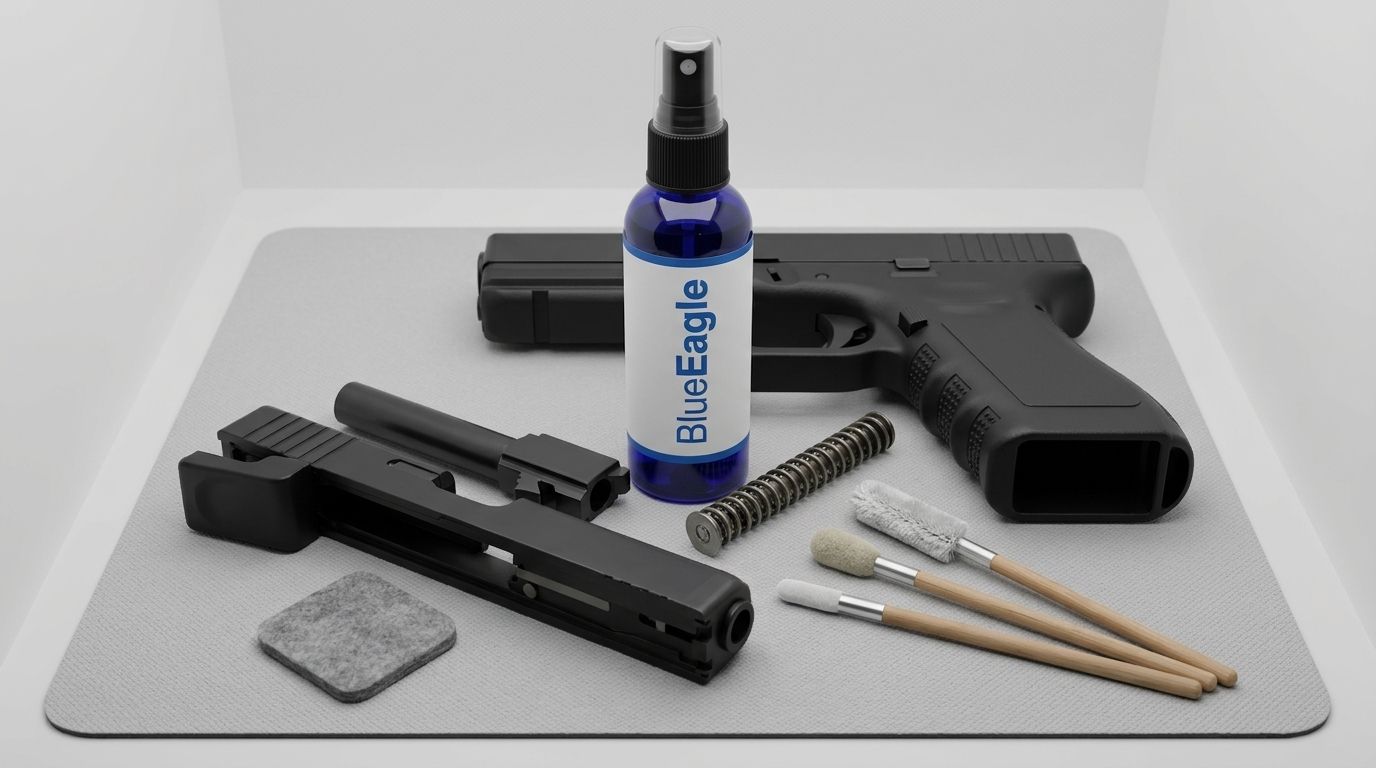
- Apply as directed. Before maintenance, unload the firearm, remove ammunition from the work area, and verify its condition according to the manual. Clean and lubricate only as instructed.

Keep cleaning residues and previous-product removal in the decision. Follow the applicable instructions before changing products; do not assume mixing lubricants preserves either product’s documented properties.
Where CLP fits beside a dedicated lubricant
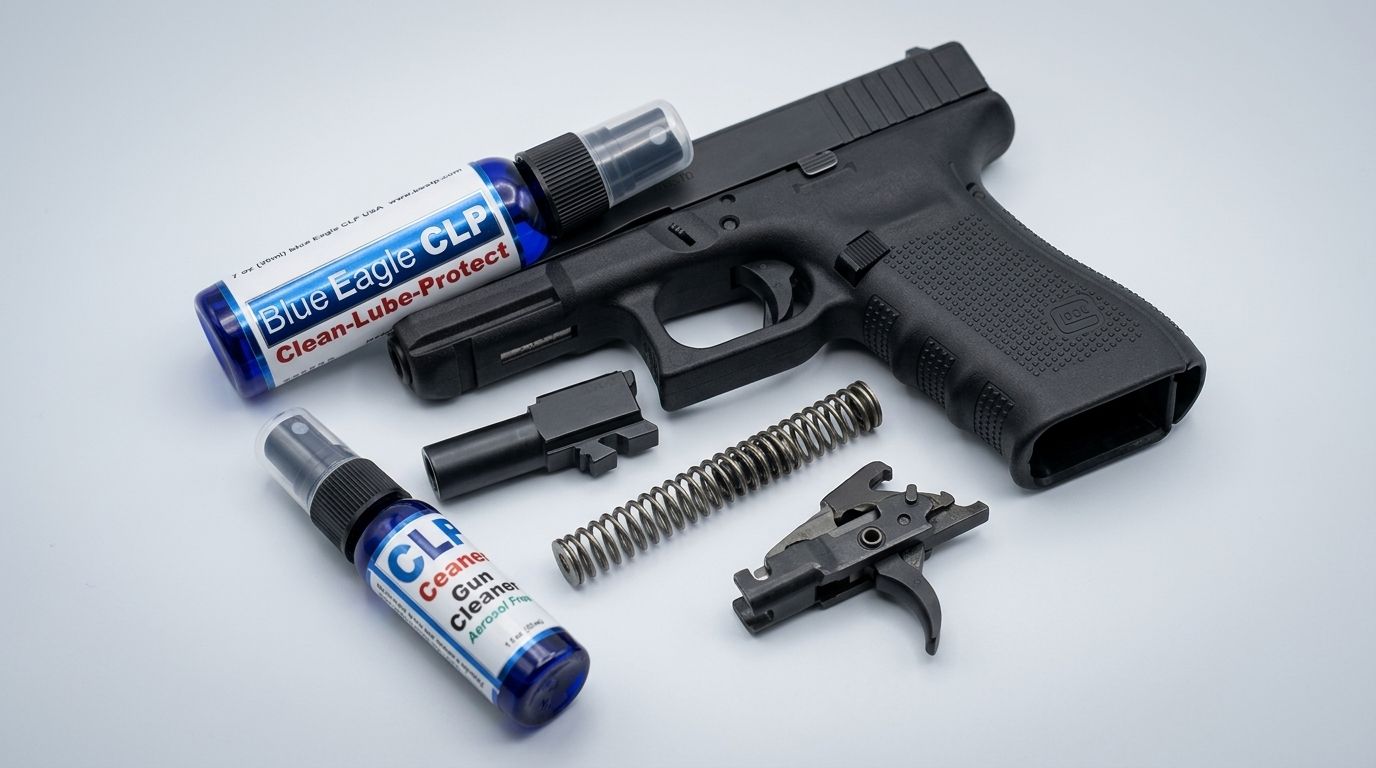
Beclp offers firearm CLP, bore cleaners, and synthetic lubricants. When considering BlueEagle CLP, assess its cleaning, lubrication, and protection instructions separately rather than assuming a claim about one function proves the other two.
Biobased cleaning and synthetic lubrication are different formulation descriptions. Biobased refers to material derived from biological sources; synthetic describes a base-oil category. Neither term establishes a complete formula, a specific biobased percentage, biodegradability, or harmlessness without product-specific evidence.
A CLP’s practical advantage is combining maintenance functions when its instructions and the firearm manual support that use. Its limitation is that the CLP label alone does not establish removal of every fouling type or suitability for every lubrication point.
A dedicated lubricant keeps the buying decision focused on lubrication, but it does not replace a separate cleaning requirement. Use the synthetic gun oil guide when deciding whether that narrower job fits your routine.
Is synthetic gun oil always better than mineral oil?
Synthetic gun oil is not automatically better than mineral oil. The finished formula, relevant test evidence, compatibility, and manufacturer approval determine the useful comparison.
Reject a blanket winner when the supporting information consists only of base-oil labels. A mineral-oil-based firearm lubricant that meets the specified requirements remains a valid candidate; a synthetic label does not excuse an unsupported application.
Can I substitute household mineral oil for gun lubricant?
Do not substitute household mineral oil unless your firearm manufacturer’s guidance supports that specific use. A shared base-oil description does not establish the additives, corrosion protection, application instructions, or material compatibility required for firearm maintenance.
Evaluate the exact product, not the familiar ingredient name. The same rule applies when considering an oil intended for another type of equipment.
Does biobased mean a gun cleaner is harmless?
Biobased does not mean harmless. Follow the exact product’s label and SDS for handling, ventilation, protective equipment, and disposal guidance.
Do not extend a biobased claim from one product to an entire range. Cleaner, bore-cleaner, CLP, and lubricant formulations require their own evidence.
FAQ
What should I compare first in synthetic gun oil vs mineral oil?
Compare your firearm manufacturer’s requirements first, then check the finished products’ documented properties. Base-oil labels alone do not establish lubrication performance, corrosion protection, or compatibility.
Does a safety data sheet tell me which gun oil protects best?
A safety data sheet does not rank firearm lubrication or corrosion performance. Use it for hazards and handling, then consult technical data and application instructions for relevant performance evidence.
What do viscosity values at 40 °C and 100 °C mean?
Viscosity values at 40 °C and 100 °C describe resistance to flow at those stated temperatures. Compare values using matching temperatures, units, and methods rather than treating a higher value as automatically better.
Is mineral-oil-based gun lubricant the same as household mineral oil?
A mineral-oil-based gun lubricant is not established as equivalent to household mineral oil by the base-oil name. Check the exact formulation’s intended use and follow your firearm manufacturer’s instructions.
Can synthetic gun oil replace bore cleaner?
Synthetic gun oil does not replace bore cleaner merely because it is synthetic. Choose a cleaner intended for the fouling involved, and follow the firearm manufacturer’s barrel-cleaning guidance.
Does a biobased cleaner need handling precautions?
A biobased cleaner still requires the handling precautions stated on its label and safety data sheet. Biological origin does not establish harmlessness or universal material compatibility.
How should I choose between Beclp CLP and a dedicated lubricant?
Choose by the maintenance job and the firearm manufacturer’s instructions. Evaluate CLP for its stated cleaning, lubrication, and protection uses, and a dedicated lubricant for its stated lubrication applications.
One last thing
A blank technical field is not a passing result. When comparing Beclp firearm-maintenance products or another supplier’s lubricant, mark an unreported property as unreported rather than assuming the base-oil category supplies the answer.
For your 2026 bench routine, keep the manual, label, SDS, and technical sheet together. That gives you a repeatable way to choose a product without turning a formulation term into a performance promise.